Symphyotrichum rhiannon
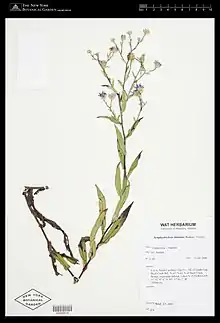
Symphyotrichum rhiannon is a species of flowering plant endemic to a serpentine barren in western North Carolina. It has been given the vernacular Rhiannon's aster and is also known as Buck Creek aster.[1] It is a perennial, herbaceous plant in the family Asteraceae.[4]
| Symphyotrichum rhiannon | |
|---|---|
 | |
Scientific classification  | |
| Kingdom: | Plantae |
| Clade: | Tracheophytes |
| Clade: | Angiosperms |
| Clade: | Eudicots |
| Clade: | Asterids |
| Order: | Asterales |
| Family: | Asteraceae |
| Tribe: | Astereae |
| Subtribe: | Symphyotrichinae |
| Genus: | Symphyotrichum |
| Subgenus: | Symphyotrichum subg. Symphyotrichum |
| Section: | Symphyotrichum sect. Symphyotrichum |
| Species: | S. rhiannon |
| Binomial name | |
| Symphyotrichum rhiannon | |
 | |
| Endemic distribution[3][4] | |

Chromosomes
Symphyotrichum rhiannon has a base number of x = 8.[5] Hexaploid cytotype with a chromosome count of 48 has been reported.[6]
Taxonomy
Symphyotrichum rhiannon was formally described by Alan Stuart Weakley and Thomas E. Govus in 2004.[4]
Etymology
Kauffman, Nesom, et al., formally explained the etymology of the species as follows:[4]
[It] is named in honor of Rhiannon Weakley, whose desire to rest during a field excursion led the authors to further investigate..., and also in honor of the original Rhiannon, a Welsh goddess figure....
Informally explained, Rhiannon Weakley was the toddler daughter of Alan and Allison Weakley. She needed a snack and a nap during the 2003 field excursion.[7]
"Rhiannon hadn’t had a nap that morning," says Alan Weakley, "and she had a little, ah, loss of composure." So the group plopped down to give Rhiannon a snack and a chance to rest. And there, growing all around, was [Laura] Mansberg's mystery aster.
Distribution and habitat
Symphyotrichum rhiannon is endemic to the Buck Creek Serpentine Barrens in Clay County, North Carolina, in the Nantahala National Forest.[4][8]
Conservation
NatureServe lists it as Critically imperiled (G1).[1]
Citations
References
- Kauffman, G.L.; Nesom, G.L.; Weakley, A.S.; Govus, T.E.; Cotterman, L.M. (2004). "A new species of Symphyotrichum (Asteraceae: Astereae) from a serpentine barren in western North Carolina". SIDA, Contributions to Botany. 21: 827–839. ISSN 0036-1488. Retrieved 8 September 2021 – via Biodiversity Heritage Library.
- NatureServe (4 June 2021). "Symphyotrichum rhiannon - Rhiannon's Aster". NatureServe. Retrieved 21 June 2021.
- POWO (2019). "Symphyotrichum rhiannon". Plants of the World Online. Royal Botanic Gardens, Kew. Retrieved 21 June 2021.
- Semple, J.C. (n.d.). "Symphyotrichum rhiannon Rhiannon's Aster". University of Waterloo (UWaterloo.ca). Waterloo, Ontario: University of Waterloo. Archived from the original on 23 August 2021. Retrieved 8 September 2021.
- Semple, J.C. (1 May 2021). "Symphyotrichum subsect. Symphyotrichum Punicei Asters". University of Waterloo (UWaterloo.ca). Waterloo, Ontario: University of Waterloo. Archived from the original on 23 August 2021. Retrieved 8 September 2021.
- Smith, J. (1 September 2005). "Rhiannon's aster — a toddler's tantrum helps a new flower get its name". Endeavors (endeavors.unc.edu) (Fall 2005 ed.). Chapel Hill, North Carolina: UNC Research. ISSN 1933-4338. Archived from the original on 16 February 2012. Retrieved 29 November 2020.
- USDA, NRCS (2014). "Symphyotrichum rhiannon". USDA PLANTS Database (plants.usda.gov). Natural Resources Conservation Service PLANTS Database. USDA. Retrieved 8 September 2021.
- USFS (n.d.). "Restoration of Buck Creek Serpentine Barrens, Tusquitee Ranger District, Nantahala National Forest". www.fs.fed.us. United States Forest Service, USDA. Retrieved 29 November 2020.