Symphyotrichum depauperatum
Symphyotrichum depauperatum (formerly Aster depauperatus), commonly known as serpentine aster,[4][5] is a rare species in the family Asteraceae adapted to serpentine barrens, an ecosystem with a high concentration of toxic metals in the soil. It has been found in Pennsylvania, Maryland, and on some diabase glades in North Carolina. It grows to 50 centimeters (1+3⁄4 feet) and has white ray florets surrounding a center of yellow disk florets.
| Symphyotrichum depauperatum | |
|---|---|
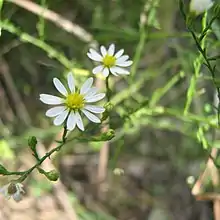 | |
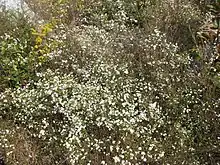
| S. depauperatum from the serpentine grassland demonstration area in Nottingham, Pennsylvania. | |
Scientific classification  | |
| Kingdom: | Plantae |
| Clade: | Tracheophytes |
| Clade: | Angiosperms |
| Clade: | Eudicots |
| Clade: | Asterids |
| Order: | Asterales |
| Family: | Asteraceae |
| Tribe: | Astereae |
| Subtribe: | Symphyotrichinae |
| Genus: | Symphyotrichum |
| Subgenus: | Symphyotrichum subg. Symphyotrichum |
| Section: | Symphyotrichum sect. Symphyotrichum |
| Species: | S. depauperatum |
| Binomial name | |
| Symphyotrichum depauperatum | |
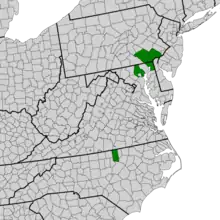 | |
| Endemic distribution[2][1] | |
| Synonyms[3] | |
|
Basionym
| |

Description
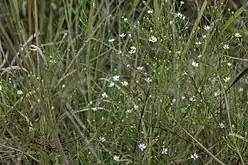
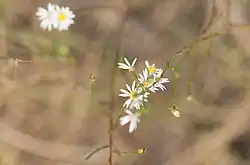
Symphyotrichum depauperatum is a perennial, herbaceous plant that may reach up to 50 centimeters (1+3⁄4 feet) tall, with 1–3 stems. The leaves are narrow and generally 2–4 centimeters (3⁄4–1+1⁄2 inches) long. The plant produces numerous flower heads in branched arrays, each head with 7–14 white or, rarely, pink ray florets surrounding 7–17 yellow disk florets.[4]
Distribution and habitat
Symphyotrichum depauperatum is adapted to serpentine barrens, an ecosystem with a high concentration of toxic metals in the soil. It has been found in Baltimore[2] and Cecil Counties, Maryland;[1] Granville County, North Carolina;[2] and, Chester, Delaware, and Lancaster Counties, Pennsylvania.[1]
Serpentine aster has been called a "flagship species" of the unique serpentine ecosystem and was once thought to be endemic to these barrens, but it also has been found to occur in a disjoint population on diabase glades in Granville County, North Carolina.[6]
Conservation
Symphyotrichum depauperatum is classified by the state of Pennsylvania as a threatened species because its range is restricted to a few limited areas, and the majority of its populations occur on sites threatened by quarrying, housing development, and industrial development.[7]
As of July 2021, NatureServe listed it as globally Imperiled (G2); Critically Imperiled (S1) in Maryland and North Carolina; and, Imperiled (S2) in Pennsylvania. NatureServe's most recent review of S. depauperatum's global status was 3 October 1997.[1]
Citations
References
- Brouillet, L.; Semple, J.C.; Allen, G.A.; Chambers, K.L.; Sundberg, S.D. (2006). "Symphyotrichum depauperatum". In Flora of North America Editorial Committee (ed.). Flora of North America North of Mexico (FNA). 20. New York and Oxford. Retrieved 3 July 2021 – via eFloras.org, Missouri Botanical Garden, St. Louis, MO & Harvard University Herbaria, Cambridge, MA.
- Gustafson, D.J.; Latham, R.E. (June 2005). "Is the serpentine aster, Symphyotrichum depauperatum (Fern.) Nesom, a valid species and actually endemic to eastern serpentine barrens?" (PDF). Biodiversity and Conservation. 14 (6). doi:10.1007/s10531-004-9670-x. Archived (PDF) from the original on 5 September 2021. Retrieved 5 September 2021 – via ResearchGate (free).
- NatureServe (2 July 2021). "Symphyotrichum depauperatum Serpentine Aster". NatureServe Explorer (explorer.natureserve.org). Arlington, Virginia: NatureServe. Retrieved 3 July 2021.
- Pennsylvania DCNR (n.d.). "Serpentine Aster profile". Pennsylvania Department of Conservation, Natural Resources Wildlife Resource Conservation Fund. Archived from the original on 10 June 2011. Retrieved 19 September 2009.
- POWO (2019). "Symphyotrichum depauperatum (Fernald) G.L.Nesom". Plants of the World Online (powo.science.kew.org). Royal Botanic Gardens, Kew. Retrieved 3 July 2021.
- USDA, NRCS (2014). "Symphyotrichum depauperatum". USDA PLANTS Database (plants.usda.gov). Natural Resources Conservation Service PLANTS Database. USDA. Retrieved 3 July 2021.
External links
- Symphyotrichum depauperatum at Ladybird Johnson Wildflower Center (wildflower.org)
- Symphyotrichum depauperatum at University of Waterloo Astereae Lab
- Symphyotrichum depauperatum at Vascular Plants of North Carolina
- Symphyotrichum depauperatum at Pennsylvania Natural Heritage Program
- Symphyotrichum depauperatum at Maryland Biodiversity Project
- Symphyotrichum depauperatum as Pennsylvania Threatened in the Pennsylvania Code