Toei 5300 series
The Tokyo Metropolitan Bureau of Transportation 5300 series (東京都交通局5300形, Tōkyō-to Kōtsū-kyoku 5300-gata), more commonly known as the Toei 5300 series (都営5300形, Toei 5300-gata), is an electric multiple unit (EMU) train type operated by Tokyo Metropolitan Bureau of Transportation (Toei) on the Toei Asakusa Line in Tokyo, Japan. Introduced into service on 31 March 1991, a total of 27 eight-car trainsets (216 vehicles) were built between 1990 and 1998[1] by Kawasaki Heavy Industries, Nippon Sharyo, Kinki Sharyo, and Hitachi to replace the 5000 series trainsets that have been used on the Asakusa Line since its inception in 1960. Withdrawals of the 5300 series commenced in 2018 following the introduction of new 5500 series trainsets.
| Toei 5300 series | |
|---|---|
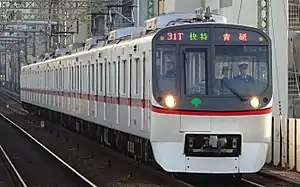 A Toei 5300 series train in January 2018 | |
| In service | 1991–present |
| Manufacturer | Kawasaki Heavy Industries, Nippon Sharyo, Kinki Sharyo, Hitachi |
| Replaced | Toei 5000 series |
| Constructed | 1990–1998 |
| Entered service | 31 March 1991 |
| Scrapped | 2018– |
| Number built | 216 vehicles (27 sets) |
| Number in service | 8 vehicles (1 set) |
| Number scrapped | 208 vehicles (26 sets) |
| Successor | Toei 5500 series |
| Formation | 8 cars per trainset |
| Fleet numbers | 5301–5327 |
| Operator(s) | Tokyo Metropolitan Bureau of Transportation |
| Line(s) served |
|
| Specifications | |
| Car body construction | Aluminium |
| Car length | 18 m (59 ft 1 in) |
| Width | 2.8 m (9 ft 2 in) |
| Height | 4.05 m (13 ft 3 in) |
| Doors | 3 pairs per side |
| Maximum speed | 110 km/h (70 mph) |
| Weight | 242 tonnes (238 long tons; 267 short tons) |
| Traction system | GTO–VVVF (Mitsubishi Electric) |
| Traction motors | 4 × 165 kW (221 hp) or 180 kW (240 hp)[lower-alpha 1] 3-phase AC induction motor (Mitsubishi Electric) |
| Power output | 2.64 MW (3,540 hp) or 2.88 MW (3,860 hp)[lower-alpha 1] |
| Transmission | Westinghouse-Natal Drive, Gear ratio: 6.0625 |
| Acceleration | 0.92 m/s2 (3.0 ft/s2) |
| Deceleration | 1.1 m/s2 (3.6 ft/s2) (service) 1.3 m/s2 (4.3 ft/s2) (emergency) |
| Electric system(s) | 1,500 V DC (nominal) from overhead catenary |
| Current collection method | Pantograph |
| Bogies | KD302, KD302A |
| Braking system(s) | Electronically controlled pneumatic brakes, regenerative braking |
| Safety system(s) | C-ATS |
| Coupling system | Janney coupler |
| Track gauge | 1,435 mm (4 ft 8+1⁄2 in) standard gauge |
Formation
As of 1 April 2016, the fleet consists of 27 eight-car trainsets formed as follows, with four motored ("M") cars and four non-powered trailer ("T") cars, and car 1 at the south end.[2]
| Car No. | 1 | 2 | 3 | 4 | 5 | 6 | 7 | 8 |
|---|---|---|---|---|---|---|---|---|
| Designation | M1c | T1 | M1 | T2 | T3 | M2 | T4 | M2c |
| Numbering | 53xx-1 | 53xx-2 | 53xx-3 | 53xx-4 | 53xx-5 | 53xx-6 | 53xx-7 | 53xx-8 |
- Cars 3 and 6 each have two lozenge-type pantographs.[2]
- Car 3 is designated as a "mildy air-conditioned" car.[2]
Interior
Passenger accommodation consists of longitudinal seating throughout. LED passenger information displays are provided above each passenger door.
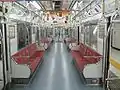 Interior of the Toei 5300 series
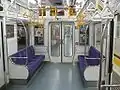 Priority seats of the 5300 series
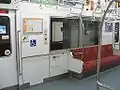 Wheelchair space on the 5300 series
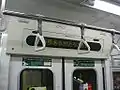 LED information display above the doors of the Toei 5300 series
History
The 5300 series was introduced on 31 March 1991 to replace the aging Toei 5000 series trains which operated on the Toei Asakusa Line since its opening in 1960.
Retirement
Following the introduction of new Toei 5500 series trainsets, set 5301 made its final run on 27 July 2018, beginning the scrapping process of the 5300 series. As of September 2021, set 5320 is the only trainset to remain in operation.[4]
Gallery
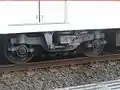 Bogie of a 5300 series
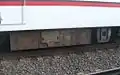 VVVF inverter as used on the 5300 series
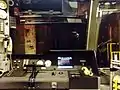 Driver's cab of the 5300 series
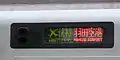 LED display depicting a 5300 series on an Airport Limited Express service to Haneda Airport
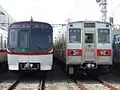 An early batch Toei 5300 series and an older Toei 5200 series. The 5200 series was retired in 2006.
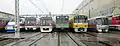 Two 5300 series EMUs at Magome Depot during the 2015 Toei Festival. The trains here are (from left) a Keisei AE100 series, two 5300 series, a Chiba New Town Railway 9000 series, a Keikyu N1000 series and a Toei 12-000 series.
Notes
- 5327 only
References
- 日本の地下鉄 [Subways of Japan] (in Japanese). Japan: Ikaros Publishing. 20 April 2013. p. 14. ISBN 978-4-86320-701-1.
- 私鉄車両編成表 2016 [Private Railway Rolling Stock Formations - 2016] (in Japanese). Japan: Kotsu Shimbunsha. 25 July 2016. p. 30. ISBN 978-4-330-70116-5.
- 東京都5300形5323編成が久里浜へ [Toei 5300 series 5323 formation to Kurihama]. Japan Railfan Magazine Online. Koyusha Co., Ltd. 26 November 2020. Retrieved 19 December 2020.
External links
 |
Wikimedia Commons has media related to Toei 5300 series. |
- Kinki Sharyo information (in Japanese)
Tokyo Metropolitan Bureau of Transportation rolling stock | ||
|---|---|---|
| Current |  | |
| Former |
| |
| Future | ||
| Locomotives | ||
| Tramcars | ||
See also: Tokyo subway rolling stock | ||