203 series
The 203 series (203系) is an Electric Multiple Unit (EMU) train type operated in Japan between 1982 and 2011 by Japanese National Railways (JNR) and later by East Japan Railway Company (JR East), and currently operated by Kereta Commuter Indonesia and Philippine National Railways.
| 203 series | |
|---|---|
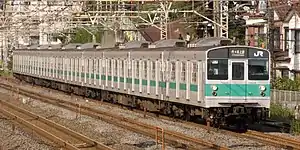 203 series Joban Line Set 67 on October 2009 | |
| In service | 1982–2011 (Japan) |
| Manufacturer | Kawasaki Heavy Industries, Kinki Sharyo, Tokyu Car Corporation |
| Replaced | Japan: 103-1000 series Philippines: 7A-2000 push-pull cars Indonesia: KRL Rheostatik |
| Constructed | 1982–1986 |
| Entered service | November 1982 |
| Refurbished | 2020– (PNR) |
| Scrapped | 2010– |
| Number built | 170 vehicles (17 sets) |
| Number in service | 40 vehicles (4 sets) (KCI) 20 vehicles (4 sets, one head car each set) (PNR) |
| Number scrapped | 80 vehicles (8 sets) (JR East) 10 vehicles (all intermediate cars) (KCI) |
| Predecessor | 103-1000 series (Japan), 7A-2000 push-pull cars (Philippines) |
| Successor | E233-2000 series (Japan) EM10000 class (Metro Manila commuter only) |
| Formation | 10 cars per trainset (JNR, JR) 8 and 12 cars per trainset (KCI)[1] 5 cars per trainset (PNR) |
| Fleet numbers | 71–78, 61–69 (JNR) 51–58, 61–69 (JR East) 2, 106, 108, 109 (KCI)[1] 01–08 (PNR) |
| Capacity | 528 |
| Operator(s) | JNR (1982–1987) JR East (1987–2011) KAI Commuter (2011–) PNR (2012–) |
| Depot(s) | Matsudo (JR East, JNR) Bukit Duri, Bogor (KCI) Tutuban (PNR) |
| Line(s) served | JNR, JR East: Joban Line, Tokyo Metro Chiyoda Line KRL: Jatinegara–Bogor, Jakarta Kota–Bogor, Jakarta Kota–Cikarang Tanah Abang–Rangkasbitung, Jakarta Kota-Tanjung Priok (Seasonal) PNR: PNR Metro Commuter Line |
| Specifications | |
| Car body construction | Aluminium |
| Car length | 20,000 mm (65 ft 7 in) |
| Width | 2,800 mm (9 ft 2 in) |
| Doors | 4 pairs per side |
| Maximum speed | 100 km/h (60 mph)[2] |
| Traction system | Mitsubishi / Toshiba Chopper MT60 (150 kW) x 24 |
| Acceleration | 3.3 km/h/s |
| Deceleration | 3.3 km/h/s |
| Train ventilation | Roof-mounted air conditioning units JNR, JR East, and KRL: JR AU75 model[3] PNR: JR AU75 model (2011–2020); INKA ACI-4202 model (2020–)[3][lower-alpha 1] |
| Electric system(s) | 1,500 V DC |
| Current collection method | Overhead catenary |
| Safety system(s) | ATS-Sn, ATC-10 (JNR, JR East) |
| Multiple working | PNR 900 class PNR 2500 class PNR 5000 Class[lower-alpha 2] |
| Track gauge | 1,067 mm (3 ft 6 in) |
| Notes | |
| |
Formation
The sets were formed as follows.[4]
| Original 10-car EMU configuration | ||||||||||
| Car No. | 1 | 2 | 3 | 4 | 5 | 6 | 7 | 8 | 9 | 10 |
|---|---|---|---|---|---|---|---|---|---|---|
| Numbering | KuHa 202 | MoHa 202 | MoHa 203 | SaHa 203 | MoHa 202 | MoHa 203 | SaHa 203 | MoHa 202 | MoHa 203 | KuHa 203 |
Cars 3, 6, and 9 were each fitted with one PS21 pantograph.[4]
Interior
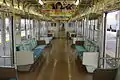 Interior view in September 2007
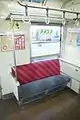 Priority seating in November 2010
History and operations
The 203 series sets were made to replace the 103-1000 series EMUs in 1982. The 203 series EMUs were on through services between the Joban Line and Tokyo Metro Chiyoda Line.
Withdrawal
The trains were gradually replaced by new E233-2000 series EMUs, and the last set ran in revenue service on 26 September 2011.[5]
Incidents
On 20 March 1995, the train number A725K, or the Matsudo Train Set Number 67, which later transferred to Philippine National Railways in 2011, was involved on the sarin gas attack which was happened on the Tokyo Metro Chiyoda Line alone, southwest-bound section bound for Yoyogi-Uehara station at 7:48 AM, As the train approached Shin-Ochanomizu Station, the central business district in Chiyoda, one member of the team punctured one of his two bags of sarin, leaving the other untouched, and exited the train at Shin-Ochanomizu. And then finally, the train has been proceeded down the line with the punctured bag of sarin leaking until 4 stops later at Kasumigaseki Station. There, the bags were removed and eventually disposed of by station attendants, of whom two died. The train continued on to the next station where it was completely stopped, evacuated and cleaned.
Overseas operations
Indonesia
Five former 203 series ten-car sets (Set numbers 51, 52, 66, 68, 69) were shipped to Kereta Commuter Indonesia (KCI) in Jakarta, Indonesia in 2011. The trainsets were subsequently reformed to create four trainsets formed as one eight-car set (set 108), two ten-car sets (sets 106 and 109), and one twelve-car set (set 2).[6] One ten-car set, set 109, has 5+5 formation with two middle driving trailers which are used only during regular maintenance.[6]
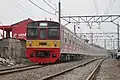 A KRL Jabodetabek 203 series 8-car set on the Bogor Line in July 2012
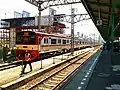 Former set 52 reformed as a 12-car set BUD 2 in August 2017
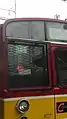 A typical Indonesian set code used on Kereta Commuter Indonesia 203 series set BOO 106 shows the head car's number in December 2017
Philippines
In November 2011, four former 203 series 10-car sets (set numbers 53, 54, 55, 67) were shipped to the Philippine National Railways (PNR) in the Philippines for use on diesel-hauled services south of Manila, replacing former Japanese 12 and 14 series coaches.[7] As of October 2013, seven four-car sets had been formed, as shown below, with car "A" at the Alabang end.[7] The units are equipped with a diesel-powered generator at one end to provide power for the doors, lighting, and air-conditioning.[7]
Due to aging reasons, the air-conditioning units of the 203 series bogged down, with replacement ones suited for tropical climate, manufactured by PT INKA installed on Sets 05 and 06/02.
Two sets of the 203 series have been stripped of paint with ongoing bodywork (with some instance of revealing their old livery dating back to their JR incarnation) since June 2020. It is presumed that they will receive sticker wraps using the current orange livery scheme reminiscent of the DMU and newer 8000-8100 PT-INKA livery.
| EMU configurations as of October 2013[8] | ||||||
| Set No. | 1 | 2 | 3 | 4 | ||
|---|---|---|---|---|---|---|
| EMU-1 | KuHa 203-107 | MoHa 203-11 | MoHa 202-7 | SaHa 203-9 | ||
| EMU-2 | KuHa 202-4 | MoHa 202-11 | MoHa 203-7 | MoHa 202-12 | ||
| EMU-3 | KuHa 203-5 | MoHa 203-9A | MoHa 202-9 | SaHa 203-10 | ||
| EMU-4 | KuHa 203-4 | MoHa 203-13 | MoHa 202-10 | SaHa 203-14 | ||
| EMU-5 | KuHa 203-3 | MoHa 203-121 | MoHa 202-120 | SaHa 203-8 | ||
| EMU-6 | KuHa 202-3 | MoHa 202-15 | MoHa 203-15 | SaHa 203-7 | ||
| EMU-7 | KuHa 202-107 | MoHa 203-120 | MoHa 202-8 | MoHa 203-10 | ||
In 2014, PNR started to operate the EMUs in 5-car configuration.[8] As of December 2018, there are five sets in operation.
EMUs 3, 4 and 7 were divided among the other EMUs to form the 5 sets, and their remnants are stored as reserve units or source of spare parts.
| EMU configurations as of 2019 | ||||||
| Set No. | 1 | 2 | 3 | 4 | 5 | |
|---|---|---|---|---|---|---|
| EMU-1 | KuHa 203-107 | MoHa 203-10 | MoHa 202-15 | SaHa 203-6 | MoHa 203-12 | |
| EMU-2 | KuHa 202-4 | MoHa 202-9 | MoHa 203-9 | SaHa 203-5 | MoHa 202-12 | |
| EMU-5 | KuHa 203-3 | MoHa 203-121 | MoHa 202-120 | SaHa 203-114 | MoHa 203-14 | |
| EMU-6 | KuHa 202-3 | MoHa 202-11 | MoHa 203-11 | SaHa 203-7 | MoHa 202-8 | |
| EMU-7 | KuHa 202-107 | MoHa 202-14 | MoHa 203-7 | SaHa 203-8 | ||
| EMU-8 | KuHa 202-5 | MoHa 202-10 | MoHa 203-13 | SaHa 203-9 | MoHa 202-119 | |
By April 2019, the lead car of EMU 06 (KuHa 202-3) was transferred to EMU 02. By May 2019, the lead car of EMU 01 (KuHa 203-107) was replaced by EMU 04's head car (KuHa 203-4) and by July, EMU 07's lead car (KuHa 202-107) was transferred to EMU 08.
In February 2020, EMUs 05 and 06/02 were installed with new Model ACI-4202 I-Cond Air-conditioning units manufactured by PT INKA.[9][10][3] On March 11, 2020, EMU 05 was spotted with new fitted windows, the old windows were replaced with polycarbonate panels, removing the need of grills.[11] Four of the active EMU sets have polycarbonate windows.
As of February 2021, EMUs 04/01 and 07/08 still don't have their new livery yet, though there are noticeable progress on their bodies.[12]
Six coaches of PNR EMUs are currently stored in the third track of Pasay Road station since December 2020.[13]
| EMU configurations as of February 2021 | ||||||
| Set No. | 1 | 2 | 3 | 4 | 5 | |
|---|---|---|---|---|---|---|
| EMU 04/01 | KuHa 203-4 | MoHa 203-10 | MoHa 202-15 | SaHa 203-6 | MoHa 203-12 | |
| EMU 06/02 | KuHa 202-3 | MoHa 202-9 | MoHa 203-9 | SaHa 203-5 | MoHa 202-12 | |
| EMU 05 | KuHa 203-3 | MoHa 203-121 | MoHa 202-120 | SaHa 203-114 | MoHa 203-14 | |
| EMU 07/08 | KuHa 202-107 | MoHa 202-10 | MoHa 203-13 | SaHa 203-9 | MoHa 202-119 | |
- Key
- KuHa: Former driving trailer car
- SaHa: Former intermediate trailer car
- MoHa 202: Former intermediate motor car
- MoHa 203: Former intermediate motor car with pantograph
 A 203 series EMU in PNR blue and orange livery (July 2016)
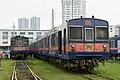 PNR EMU 02 and 6 At Tutuban Station (2016)
 Interior of PNR MoHa 203 (2017)
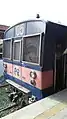 PNR EMU 05 leaving Santa Mesa station (December 2018)
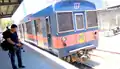 PNR EMU 07 at Alabang (April 2019)
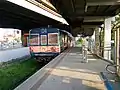 PNR EMU 04 at FTI station (May 2019)
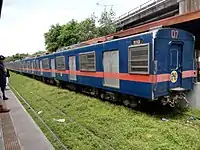 PNR EMU 07 at FTI station (June 2019)
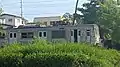 PNR EMU 04 headcar in stripped livery near Sucat station (December 2020)
 PNR EMU 06/02 in blue/orange livery near Sucat station, with polycarbonate windows and air-conditioning units from PT INKA (December 2020)
Relegation
PNR General Manager Junn Magno then announced on a press conference in 2018 that aside from building the NSCR, it will also modernize its existing fleet for the PNR Metro Commuter Line in Metro Manila to increase capacity and frequency. He also mentioned that the agency is planning to relegate some of the older rollingstocks to the Naga–Legazpi Bicol Commuter service. This will push through once all still-serviceable trainsets have been refurbished.[14]
References
- "Litbang KRL Jepang". gm-marka.com. Retrieved 5 June 2019.
- Jēāru zensharyō handobukku: Rail Magazine 2009 JR全車輌ハンドブック2009 [JR Rolling Stock Handbook 2009]. Japan: Neko Publishing. 2009. pp. 357–358, 628–629. ISBN 978-4-7770-0836-0.
- "元 JR東日本203系外観" (in Japanese). Retrieved 14 December 2021.
- JR電車編成表 2011夏 [JR EMU Formations - Summer 2011]. Japan: Kotsu Shimbunsha. May 2010. p. 77. ISBN 978-4-330-21211-1.
- 203系が営業運転から離脱 [203 series withdrawn from revenue service]. Japan Railfan Magazine Online (in Japanese). Japan: Koyusha Co., Ltd. 28 September 2011. Retrieved 28 September 2011.
- Takagi, Satoru (January 2018). ジャカルタ 東京地下鉄関連の車両 [Tokyo Metro rolling stock in Jakarta]. Japan Railfan Magazine (in Japanese). Vol. 58 no. 681. Japan: Koyusha Co., Ltd. p. 125.
- Saito, Miko (March 2014). フィリピン国鉄南方線の日本型車両 [Japanese rolling stock on the PNR Southern Line]. The Railway Pictorial (in Japanese). 64 (887): 64–72.
- "フィリピン国鉄(PNR)元 JR東日本203系" (in Japanese). Retrieved 15 December 2021.
- PNR EMU 05 Fitted with New INKA Air-conditioning Units (Reupload). YouTube. 3 February 2020. Retrieved 4 May 2021.
- PNR EMU 06/02 Fitted with New INKA Air-conditioning Units. YouTube. 9 February 2020. Retrieved 4 May 2021.
- PNR EMU 05 Fitted with New Polycarbonate Windows. YouTube. 11 March 2020. Retrieved 4 May 2021.
- PNR Sucat Trainspotting | GE U15C DELs with Stripped-livery EMUs and PT INKA DMU 8103 [with mmz 919]. YouTube. 14 February 2021. Retrieved 4 May 2021.
- PNR INKA DMU 8101 approaching Pasay Road station ft. EMU 08. YouTube. 12 December 2020.
- Valdez, Denise (30 May 2018). "PNR buys 7 new train sets from Indonesia". Retrieved 16 February 2021.
External links
 |
Wikimedia Commons has media related to JNR 203. |
- "JR East 203 series". jreast.co.jp (in Japanese). Archived from the original on 17 May 2011. Retrieved 2008-01-21.
 Electric multiple units of Japanese National Railways Electric multiple units of Japanese National Railways | ||
|---|---|---|
| DC commuter/suburban |  | |
| DC express/limited express | ||
| AC/DC commuter/suburban | ||
| AC/DC express/limited express | ||
| AC commuter/suburban | ||
| AC limited express | ||
| Non-revenue/experimental |
| |
This list shows all JNR EMUs, both active and withdrawn. Shinkansen types are omitted. | ||
.svg.png.webp) Multiple-units of East Japan Railway Company Multiple-units of East Japan Railway Company | |||||||||||||||||||||||||||||||||||||||||||||||||||||||||
|---|---|---|---|---|---|---|---|---|---|---|---|---|---|---|---|---|---|---|---|---|---|---|---|---|---|---|---|---|---|---|---|---|---|---|---|---|---|---|---|---|---|---|---|---|---|---|---|---|---|---|---|---|---|---|---|---|---|
| Current / active |
| ||||||||||||||||||||||||||||||||||||||||||||||||||||||||
| Future |
| ||||||||||||||||||||||||||||||||||||||||||||||||||||||||
| Retired / withdrawn |
| ||||||||||||||||||||||||||||||||||||||||||||||||||||||||
| Experimental | |||||||||||||||||||||||||||||||||||||||||||||||||||||||||