PNR EM10000 class
The PNR EM10000 class (Tagalog: Klaseng EM10000 ng PNR) are electric multiple unit commuter trains that will be operated by the Philippine National Railways on the North–South Commuter Railway. Prior to the reveal of their numbering scheme in October 2021, the trains were known as the PNR Sustina Commuter. Set to enter service by 2022, it will be PNR's first trainsets to be run on standard gauge and be powered by electric traction.
| PNR EM10000 class | |
|---|---|
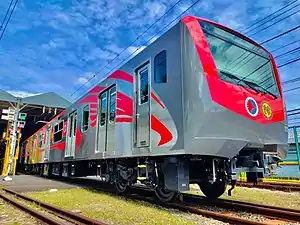 EM10011L in J-TREC's facility awaiting to be transported to the Port of Yokohama. | |
| In service | 2022 (planned) |
| Manufacturer | J-TREC |
| Designer | Japan Railway Technical Service[1] Sumitomo Corporation |
| Assembly | Yokohama, Japan |
| Family name | sustina[lower-alpha 1] |
| Constructed | 2021–present |
| Entered service | Fiscal 2022 |
| Number under construction | 96 vehicles (12 sets)[lower-alpha 2] |
| Number built | 8 vehicles (1 set) |
| Formation | Tc-M-M-T-T-M-M-Tc |
| Fleet numbers | 10011-10014 |
| Capacity | 2,266 with wheelchair spaces |
| Operator(s) | Philippine National Railways |
| Depot(s) | Malanday,[lower-alpha 3] Mabalacat, Banlic |
| Line(s) served | North–South Commuter Railway |
| Specifications | |
| Car body construction | Lightweight stainless steel |
| Train length | 160,000 mm (520 ft)[lower-alpha 4] |
| Car length | 2,000 mm (6.6 ft) |
| Width | 2,950 mm (9 ft 8 in) |
| Height | 4,150 mm (13 ft 7 in) |
| Floor height | 1,150 mm (3 ft 9 in) |
| Platform height | 1,100 mm (3 ft 7 in) |
| Doors | 4 doors per side |
| Wheel diameter | 780–860 mm (2 ft 7 in–2 ft 10 in) |
| Wheelbase | 2,100 mm (6 ft 11 in) |
| Maximum speed | 120 km/h (75 mph) |
| Weight | 270 t (600,000 lb) |
| Axle load | 16 t (35,000 lb) |
| Steep gradient | 25‰ |
| Traction system | VVVF |
| Traction motors | 16 3-phase AC squirrel cage traction motors |
| Acceleration | 3.3 km/h (2.1 mph) per second |
| Deceleration | 4.2 km/h (2.6 mph) per second |
| Auxiliaries | Hybrid SiC/IGBT; Low-power DC voltage supply; Batteries |
| Train ventilation | Roof-mounted air conditioning units (2 per car) |
| Electric system(s) | 1,500 V DC Overhead lines |
| Current collection method | Single-arm pantograph |
| UIC classification | 2'2'+2(Bo'Bo')+2(2'2')+2(Bo'Bo')+2'2' |
| AAR wheel arrangement | 2-2+2(B-B)+2(2-2)+2(B-B)+2-2 |
| Bogies | B15C bogies[lower-alpha 5] |
| Minimum turning radius | 400 m (1,300 ft) on mainline 92 m (302 ft) on depot |
| Braking system(s) | Tread brake |
| Safety system(s) | ATP, ATC, Eurobalise and GSM-R under ETCS-2 |
| Coupling system | Shibata coupling |
| Track gauge | 1,435 mm (4 ft 8+1⁄2 in) standard gauge |
| Seating | Longitudinal seating |
Background
Tokyu Car's involvement in the Philippines
Tokyu Car Corporation[lower-alpha 6] once constructed diesel multiple units and locomotive-hauled cars for the Manila Railroad Company and its succeeding incarnation, the Philippine National Railways. The company first built twenty JMC class DMUs alongside Mitsubishi Heavy Industries for its short-range services in 1955 as part of Manila Railroad's efforts towards dieselization.[1] In 1968, a daily commuter service to San Fernando, Pampanga was launched, using the MC-300 cars also built by Tokyu.[2]
A second batch of 24 CMC class railcars were ordered for the expanded Metro Manila Commuter Service to Angeles City. The trainsets arrived in batches between 1974 and 1976.[3] By the mid and late 1980s, long-haul commuter services such as those leading to Pampanga were cut due to a lack of funding, political instability, and a government debt crisis.[4]
The CMC and JMC were then retired from service in 2004 after being replaced by ex-JNR 12 and 14-series locomotive-hauled coaches, referred to as the 7A-2000 class.[5]
PNR electrification plans
Numerous plans to electrify the PNR network have been made since 1978,[6] most notably the discontinued Northrail project which would have used the European 25 kV AC railway electrification standard. It was cancelled in 2011 due to alleged overpricing and reports of anomalous deals.[7] The Northrail project was then revived in the late 2010s as the North–South Commuter Railway but now using the Japanese 1.5 kilovolt DC electrification standard.
Development and purchase
The Japan Railway Technical Service (JARTS)[lower-alpha 7] developed the STRASYA standard in 2004. It is an acronym for Standard Urban Railway System for Asia and are Japanese-built trains exported for use by other Asian countries. It uses a standardized rolling stock gauge of 20 m (66 ft) long, 2.95 m (9 ft 8 in) wide, and 3.65 m (12.0 ft) tall without a pantograph.[1] Meanwhile, the newly-formed Japan Transport Engineering Company introduced the sustina platform at InnoTrans 2012. This was shortly after Tokyu Car was reorganized and renamed as a result of its acquisition by the East Japan Railway Company. Its main distinction from other commuter train families is that the trainsets are constructed with lightweight stainless steel manufacturing technology patented by J-TREC.[8]
The National Economic and Development Authority has then required all new railroad projects to use standard-gauge track in 2016.[9] The North–South Commuter Railway, successor to the Manila–Clark rapid railway and Northrail projects, was announced the following year as a mostly elevated mainline.[10] The Department of Transportation (DOTr) then announced the order of 104 electric railcars from the Japan Transport Engineering Company (J-TREC) on July 16, 2019, equivalent to thirteen 8-car trainsets.[11][12] An additional order for 360 EMUs has been underway comprising an additional 304 commuter trains as well as 56 airport express trains.[13]
Production
The Department of Transportation unveiled pictures of the trainsets under production on May 15, 2021 with the completion of the first B15C bogies.[14] The first trainset was finished on October 7, 2021.[15] Delivery started on October 18, 2021 with each car being carried by semi-trailer trucks to the Port of Yokohama. The first train arrived at the Port of Manila on November 21, 2021.[16] The remaining 12 trainsets are still under production at the company's main facility in Yokohama until 2024.
Specifications
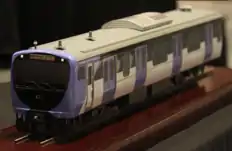
The EM10000 class' design is part of the larger sustina (trademarked in all-lower case format) family of electric trainsets and is largely based on the Sustina Commuter design.[11] These sets in particular are based on existing Japanese designs such as East Japan Railway Company's E233 series and E235 series, the latter being another derivative of the sustina platform. The design has also been adopted to standard-gauge track, as with the variant operated by Bangkok's Purple Line.[17] Each train is composed of 8 cars, expandable to 10. At its base form, it is twice longer than the 4-car trains of the LRTA 2000 class of 2003, its nearest counterpart in Metro Manila. The overall car length is at 160 meters (520 ft) for 8-car models and 200 meters (660 ft) for the 10-car expanded set.[18]
The class also adopted a new red-orange livery, having been revised from a bluish-purple livery adopted for the original proposal in 2019. This is after the DOTr unveiled the driver's cab of the units on June 29, 2021.[19] They also feature eagle design highlights on the sides of the train.
Overall, the tare weight of the trainsets are at 270 metric tons (600,000 lb).[20]
Mechanical
The bogies will be different from the DT and TR series used in Japan due to a difference in track gauges. One of the bogies appear to carry the serial number B15C according to images obtained by the Philippine Railway Historical Society.[14]
During the design stage, the trainsets were set to use American Tightlock coupling (Type H) according to design documents.[18][20] It was later changed to Shibata coupling after the first trainset was unveiled.[14]
Electrical
The trains will use 1,500 volt direct current (DC) power through overhead lines, making the electrification system standards the same as Japan. All motor cars will have a single-arm pantograph in each car. While the main source of traction are variable-voltage/variable-frequency drive (VVVF) motors activated by the pantograph, batteries and auxiliary power consisting of AC motors will also be used to power the train's lighting and controls as well as allowances for moving slowly (at c. 30 km/h (19 mph)) in case of an emergency before coming to a complete stop. The electrical components are required to be tropicalized and would have insulation requirements following IEC 60085 Thermal class 200 specifications. The acceleration is set at 3.3 km/h (2.1 mph) per second, while service braking deceleration is at 4.2 km/h (2.6 mph) per second and emergency braking deceleration is at 4.7 km/h (2.9 mph) per second.[20]
Signaling and safety equipment
The trains will adopt ETCS Level 2 for signalling and train control which combines Eurobalise with the GSM-R communication system. Although the adoption of ETCS will allow the NSCR to operate at 160 kilometers per hour (99 mph) under heavy traffic, the commuter trains themselves are limited to a maximum speed of 120 kilometers per hour (75 mph). Allowances have been considered for the future adoption of automatic train operation (ATO). Lastly, station platforms will have platform screen doors which will only open after the train doors do the same for safe boarding. Boarding time on the trainsets will be limited to 30 seconds.[20]
The ETCS equipment packages first underwent a non-competitive bidding as procurement and direct contracting. Hitachi Rail STS, an Italy-based subsidiary of Japanese manufacturer Hitachi and formerly Ansaldo STS, was the sole known bidder.[21] Two consortiums participated on a new bid opening on November 26, 2021. The first is Japanese firm Mitsubishi, with Alstom as its ETCS quipment supplier. On the other hand, Sojitz's supplier remains unknown.[22]
Interior
The design capacity for an 8-car trainset is 2,266 passengers with 2,242 being regular seats and standees and another 24 wheelchair spaces. Meanwhile, a future expanded 10-car variant will have 2,656 standing and regular seated passengers. Seating capacity will be different for lead and intermediate cars. Lead cars at each end of the train will have 211 standing passengers, 45 seated and 3 wheelchair spaces for a total of 269 passengers per car. Meanwhile, intermediate cars will have 231 standing, 54 seated and 3 wheelchair spaces for a total of 288 passengers per car. All seats will be of a single class and there will be no Green Class-style bilevel cars used by its Japanese counterparts.[18] There shall be provisions for priority seating and wheelchair space on the train per Japanese standards. However, unlike the Airport Express trains, there are no toilets on board.[20]
Each car also has eight electrically-driven bi-parting pocket doors. For end cars, an additional pair of single-type pocket doors will be installed on the car cabs.
Formation
← Northbound Southbound → | ||||||||||
| Car No. | 1 | 2 | 3 | 4 | 5 | 6 | 7 | 8 | ||
|---|---|---|---|---|---|---|---|---|---|---|
| Designation | Tc | M1A | M2A | T | T | M1B | M2B | Tc' | ||
| Numbering | EM10001L | EM10001M | EM10002M | EM10001T | EM10002T | EM10003M | EM10004M | EM10002L | ||
| Seated | 45 | 54 | 54 | 54 | 54 | 54 | 54 | 45 | ||
| Standing | 211 | 231 | 231 | 231 | 231 | 231 | 231 | 211 | ||
| Wheelchair spaces | 3 | 3 | 3 | 3 | 3 | 3 | 3 | 3 | ||
| Total | 269 | 288 | 288 | 288 | 288 | 288 | 288 | 269 | ||
The following are the definitions of the three-letter designation system.[1]
- L refers to the lead car or control car. The Japanese equivalent for this type is KuHa.
- M refers to a powered intermediate car. According to bidding documents, all motor cars have its own pantograph. Its Japanese equivalent is MoHa.
- T refers to an unpowered intermediate (trailer) car. Its Japanese equivalent is SaHa.
Operations
The first trainset arrived on November 21, 2021, while the second trainset is slated for delivery by 2022.[16] In preparation, train drivers will be tested to simulation training.[23] The first of the simulators arrived along with the test cab car on June 2021 and was already operational by September 9.[24] The first trainsets arrived on the Port of Manila on November 21, 2021, two weeks ahead of schedule set by the DOTr.[25] During this stage, the trains will be initially stored at the Malanday yards. It will then be subjected to testing before the commencement of regular operations on the Tutuban–Malolos segment (Phase 1) by 2022.[20]
Once operational, this will be used for both Commuter and Commuter Express services. Three routes were planned in 2018: Tutuban–New Clark City; Clark International Airport–Calamba; and Tutuban–Calamba.[18]
Notes
- Also incorporates designs from the STRASYA platform and the E233 series.[1]
- An additional 304 cars or 38 sets are being procured.
- Main depot
- 200 m (660 ft) for the proposed 10-car variant
- Serial number
- Predecessor to J-TREC and bore the Wasei-eigo form Co., Ltd. as a translation of Kabushiki gaisha during the 1950s.
- Japanese: 海外鉄道技術協力協会, romanized: Kaigai Tetsudō Gijutsu Kyōryoku Kyōkai, lit. 'Overseas Railway Technical Cooperation Association'
See also
- E233 series – Japanese narrow-gauge commuter trainsets in which the EM10000 design is derived from.
- E235 series – Another narrow-gauge commuter design belonging to the same sustina family, which the sides of the EM10000 trains is derived.
- MRTJ 1000 series – Indonesian narrow-gauge variant of the STRASYA for the Jakarta MRT.
References
- "NSCR(南北通勤鉄道)第1編成 J-TREC出場" [NSCR's (North-South Commuter Railway) first trainset leaves J-TREC's production facility] (in Japanese). Retrieved October 30, 2021.
- Philippine National Railways (January 21, 1968). PNR San Fernando Commuter Train. Manila Chronicle. Retrieved September 6, 2021.
- Philippine National Railways. "PNR Schedule effective September 11, 1976". www.flickr.com. Retrieved July 23, 2020.
- Doner, Robert; Intal, Ponciano (1989). Debt Crisis and Adjustment in the Philippines (PDF). Developing Country Debt and the World Economy (Thesis). University of Chicago Press. Retrieved September 6, 2021.
- Peadon, Brad. "April 2020". Philippine National Railways Rolling Stock Update. Philippine Railways Historical Society. 3.
- "REPORT ON STUDY OF THE ELECTRIFICATION OF THE PNR COMMUTER SERVICE" (PDF). Japan International Cooperation Agency. December 1978. Archived (PDF) from the original on May 22, 2021. Retrieved February 15, 2021.
- News, ABS-CBN (July 15, 2008). "Off track: Northrail timeline". ABS-CBN News. Archived from the original on February 17, 2019. Retrieved February 17, 2019.
- "海外向けステンレス車両のブランド名を「sustina(サスティナ)」に - 総合車両製作所" (PDF). Japan Transport Engineering Company. September 12, 2012. Retrieved October 30, 2021.
- "Philippines adopts standard gauge for new lines". International Railway Journal. August 9, 2016. Archived from the original on April 23, 2021. Retrieved May 17, 2021.
- Dela Paz, Chrisee. "17 stations of Manila–Clark railway announced". Rappler. Archived from the original on March 22, 2019. Retrieved February 17, 2019.
- "Order Received to Supply 104 Train Cars for Philippines' North-South Commuter Railway Project". Sumitomo Corporation Africa. July 16, 2019. Retrieved August 12, 2021.
- Lopez, Melissa Luz (July 16, 2019). "DOTr taps Japan bullet train supplier for Tutuban-Malolos railway". CNN Philippines. Retrieved November 22, 2021.
- Dela Cruz, Raymond (July 22, 2021). "PNR Calamba receives 'record-breaking' number of bids". Philippine News Agency. Retrieved November 3, 2021.
- Sneak peak inside the NSCR Rolling stock for commuter service. Philippine Railway Historical Society. September 15, 2021. Retrieved September 27, 2021. (registration required)
- GOOD NEWS. Facebook. Department of Transportation (Philippines). October 7, 2021. Retrieved October 9, 2021.
- "First 8-car trainset for PNR Clark Phase 1 arrives in PH". ABS-CBN News. November 21, 2021. Retrieved November 22, 2021.
- "J-TREC starts shipment of the Bangkok Purple Line Rolling Stock". Japanese Overseas Railway System Association. September 7, 2015. Retrieved August 12, 2021.
- Department of Transportation The Republic of the Philippines (October 2018). "FEASIBILITY STUDY ON THE NORTH SOUTH RAILWAY PROJECT-SOUTH LINE (COMMUTER)(NORTH-SOUTH COMMUTER RAILWAY EXTENSION PROJECT) IN THE REPUBLIC OF THE PHILIPPINES" (PDF). jica.go.jp. Archived (PDF) from the original on April 11, 2021. Retrieved April 26, 2019.
- "LOOK: DOTr unveils driver's cab model for PNR Tutuban-Malolos railway". Philippine Daily Inquirer (auto-generated article). June 29, 2021. Retrieved August 12, 2021.
- B) TECHNICAL REQUIREMENTS (ERT) from BIDDING DOCUMENTS FOR PROCUREMENT OF PACKAGE CP NS-02: ROLLING STOCK - COMMUTER TRAINSETS Volume II of III (Report). Philippine National Railways. September 2020. Retrieved December 17, 2021.
- "NORTH-SOUTH COMMUTER RAILWAY PROJECT (MALOLOS-TUTUBAN) N1CP04: ELECTRICAL AND MECHANICAL SYSTEMS AND TRACKWORKS". Department of Transportation (Philippines). August 25, 2021. Retrieved November 5, 2021.
- LIVE: Opening of Bid for North-South Commuter Railway Extension Project “NSCREx” Contract Package (“CP”) NS01 (16:9 720p). Department of Transportation (Philippines). November 26, 2021. Retrieved December 2, 2021.
- Balao, Louigi (June 5, 2021). "PNR Clark, Calamba trains to arrive in December 2021". www.yugatech.com. Retrieved August 12, 2021.
- NSCR CAB SIM VIEW (YouTube). September 9, 2021. Retrieved October 21, 2021.
- Grecia, Leandre (November 22, 2021). "The new PNR Clark Phase 1 trains have arrived". Top Gear Philippines. Retrieved November 22, 2021.