PNR 8100 class
The PNR 8100 class,[2][4] also known as INKA DMUs,[5] is a class of diesel multiple units (DMUs) ordered by the Philippine National Railways. It entered service in February 2020.
| PNR 8100 class | |
|---|---|
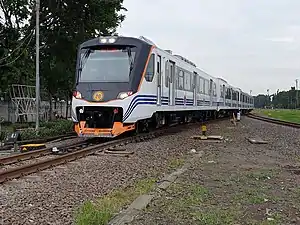 An 8100 class trainset on a trial run from Madiun to Jombang, taken near Wonokromo station in 21 January 2020. | |
| In service | 2020–present |
| Manufacturer | PT INKA |
| Built at | Madiun, Indonesia |
| Family name | INKA K3 coach |
| Replaced | KiHa 350 KiHa 52 203 series |
| Constructed | 2018–2020 |
| Entered service | February 20, 2020 |
| Number built | 16 vehicles (4 sets) |
| Number in service | 16 vehicles (4 sets) |
| Formation | 4 cars per trainset |
| Fleet numbers | 8101–8104 |
| Capacity | 1,000 passengers |
| Operator(s) | Philippine National Railways |
| Depot(s) | Tayuman Yard |
| Line(s) served | PNR Metro Commuter Line |
| Specifications | |
| Car body construction | Stainless steel |
| Train length | 82,800 mm (271 ft 8 in) |
| Car length | 20,000 mm (65 ft 7 in) 20,700 mm (67 ft 11 in) including coupler |
| Width | 2,990 mm (9 ft 10 in) 3,180 mm (10 ft 5 in) including signal lights |
| Height | 3,530 mm (11 ft 7 in) 3,830 mm (12 ft 7 in) including radiator |
| Doors | 3 double-leaf doors per side |
| Wheelbase | 2,200 mm (7 ft 3 in) |
| Maximum speed | 100 km/h (60 mph) |
| Train ventilation | Roof-mounted air conditioning units (1 unit per car; 4 units per train) |
| Bogies | Bolsterless type |
| Coupling system | Janney coupler |
| Track gauge | 1,067 mm (3 ft 6 in) |
| Seating | Longitudinal seating |
| Notes | |
| References of key features: [1][2][3] | |
Purchase
As part of the Philippine National Railways' modernization program, PNR received a budget through the 2018 General Appropriations Act for the purchase of trains.[6] On May 28, 2018, four sets of four-car trains were ordered together with three INKA CC300 locomotives and fifteen passenger coaches worth ₱2.5 billion (US$47.4 million).[7][8][9]
Design and features
The trains were manufactured by the Indonesian firm PT Industri Kereta Api (Persero), also known as INKA. The design of the 8100 class is identical to the 8000 class DMUs deployed earlier with three double-leaf sliding doors per side and longitudinal seats, with the exception of additional intermediate coaches; the 8100 classes comprises 4 units unlike the earlier 8000 units with just 3. The 8000 and 8100 class DMUs as well as the 8300 class coaches are given the designation K3 while in Indonesia.
The DMU train sets has an obstacle door detector that keeps passengers from being caught in between doors with Emergency door release that opens the door manually in case of emergency.[2]
The trains are equipped with polycarbonate glass windows that can withstand damages from stoning, four roof-mounted air-conditioning units (each train car has one unit) suitable for the local tropical climate, and an emergency intercom equipped with two way communication.[2]
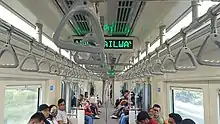
The trains also feature an LED passenger information system display in each train car.
Operations
The trains were delivered in two batches: the first batch of trains arrived in February 2020, while the second batch arrived in March 2020. The first batch of the 8100 class DMUs were unveiled on February 14, 2020 and inaugurated on February 20, 2020 at the Tutuban station.[2] These underwent 150-hour RAMS validation before it entered revenue service.[4] The tests for the trains have continued and were successful amidst the effects of the COVID-19 pandemic. Meanwhile, on March 28, 2020, the second batch of two train sets consisting 8 vehicles have been shipped and arrived in the country.[10] The two train sets also underwent RAMS validation tests from May 21 to 31, 2020 before it entered revenue service.[11] It entered revenue service when PNR resumed operations on June 1, 2020 upon the lifting of the metropolis' Modified Enhanced Community Quarantine.[12]
The four train sets entered revenue service in June 2020.[2]
From February 2020 to March 2020, the trains serviced the Metro South Commuter line from Tutuban to FTI stations and vice versa, and since June 2020 the trains now service until Alabang stations and vice versa.
References
- "Diesel Multiple Unit Philippine National Railways". www.inka.co.id. Retrieved December 11, 2021.
- Marquez, Consuelo (February 20, 2020). "PNR rolls out 2 new train sets from Indonesia". Philippine Daily Inquirer. Retrieved February 27, 2020.
- "フィリピン国鉄(PNR)8000・8100 Series". 2427junction.com (in Japanese). Retrieved December 11, 2021.
- "Two more PNR trainsets arrive in PH". ph.news.yahoo.com. Retrieved February 12, 2020.
- "PNR unveils 2 brand new diesel multiple unit trains bought from Indonesia". Manila Standard. Retrieved February 3, 2020.
- "NEW DMU TRAINS FOR PNR IN 2019". www.pnr.gov.ph. Retrieved February 3, 2020.
- "Philippines awards train contracts to PT Inka". International Railway Journal. June 8, 2018. Retrieved February 3, 2020.
- Railway Gazette (June 8, 2018). "PNR orders DMUs and push-pull sets". Railway Gazette International. Retrieved February 3, 2020.
- "INKA - PNR Contract Signing Ceremony". www.pnr.gov.ph. Retrieved February 3, 2020.
- "2 New PNR Trains Arrive From Indonesia". Mintfo. April 7, 2020. Retrieved February 22, 2021.
- "PNR INKA Trainset 8103 passing Nichols Level Crossing". YouTube. May 26, 2020. Retrieved March 8, 2021.
- "PNR ready to resume operations, to deploy brand new trains". Philippine Information Agency. May 31, 2020. Retrieved February 24, 2021.
