Asteria (Titaness)
In Greek mythology, Asteria or Asterie (/əˈstɪəriə/; Ancient Greek: Ἀστερία, lit. 'of the stars, starry one') was a daughter of the Titans Coeus (Polus) and Phoebe and the sister of Leto.[1][2][3] According to Hesiod, by the Titan Perses she had a daughter, Hecate, goddess of witchcraft.[4][5][6] Other authors made Asteria the mother of the fourth Heracles[7][8] and Hecate[9] by Zeus.
| Asteria | |
|---|---|
Goddess of Delos | |
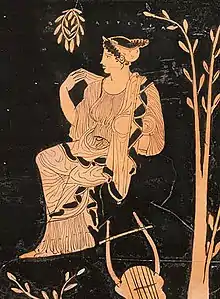 Asteria seated on a rock with a lyre and laurel wreath at her side | |
| Abode | Delos |
| Personal information | |
| Parents | Coeus and Phoebe |
| Siblings | Leto |
| Consort | Perses |
| Children | Hecate |
Mythology
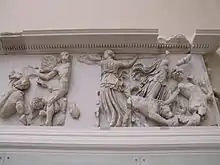
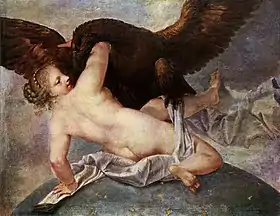
Asteria was an inhabitant of Olympus, and like her sister Leto was beloved by Zeus. In order to escape the amorous advances of the god, who in the form of an eagle pursued her,[10] she transformed herself into a quail (ortux) and flung herself into the Aegean Sea. It was there that Asteria metamorphosed into the island Asteria (the island which had fallen from heaven like a star) or the "quail island" Ortygia.[11][12] This then became identified with the island of Delos, which was the only place on earth to give refuge to the fugitive Leto when, pregnant with Zeus's children, she was pursued by vengeful Hera.[13] According to Hyginus, Leto was borne by the north wind Boreas at the command of Zeus to the floating island, at the time when Python was pursuing her, and there clinging to an olive, she gave birth to Apollo and Artemis.[14] On the island of Delos Asteria married Perses and gave birth to their child Hecate.[15]
A different version was added by the poet Nonnus who recounted that, after Asteria was pursued by Zeus but turned herself into a quail and leapt into the sea, Poseidon instead took up the chase. In the madness of his passion, he hunted the chaste goddess to and fro in the sea, riding restless before the changing wind and thus she transformed herself into the desert island of Delos with the help of her nephew Apollo who rooted her in the waves immovable.[16]
In the rare account where Asteria was the mother of Heracles by Zeus, the Phoenicians sacrifice quails to the hero because when he went into Libya and was killed by Typhon, Iolaus brought a quail to him, and having put it close to him, he smelt it and came to life again.[8]
Genealogy
| Asteria's family tree [17] |
|---|
See also
- The Astra Planeta (five of Astraea's siblings)
Notes
- Hesiod, Theogony 404ff
- Pseudo-Apollodorus, Bibliotheca 1.2.2
- Hyginus, Fabulae Preface
- Hesiod, Theogony 409–11
- Pseudo-Apollodorus, Bibliotheca 1.2.4
- Servius, Commentary on Virgil's Aeneid 3.73
- Cicero, De Natura Deorum 3.16
- Athenaeus, Deipnosophists 9.392
- according to Musaeus as cited Scholiast on Apollonius Rhodius, Argonautica 3.467
- Ovid, Metamorphoses 6.108
- John Tzetzes
- Pseudo-Apollodorus, Bibliotheca 1.4.1
- Callimachus, Hymns in Delos 37
- Hyginus, Fabulae 53
- Roman, Luke; Roman, Monica (2010). Encyclopedia of Greek and Roman Mythology. Infobase Publishing. p. 88. ISBN 9781438126395.
- Nonnus, Dionysiaca 2.125 ff, 33.336 ff & 42.410 ff
- Hesiod, Theogony 132–138, 337–411, 453–520, 901–906, 915–920; Caldwell, pp. 8–11, tables 11–14.
- Although usually the daughter of Hyperion and Theia, as in Hesiod, Theogony 371–374, in the Homeric Hymn to Hermes (4), 99–100, Selene is instead made the daughter of Pallas the son of Megamedes.
- According to Hesiod, Theogony 507–511, Clymene, one of the Oceanids, the daughters of Oceanus and Tethys, at Hesiod, Theogony 351, was the mother by Iapetus of Atlas, Menoetius, Prometheus, and Epimetheus, while according to Apollodorus, 1.2.3, another Oceanid, Asia was their mother by Iapetus.
- According to Plato, Critias, 113d–114a, Atlas was the son of Poseidon and the mortal Cleito.
- In Aeschylus, Prometheus Bound 18, 211, 873 (Sommerstein, pp. 444, 445 n. 2, 446, 447 n. 24, 538, 539 n. 113) Prometheus is made to be the son of Themis.
References
- Athenaeus of Naucratis, The Deipnosophists or Banquet of the Learned. London. Henry G. Bohn, York Street, Covent Garden. 1854. Online version at the Perseus Digital Library.
- Athenaeus of Naucratis, Deipnosophistae. Kaibel. In Aedibus B.G. Teubneri. Lipsiae. 1887. Greek text available at the Perseus Digital Library.
- Callimachus, Callimachus and Lycophron with an English translation by A. W. Mair ; Aratus, with an English translation by G. R. Mair, London: W. Heinemann, New York: G. P. Putnam 1921. Internet Archive
- Callimachus, Works. A.W. Mair. London: William Heinemann; New York: G.P. Putnam's Sons. 1921. Greek text available at the Perseus Digital Library.
- Gaius Julius Hyginus, Fabulae from The Myths of Hyginus translated and edited by Mary Grant. University of Kansas Publications in Humanistic Studies. Online version at the Topos Text Project.
- Hesiod, Theogony from The Homeric Hymns and Homerica with an English Translation by Hugh G. Evelyn-White, Cambridge, MA.,Harvard University Press; London, William Heinemann Ltd. 1914. Online version at the Perseus Digital Library. Greek text available from the same website.
- Marcus Tullius Cicero, Nature of the Gods from the Treatises of M.T. Cicero translated by Charles Duke Yonge (1812-1891), Bohn edition of 1878. Online version at the Topos Text Project.
- Marcus Tullius Cicero, De Natura Deorum. O. Plasberg. Leipzig. Teubner. 1917. Latin text available at the Perseus Digital Library.
- Maurus Servius Honoratus, In Vergilii carmina comentarii. Servii Grammatici qui feruntur in Vergilii carmina commentarii; recensuerunt Georgius Thilo et Hermannus Hagen. Georgius Thilo. Leipzig. B. G. Teubner. 1881. Online version at the Perseus Digital Library.
- Nonnus of Panopolis, Dionysiaca translated by William Henry Denham Rouse (1863-1950), from the Loeb Classical Library, Cambridge, MA, Harvard University Press, 1940. Online version at the Topos Text Project.
- Nonnus of Panopolis, Dionysiaca. 3 Vols. W.H.D. Rouse. Cambridge, MA., Harvard University Press; London, William Heinemann, Ltd. 1940-1942. Greek text available at the Perseus Digital Library.
- Pseudo-Apollodorus, The Library with an English Translation by Sir James George Frazer, F.B.A., F.R.S. in 2 Volumes, Cambridge, MA, Harvard University Press; London, William Heinemann Ltd. 1921. ISBN 0-674-99135-4. Online version at the Perseus Digital Library. Greek text available from the same website.
- Publius Ovidius Naso, Amores edited by Christopher Marlowe, Ed. Online version at the Perseus Digital Library.
- Publius Ovidius Naso, Amores, Epistulae, Medicamina faciei femineae, Ars amatoria, Remedia amoris. R. Ehwald. edidit ex Rudolphi Merkelii recognitione. Leipzig. B. G. Teubner. 1907. Latin text available at the Perseus Digital Library.