Selene
In Greek mythology, Selene (/sɪˈliːniː/; Ancient Greek: Σελήνη, romanized: Selḗnē, lit. '"Moon"', Greek pronunciation: [selɛ̌ːnɛː]) is the goddess of the Moon. She is the daughter of the Titans Hyperion and Theia, and sister of the sun god Helios and the dawn goddess Eos. She drives her moon chariot across the heavens. Several lovers are attributed to her in various myths, including Zeus, Pan, and the mortal Endymion. In post-classical times, Selene was often identified with Artemis, much as her brother, Helios, was identified with Apollo.[2] Selene and Artemis were also associated with Hecate and all three were regarded as moon and lunar goddesses, but only Selene was regarded as the personification of the Moon itself. Her Roman equivalent is Luna.[3]
| Selene | |
|---|---|
Personification of the Moon | |
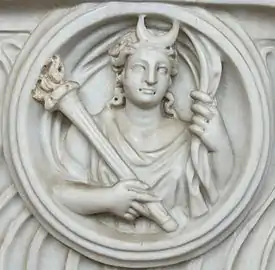 Detail of Selene from a Roman sarcophagus | |
| Abode | Sky |
| Planet | Moon[1] |
| Symbol | Crescent, chariot, torch, billowing cloak, bull |
| Day | Monday (hēméra Selḗnēs) |
| Personal information | |
| Parents | Hyperion and Theia, or Pallas, the son of Megamedes or Helios. |
| Siblings | Helios and Eos |
| Consort | Endymion |
| Children | Fifty daughters to Endymion; Pandia and Ersa to Zeus; four Horae to Helios; Musaeus |
| Roman equivalent | Luna |
Names
| Part of a series on |
| Ancient Greek religion |
|---|
 |
|

The name "Selene" is connected to the Greek noun selas (σέλας), meaning "light, brightness, gleam".[5]
Selene was also called Mene.[6] The Greek word men (feminine mene), meant the moon, and the lunar month.[7] It was also the name of the Phrygian moon-god Men.[8] The Greek Stoic philosopher Chrysippus interpreted Selene and Men as, respectively, the female and male aspects of the same god.[9]
Just as Helios, from his identification with Apollo, is called Phoebus ("bright"), Selene, from her identification with Artemis, is also called Phoebe (feminine form).[10] The original Phoebe of Greek mythology is Selene's aunt, the Titan mother of Leto and Asteria, and grandmother of Apollo, Artemis, and Hecate. Also from Artemis, Selene was sometimes called "Cynthia".[11]
Family
The usual account of Selene's origin is given by Hesiod in his Theogony, where the sun-god Hyperion espoused his sister Theia, who gave birth to "great Helios and clear Selene and Eos who shines upon all that are on earth and upon the deathless Gods who live in the wide heaven".[12] The Hymn to Helios follows this tradition: "Hyperion wedded glorious Euryphaëssa, his own sister, who bare him lovely children, rosy-armed Eos and rich-tressed Selene and tireless Helios",[13] with Euryphaëssa ("widely-shining") probably being an epithet of Theia.[14]
Other accounts give other parents for Selene. The Hymn to Hermes has Selene as the daughter of Pallas, the son of Megamedes (possibly identified with Titan Pallas),[15] Euripides has Selene as the daughter of Helios (rather than sister).[16] while an Aeschylus fragment possibly has Selene as the daughter of Leto.[17]
According to the Hymn to Selene, the goddess bore Zeus a daughter, Pandia ("All-brightness"),[18] "exceeding lovely amongst the deathless gods".[19] The 7th century BC Greek poet Alcman makes Ersa ("Dew") the daughter of Selene and Zeus.[20] Selene and Zeus were also said to be the parents of Nemea, the eponymous nymph of Nemea, where Heracles slew the Nemean Lion, and where the Nemean Games were held.[21]
From Pausanias we hear that Selene was supposed to have had by Endymion fifty daughters, who possibly represented the fifty lunar months of the Olympiad.[22] Nonnus has Selene and Endymion as the parents of the beautiful Narcissus,[23] but in other accounts, including Ovid's Metamorphoses, Narcissus was the son of Cephissus and Liriope.[24]
Quintus Smyrnaeus makes Selene, with her brother Helios, the parents of the Horae, goddesses and personifications of the four seasons; Winter, Spring, Summer, and Autumn.[25] Smyrnaeus describes them as the four handmaidens of Hera, but in most other accounts their number is three; Eirene ("peace"), Eunomia ("order"), and Dike ("justice"), and their parents are Zeus and Themis instead.
Lastly, Selene was said to be the mother (by the legendary seer Eumolpus[26] according to Philochorus) of the legendary Greek poet Musaeus.[27]
Mythology
Endymion
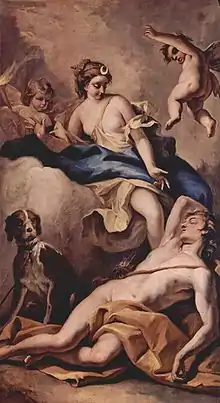
Selene is best known for her affair with the beautiful mortal Endymion.[28] The late 7th-century – early 6th-century BC poet Sappho apparently mentioned Selene and Endymion.[29] However, the first account of the story comes from the third-century BC Argonautica of Apollonius of Rhodes, which tells of Selene's "mad passion" and her visiting the "fair Endymion" in a cave on Mount Latmus:[30]
And the Titanian goddess, the moon, rising from a far land, beheld her [Medea] as she fled distraught, and fiercely exulted over her, and thus spake to her own heart:
"Not I alone then stray to the Latmian cave, nor do I alone burn with love for fair Endymion; oft times with thoughts of love have I been driven away by thy crafty spells, in order that in the darkness of night thou mightest work thy sorcery at ease, even the deeds dear to thee. And now thou thyself too hast part in a like mad passion; and some god of affliction has given thee Jason to be thy grievous woe. Well, go on, and steel thy heart, wise though thou be, to take up thy burden of pain, fraught with many sighs."[31]
The eternally sleeping Endymion was proverbial,[32] but exactly how this eternal sleep came about and what role, if any, Selene may have had in it is unclear. According to the Catalogue of Women, Endymion was the son of Aethlius (a son of Zeus), and Zeus granted him the right to choose when he would die.[33] A scholiast on Apollonius says that, according to Epimenides, Endymion fell in love with Hera, and Zeus punished him with eternal sleep.[34] However, Apollodorus says that because of Endymion's "surpassing beauty, the Moon fell in love with him, and Zeus allowed him to choose what he would, and he chose to sleep for ever, remaining deathless and ageless".[35] Theocritus portrays Endymion's sleep as enviable because (presumably) of Selene's love for him.[36] Cicero seems to make Selene responsible for Endymion's sleep, so that "she might kiss him while sleeping".[37] The Roman playwright Seneca, has Selene abandoned the night sky for Endymion's sake having entrusted her "shining" moon chariot to her brother Helios to drive.[38] The Greek satirist Lucian's dialogue between Selene and the love goddess Aphrodite has the two goddesses commiserate about their love affairs with Endymion and Adonis, and suggests that Selene has fallen in love with Endymion while watching him sleep each night.[39] In his dialogue between Aphrodite and Eros, Lucian also has Aphrodite admonish her son Eros for bringing Selene "down from the sky".[40] While Quintus Smyrnaeus' wrote that, while Endymion slept in his cave beside his cattle, "Selene watched him from on high, and slid from heaven to earth; for passionate love drew down the immortal stainless Queen of Night."[41]
Lucian also records an otherwise unattested myth where a pretty young girl called Muia becomes Selene's rival for Endymion's affections; the chatty maiden would endlessly talk to him while he slept, causing him to wake up. This irritated Endymion, and enraged Selene, who transforms the girl into a fly (Ancient Greek: μυῖα, romanized: muía). In memory of the beautiful Endymion, the fly still grudges all sleepers their rest and annoys them.[42]
Philologist Max Müller's interpretation of solar mythology as it related to Selene and Endymion concluded that the myth was a narrativized version of linguistic terminology. Because the Greek endyein meant "to dive," the name Endymion ("Diver") at first simply described the process of the setting sun "diving" into the sea. In this case, the story of Selene embracing Endymion, or Moon embraces Diver, refers to the sun setting and the moon rising.[43]
Gigantomachy
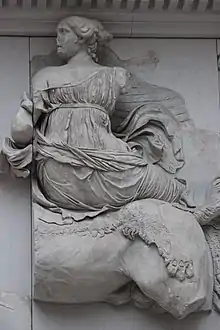
Gaia, angered about her children the Titans being thrown into Tartarus following their defeat, brought forth the Giants, to attack the gods, in a war that was called the Gigantomachy. When Gaia heard of a prophecy that a mortal would help the gods to defeat the giants, she sought to find a herb that would make them undefeatable. Zeus heard of that, and ordered Selene as well as her siblings Helios (Sun) and Eos (Dawn) not to shine, and harvested all of that plant for himself.[44]
Fight with Typhon
According to the late account of Nonnus, when the gigantic monster Typhon laid siege against the heavens, he attacked Selene as well by hurling bulls at her, though she managed to stay in her course, and rushed at her hissing like a viper. Selene fought back the giant, locking horns with Typhon; afterwards, she carried many scars on her orb, reminiscent of their battle.[45]
Ampelus
Ampelus was a very beautiful satyr youth, loved by the god Dionysus.[46] One day, in Nonnus' account, Ampelus rode on a bull, and proceeded to compare himself to Selene, saying that he was her equal, having horns and riding bulls just like her. The goddess took offense, and sent a gadfly to sting Ampelus' bull. The bull panicked, threw Ampelus and gored him to death.[47]
The Nemean Lion

Whereas for Hesiod, the Nemean Lion was born to Orthrus and the Chimera (or perhaps Echidna) and raised by Hera,[48] other accounts have Selene involved in some way in its birth or rearing.[49] Aelian states: "They say that the Lion of Nemea fell from the moon", and quotes Epimenides as saying:[50]
For I am sprung from fair-tressed Selene the Moon, who in a fearful shudder shook off the savage lion in Nemea, and brought him forth at the bidding of Queen Hera.[51]
Anaxagoras also reports that the Nemean lion was said to have fallen from the moon.[52] Pseudo-Plutarch's On Rivers has Hera collaborating with Selene, "employing magical incantations" to create the Nemean Lion from a chest filled with foam.[53] Hyginus says that Selene had "nourished" the lion in a "two-mouthed cave".[54]
Pan
According to Virgil, Selene also had a tryst with the god Pan, who seduced her with a "snowy bribe of wool".[55] Scholia on Virgil add the story, ascribed to Nicander, that as part of the seduction, Pan wrapped himself in a sheepskin.[56]
Other accounts
Diodorus Siculus recorded an unorthodox version of the myth, in which Basileia, who had succeeded her father Uranus to his royal thrown, married her brother Hyperion, and had two children, a son Helios and a daughter Selene, "admired for both their beauty and their chastity". Because Basileia's other brothers envied these offspring, and feared that Hyperion would try to seize power for himself, conspired against him; they put Hyperion to the sword and drowned Helios in the river Eridanus. Selene herself, upon discovering this, took her own life. After these deaths, her brother appeared in a dream to their grieving mother and assured her that he and his sister would now transform into divine natures; and:[57]
that which had formerly been called the "holy fire" in the heavens would be called by men Helius ("the sun") and that addressed as "menê" would be called Selenê ("the moon").[58]
Plutarch recorded a fable-like story (sometimes categorized as an Aesop's fable) where Selene asked her mother to weave her a garment to fit her measure, and her mother replied that she was unable to do so, as she kept changing shape and size, sometimes full, then crescent-shaped and others yet half her size.[59]
In Lucian's, Icaromenippus, Selene complains to the titular Menippus of all the outrageous claims philosophers are making about her, such as wondering why she is ever waxing or gibbous, whether she is populated or not, and stating that she is getting her stolen light from the Sun, causing strife and ill feelings between her and her brother. She asks Menippus to report her grievances to Zeus, with the request that Zeus wipes all these natural philosophers from the face of the earth.[60] Zeus agrees, urged by Selene's complaints and having long intended to deal with the philosophers himself.[61]
Claudian wrote that in her infancy, when her horns had not yet grown, Selene (along with Helios – their sister Eos is not mentioned with them) was nursed by her aunt, the water goddess Tethys.[62]
Moon chariot

Like her brother Helios, the Sun god, who drives his sun chariot across the sky each day, Selene is also said to drive a chariot across the heavens.[63] There are no mentions of Selene's chariot in either Homer or Hesiod, but the Hymn to Selene, gives the following description:[64]
The air, unlit before, glows with the light of her golden crown, and her rays beam clear, whensoever bright Selene having bathed her lovely body in the waters of Ocean, and donned her far-gleaming raiment, and yoked her strong-necked, shining team, drives on her long-maned horses at full speed, at eventime in the mid-month: then her great orbit is full and then her beams shine brightest as she increases. So she is a sure token and a sign to mortal men.[65]
The earliest known depiction of Selene driving a chariot adorns the inside of an early 5th century BC red-figure cup attributed to the Brygos Painter, showing Selene plunging her chariot, drawn by two winged horses, into the sea.[66] The geographer Pausanias, reports seeing a relief of Selene driving a single horse, as it seemed to him, or as some said, a mule, on the pedestal of the Statue of Zeus at Olympia (c. 435 BC).[67] While the sun chariot has four horses, Selene's usually has two,[68] described as "snow-white" by Ovid.[69] In some cases the chariot was drawn by oxen or bulls.[70] Though the moon chariot is often described as being silver,[71] for Pindar it was golden.[72]
Descriptions
Surviving descriptions of Selene's physical appearance and character, apart from those which would apply to the moon itself, are scant. Three early sources mention Selene's hair. Both the Hymn to Helios and the Hymn to Selene use the word εὐπλόκαμος, variously translated as "rich", "bright", or "beautiful haired", and Epimenides uses the epithet "lovely-haired".[73] The Hymn to Selene describes the goddess as very beautiful, with long wings and a golden diadem, calling her "white-armed" and "benevolent".[74] Aeschylus calls Selene "the eye of night".[75]
In late accounts, she is often described as having horns.[76] The Orphic Hymn to Selene addresses her as "O bull-horned Moon", and further describes her as "torch-bearing, ... feminine and masculine, ... lover of horses," and grantor of "fulfillment and favor".[77] Empedocles, Euripides and Nonnus all describe her as γλαυκῶπις (glaukṓpis, "bright, grey-eyed", a common epithet of the goddess Athena)[78][79] while she is κυανῶπις (kyanṓpis, "dark-eyed") according to Pamprepius.[80] Mesomedes of Crete calls her γλαυκὰ (glaukà, "silvery grey").[81]
Iconography
_-_Napoli_MAN_9240.jpg.webp)
In antiquity, artistic representations of Selene included sculptural reliefs, vase paintings, coins, and gems.[82] In red-figure pottery before the early 5th century BC, she is depicted only as a bust, or in profile against a lunar disk.[83] In later art, like other celestial divinities such as Helios, Eos, and Nyx ("night"), Selene rides across the heavens. She is usually portrayed either driving a chariot or riding sidesaddle on horseback[84] (sometimes riding an ox, a mule or a ram).[85]
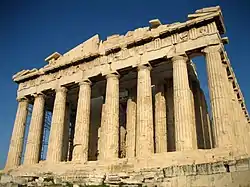
Paired with her brother Helios, Selene adorned the east pediment of the Parthenon, where the two framed a scene depicting the birth of Athena, with Helios driving his chariot rising from the ocean on the left, and Selene and her chariot descending into the sea on the right.[86] From Pausanias, we learn that Selene and Helios also framed the birth of Aphrodite on the base of the Statue of Zeus at Olympia.[87] There are indications of a similar framing by Selene and Helios of the birth of Pandora on the base of the Athena Parthenos.[88] Pausanias also reports seeing stone images of Helios, and Selene, in the market-place at Elea, with rays projecting from the head of Helios, and horns from the head of Selene.[89] Selene also appears on horseback as part of the Gigantomachy frieze of the Pergamon Altar.[90]
Selene is commonly depicted with a crescent moon, often accompanied by stars; sometimes, instead of a crescent, a lunar disc is used.[91] Often a crescent moon rests on her brow, or the cusps of a crescent moon protrude, horn-like, from her head, or from behind her head or shoulders.[92] Selene's head is sometimes surrounded by a nimbus, and from the Hellenistic period onwards, she is sometimes pictured with a torch.[93]
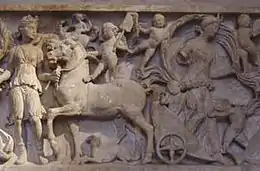
In later second and third century AD Roman funerary art, the love of Selene for Endymion and his eternal sleep was a popular subject for artists.[94] As frequently depicted on Roman sarcophagi, Selene, holding a billowing veil forming a crescent over her head, descends from her chariot to join her lover, who slumbers at her feet.[95]
Cult
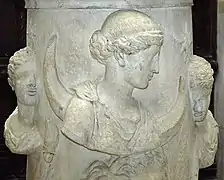
Moon figures are found on Cretan rings and gems (perhaps indicating a Minoan moon cult), but apart from the role played by the moon itself in magic, folklore, and poetry, and despite the later worship of the Phrygian moon-god Men, there was relatively little worship of Selene.[97] An oracular sanctuary existed near Thalamai in Laconia. Described by Pausanias, it contained statues of Pasiphaë and Helios. Here Pasiphaë is used as an epithet of Selene, instead of referring to the daughter of Helios and wife of Minos.[98] Pausanias also described seeing two stone images in the market-place of Elis, one of the sun and the other of the moon, from the heads of which projected the rays of the sun and the horns of the crescent moon.[99]
Originally, Pandia may have been an epithet of Selene,[100] but by at least the time of the late Hymn to Selene, Pandia had become a daughter of Zeus and Selene. Pandia (or Pandia Selene) may have personified the full moon,[101] and an Athenian festival, called the Pandia, usually considered to be a festival for Zeus,[102] was perhaps celebrated on the full moon and may have been associated with Selene.[103]
Selene was sometimes associated with childbirth, for it was believed that during the full moon women had the easiest labours; this helped in her identification with the goddess Artemis,[104] as well as other goddesses connected to women's labours. The idea that Selene would also give easy labours to women paved way for identification with Hera and the Roman Juno and Lucina, three other childbirth goddesses; Plutarch calls Selene "Hera in material form."[105] Roman philosopher Cicero connected Selene's Roman counterpart Luna's name to childbirth goddess Lucina's, both deriving from "light" (thus bringing the unborn child into the light).[106] Nonnus of Panopolis also identified Selene with Eileithyia.[107]
Selene played an important role in love magic.[108] In Theocritus's second Idyll, a young girl invokes Selene in a love-spell.[109] And, according to a scholium on Theocritus, Pindar wrote that lovesick women would pray to Selene for help, as Euripides apparently had Phaedra[110] do in his lost play Hippolytus Veiled.[111]
The ancient Greeks called Monday "day of the Moon" (ἡμέρα Σελήνης) after her.[112]
Orphic literature
According to a certain Epigenes,[113] the three Moirai, or Fates, were regarded in the Orphic tradition as representing the three divisions of Selene, "the thirtieth and the fifteenth and the first" (i.e. the crescent moon, full moon, and dark moon, as delinted by the divisions of the calendar month).[114]
Namesakes
- Selene is the Greek proper name for the Moon.[115]
- 580 Selene, a minor planet in the asteroid belt, is also named after this goddess.
- The chemical element Selenium is named after Selene.
Genealogy
Notes
- Evans, James (1998). The History and Practice of Ancient Astronomy. Oxford University Press. pp. 296–7. ISBN 978-0-19-509539-5. Retrieved 2008-02-04.
- Hard, p. 46; Oxford Classical Dictionary, s.v. Selene, pp. 970–971; Morford, pp. 64, 219–220; Smith, s.v. Selene.
- Smith, s.v. Selene; Kerényi, pp. 196–197; Oxford Classical Dictionary, s.v. Selene, pp. 970–971; Hard, p. 46; Morford, pp. 64, 219–221.
- Stefania Sorrenti, "Les représentations figurées de Jupiter Dolichénien à Rome," in La terra sigillata tardo-italica decorata del Museo nazionale romano, "L'Erma" di Bretschneider, 1999), p. 370.
- Athanaassakis and Wolkow, p. 90, on lines 1–2; Kerényi, pp. 196–197; Keightley, p. 56.
- Hard, p. 46; Oxford Classical Dictionary, s.v. Selene, pp. 970–971; Smith, s.v. Selene.
- Kerényi, p. 197; Athanaassakis and Wolkow, pp. 90, on lines 1–2, 91, on line 5. Athanaassakis and Wolkow speculate that Selene's name "might have developed as a euphemism for the moon proper (Greek "mēnē")" .
- Oxford Classical Dictionary, s.v. Selene, pp. 970–971; Kerényi, p. 197.
- Obbink 2002, p. 200.
- Morford, p. 64; Smith, s.v. Selene.
- Pannen, p. 96. For example see Ovid, Heroides 18.59–74.
- Hard, p. 43; Hesiod, Theogony 371–374. See also Apollodorus 1.2.2, Hyginus, Fabulae Preface 12.
- Hard, p. 46; Hymn to Helios (31) 4–7. Assuming that their order of mention is meant to be their order of birth, Hesiod and Hyginus (Fabulae Preface 12) make Helios the oldest of the siblings, with Eos the youngest, while the Hymn swaps the order of Eos and Helios, and Apollodorus (1.2.2) has Selene as the youngest, with Eos as the oldest.
- Morford, p. 61; West 2003, p. 215 n. 61.
- Hard, p. 46; Gantz, p. 34; Vergados, p. 313; Hymn to Hermes (4), 99–100.
- Hard, p. 46; Euripides, The Phoenician Women 175 ff. (with scholia); see also Nonnus, Dionysiaca 44.191; Scholia to Aratus 445. Hard notes the appropriateness of Selene being the daughter of Helios "in the view of her borrowed light".
- Hard, p. 46, Gantz, pp. 34–35; Aeschylus fr. 170 Sommerstein [= fr. 170 Radt, Nauck].
- Fairbanks, p. 162.
- Hard, p. 46; Gantz, p. 34; Hymn to Selene (32) 15–16; so also Hyginus, Fabulae Preface 28. Allen, [15] "ΠανδείηΝ", says that Pandia, "elsewhere unknown as a daughter of Selene ... seems to be merely an abstraction of the moon herself". Cook p. 732 says that it seems probable that, instead of being her daughter, "Pandia was originally an epithet of Selene". Either Selene or her daughter may have been connected to the Athenian festival Pandia.
- Hard, p. 46; ní Mheallaigh, p. 26; Keightley, p. 55; Alcman fr. 57 Campbell [= Plutarch, Moralia, 659 B = fr. 48 Bergk = fr. 43 Diehl] (see also Plutarch, Moralia 918 A, 940 A). According to Hard, "this is really no more than an allegorical fancy referring to the heavy dew-fall associated with clear moonlit nights".
- Cook, p. 456; Smith, s.v. Selene; Pausanias, 2.15.3 has Asopus as the father of Nemea.
- Pausanias, 5.1.4; Cashford 2003b, p. 137; Mayerson p. 167; Davidson, pp. 204–205; Seyffert, "Endymion" p. 213; There are other accounts of fifty daughters in Greek mythology, the Nereids were fifty sea nymphs born to Nereus and Doris (Hesiod, Theogony 240–264), and Thespius had fifty daughters, each of whom bore a son to Heracles (Apollodorus, 2.4.10, 2.7.8).
- Nonnus, Dionysiaca 48.581 ff.
- Ovid, Metamorphoses 3.342.
- Oxford Classical Dictionary, s.v. Selene, pp. 970–971; Quintus Smyrnaeus, The Fall of Troy 10.336–340, pp. 442–443. Compare with Nonnus, Dionysiaca 12.1–2, which has the Horae as the daughters of Helios, without mentioning a mother.
- Scholia on Aristophanes' Ranae 1033
- Plato, Republic 2.364e; Obbink 2011, p. 353; Burkert 1972, p. 346 n. 48; see Smith, s.v. Musaeus (literary 1), for Eumolpus as father.
- Hard, pp. 46, 411; Athanaassakis and Wolkow, p. 89; Gantz, p. 34. The story was especially popular with Hellenistic and Roman poets, for which Fowler, p. 134, describes the theme as "irresistible", e.g. Catullus, 66.5–6; Palatine Anthology, 5.123, 5.165, 6.58; Propertius, Elegies 2.15.15–16; Ovid, Amores 11.13.43–44, Ars Amatoria 3.83, Heroides 15.89–90, 18.59–74; Seneca, Medea 93–101, Phaedra 309–316, 406–422, 785–794; Valerius Flaccus, Argonautica 8.28–30.
- Fowler 2013, p. 133; Gantz, p. 35; Sappho fr. 199 Campbell [= Scholia on Apollonius of Rhodes Argonautica 4.57].
- Gantz, p. 35.
- Apollonius of Rhodes, Argonautica 4.54–65.
- Fowler 2013, pp. 133–134; Frazer's note to Apollodorus, 1.7.5; e.g. Plato, Phaedo, 72c; Aristotle, Nicomachean Ethics 10.8.7.
- Gantz, p. 35; Fowler 2013, p. 134; Hard, p. 411; Hesiod fr. 10.58–62 Most [= fr. 10a.58–62 Merkelbach-West].
- Fowler 2013, p. 134; Hard, p. 411; Gantz, p. 35; Scholia on Apollonius of Rhodes’ Argonautica 4.57–58 [= Epimenides, fr. 14 = Epimenides fr. 12 Fowler = FGrHist 457 F10 = 3B14 Diels]. The same scholiast gives another story involving Endymion's love for Hera, this time attributed to the Great Ehoiai, saying that "Endymion was carried up by Zeus to heaven, but that he was seized by desire for Hera and was deceived by the phantom of a cloud, and that because of this desire he was thrown out and went down to Hades", see Hesiod fr. 198 Most [= fr. 260 Merkelbach-West = Scholia on Apollonius of Rhodes’ Argonautica 4.58]; see also Acusilaus fr. 36 Fowler.
- Apollodorus, 1.7.5 [= Zenobius 3.76].
- Gantz, p. 35; Theocritus, 3.49–50. See also Theocritus, 20.37–39.
- Hard, p. 411; Cicero, Tusculan Disputations 1.38.92, p. 50. See also Ovid, Amores, 11.13.43–44: "Look, how many hours of slumber has Luna bestowed upon the youth she loves! [Endymion]"; Gantz, p. 35, discussing Selene's role, says that "no source claims that the sleep was her idea, and likely enough (given its role in some quarters as a punishment, and his love for Hera), she was not always a part of the story." Gantz also notes that "Vases and artifacts from the second half of the fifth century on may possibly show Selene leaving an awake Endymion."
- Seneca, Phaedra, 309–316.
- Gantz, p. 35; Lucian, Dialogues of the Gods 19 (11).
- Lucian, Dialogues of the Gods 20 (12).
- Quintus Smyrnaeus, The Fall of Troy 10.125 ff., pp. 428–429.
- Lucian, The Fly 10.
- Powell, Barry B. (1995). Classical Myth. Englewood Cliffs, N.J: Prentice Hall. pp. 677–678.
- Apollodorus, 1.6.1.
- Nonnus, Dionysiaca 1.213–223.
- Ovid, Fasti 3.409–410.
- Nonnus, Dionysiaca 11.167–223.
- Hard, p. 63; Hesiod, Theogony 327
- Cook, pp. 456–457; Hard, p. 256.
- Cook, p. 456; Gantz, p. 25; Burkert 1972, p. 346 n. 48; West 1983, pp. 47–48.
- Aelian, On Animals 12.7 [= Epimenides fr. 3B2 Diels = fr. 2 Freeman (Online version at Demonax | Hellenic Library].
- Anaxagoras, fr. A77 Curd [= Scholia on Apollonius of Rhodes 1.498]. See also Plutarch, Moralia 677 A [= Euphorion fr. 107 Lightfoot = fr. 84 Powell] (Nemean Lion called "Menê’s fierce-eyed son"). For other accounts see Cook, p. 457 notes 2 and 3.
- Pseudo-Plutarch, On Rivers 18.4; Cook, p. 457 n. 3.
- Hyginus, Fabulae 30; Cook, p. 456.
- Virgil, Georgics 3.391–393.
- Hard, p. 46; Gantz, p. 36; Kerényi, pp. 175, 196; Grimal, s.v. Selene, p. 415; Servius, Commentary on the Georgics of Vergil 3.391. Hard describes this "tale" as "interesting but poorly attested", and says that the "rusticity of the tale suggests that it may have originated as a local legend in Arcadia."
- Caldwell, p. 40, on lines 207–210; Diodorus Siculus, 3.57.
- Diodorus Siculus, 3.57.5.
- Plutarch, Septem Sapientium Convivium 14.1.
- Lucian, Icaromenippus 20–21.
- Lucian, Icaromenippus 29-33
- Claudian, Rape of Persephone Book II.
- Hard, p. 46; Keightley; p. 54; Pindar, Olympian 3.19–20; Euripides, The Suppliant Women, 990–991; Theocritus, 2.163–166; Ovid, Fasti 4.373–374, 3.109–110, Metamorphoses 2.208 ff.; Valerius Flaccus, Argonautica 5.410–415; Statius, Thebaid 1.336–341.
- Keightley, p. 54.
- Hymn to Selene (32) 5–14.
- Cohen, pp. 156–157, 177–179; Savignoni, pp. 267–268. For Selene driving another pair of winged horses see Zschietzschmann, p. XII, p. 23.
- Keightley, p. 54; Pausanias, 5.11.8.
- Morford, p. 63; Kerényi, p. 196. For an example of Selene driving the less usual four horses see Morford, p. 353.
- Ovid, Fasti 4.374.
- Oxford Classical Dictionary, s.v. Selene, pp. 970–971; Nonnus, Dionysiaca 7.244, 11.185 ff., 1.214 ff., 2.405 ff.. For an image of Selene driving cattle, see LIMC 13303 (Selene, Luna 61).
- Grimal, s.v. Selene p. 415; Nonnus, Dionysiaca 44.191.
- Pindar, Olympian 3.19–20. For the use of "golden" in reference to the moon, see: Allen, [6] "χρυσέου".
- Hymn to Helios (31) 6, Hymn to Selene, (32) 18; Rudin, pp. 94–95; Morford, p. 64; Aelian, On Animals, 12.7.
- "Winged": Hymn to Selene, (32) 1 (a winged Selene seems to be unique to this Hymn, see Allen, [1] "τανυσίπτερον"); "White-armed": Hymn to Selene, (32) 17; "Benevolent": Allen, [18] "Πρόφρον".
- Aeschylus, Seven Against Thebes 390.
- Ovid, Metamorphoses 7.179; Aratus, Phaenomena 733; Nonnus, Dionysiaca 48.583; Valerius Flaccus, Argonautica 8.29; Quintus Smyrnaeus, Fall of Troy 1.147; Virgil, Georgics 1.436; Seneca, Medea 98, Phaedra 419; Statius, Thebaid 12.1–3; Tryphiodorus, The Taking of Ilios 514.
- Orphic Hymn to Selene (Athanaassakis and Wolkow, p. 11).
- Keightley, p. 56.
- Nonnus, Dionysiaca 5.70.
- Pamprepius, frag 3.
- Mesomedes, Hymn to the Sun 15.
- For an example of Selene depicted on a coin see British Museum, R.7248; for an example of a gem see the British Museum 1923,0401.199.
- Cohen, p. 157.
- Hard, p. 46; Savignoni, p. 271; Walters, p. 79; Murray (1892) p. 272.
- Hard, p. 46; Oxford Classical Dictionary, s.v. Selene, pp. 970–971; Murray (1903) p. 47. Hansen, p. 221 shows two images one captioned "Selene riding a mule", the other "Selene riding a ram". Cf. Pausanias, 5.11.8.
- Neils, pp. 236–237; Palagia, p. 22. This is the usual interpretation, but some have suggested that instead of Selene, the goddess on the right could be Nyx or Eos, e.g. see Robertson 1981, p. 96. The same pair also appear on the North Metopes of the Parthenon, with Selene this time entering the sea on horseback, see Hurwit, p. 170.
- Robertson 1981, p. 96, Pausanias, 5.11.8.
- Morris, p. 87. For another example of the framing of a scene, in this case the Judgement of Paris, see Robertson 1992, p. 255.
- Pausanias, 6.25.6.
- Thomas, p.17; Mitchell, p. 92.
- Savignoni, pp. 270–271; Cohen, pp. 178–179; LIMC 13265 (Selene, Luna 35); Zschietzschmann, p. 23.
- British Museum 1923,0401.199; LIMC 13213 (Selene, Luna 21); LIMC 13181 (Selene, Luna 4); LIMC 18206 (Mithras 113); LIMC 13207 (Selene, Luna 15); LIMC 13264 (Selene, Luna 34); LIMC 6780 (Selene, Luna 2); LIMC 13186 (Selene, Luna 7); LIMC 13188 (Selene, Luna 9); LIMC 3076 (Selene, Luna 10); LIMC 13211 (Selene, Luna 19). For the close association between the crescent moon and horns see Cashford 2003b.
- Parisinou, p. 34.
- Fowler, p. 134; Sorabella, p. 70; Morford, p. 65.
- Examples, among many others, include sarcophagi in the Capitoline Museum in Rome (c. 135 AD ), two in the Metropolitan Museum of Art in New York (c. 160 AD and c. 220 AD), and one in Palazzo Doria Pamphilj Rome (c. 310 AD), for images see Sorabella, figs. 1–7, 12.
- de Clarac, p. 340; "Site officiel du musée du Louvre". cartelfr.louvre.fr. Retrieved 2020-04-22.; "Image gallery: drawing / album". British Museum. Retrieved 2020-04-22..
- Athanaassakis and Wolkow, p. 89; Oxford Classical Dictionary, s.v. Selene, pp. 970–971; Burkert 1991, p. 176.
- Plutarch, Agis 9; Pausanias, 3.26.1.
- Pausanias, 6.24.6.
- Hard, p. 46; Cashford 2003a, p. 174; Willetts, p. 178; Cook, p. 732; Roscher, p. 100.
- Cashford 2003a, p. 174; Kerényi, p. 197; Cox, pp. 138, 140.
- Parker 2005, pp. 447–448.
- Robertson 1996, p. 75 n. 109; Willets, pp. 178–179; Cook, 732; Harpers, s.v. Selene; Smith, s.v. Pandia.
- Chrysippus frag 748.
- Plutarch, Quaestiones Romanae 77.
- Cicero, De Natura Deorum 2.68.
- Nonnus, Dionysiaca 38.149.
- Hard, p. 46.
- Hard, p. 46; Athanaassakis and Wolkow, p. 90; Theocritus, 2.10–11, 69–166.
- Selene's great-niece.
- Farone, p. 139; Collard and Cropp, p. 469; Scholia on Theocritus 2.10.
- Martin, p. 302; Olderr, p. 98.
- This Epigenes has been tentatively identified with Epigenes, the follower of Socrates, see Blum, p. 180; Edmonds 2013, p. 14.
- Jones, pp. 50–51, citing Clement of Alexandria, Stromata: Abel, frg. 253.
- Planetary names: Moon
- Hesiod, Theogony 132–138, 337–411, 453–520, 901–906, 915–920; Caldwell, pp. 8–11, tables 11–14.
- Although usually the daughter of Hyperion and Theia, as in Hesiod, Theogony 371–374, in the Hymn to Hermes (4), 99–100, Selene is instead made the daughter of Pallas the son of Megamedes.
- According to Hesiod, Theogony 507–511, Clymene, one of the Oceanids, the daughters of Oceanus and Tethys, at Hesiod, Theogony 351, was the mother by Iapetus of Atlas, Menoetius, Prometheus, and Epimetheus, while according to Apollodorus, 1.2.3, another Oceanid, Asia was their mother by Iapetus.
- According to Plato, Critias, 113d–114a, Atlas was the son of Poseidon and the mortal Cleito.
- In Aeschylus, Prometheus Bound 18, 211, 873 (Sommerstein, pp. 444, 445 n. 2, 446, 447 n. 24, 538, 539 n. 113) Prometheus is made to be the son of Themis.
References
- Aelian, On Animals, Volume III: Books 12-17, translated by A. F. Scholfield, Loeb Classical Library No. 449, Cambridge, Massachusetts, Harvard University Press, 1959. Online version at Harvard University Press. ISBN 978-0-674-99494-2.
- Aeschylus, Fragments, edited and translated by Alan H. Sommerstein, Loeb Classical Library No. 505. Cambridge, Massachusetts: Harvard University Press, 2009. ISBN 978-0-674-99629-8. Online version at Harvard University Press.
- Allen, Thomas W., E. E. Sikes. The Homeric Hymns, edited, with preface, apparatus criticus, notes, and appendices. London. Macmillan. 1904.
- Anaxagoras, Anaxagoras of Clazomenae: Fragments and Testimonia: A Text and Translation with Notes and Essays, edited and translated by Patricia Curd, University of Toronto Press, 2007. ISBN 9780802093257.
- Apollodorus, Apollodorus, The Library, with an English Translation by Sir James George Frazer, F.B.A., F.R.S. in 2 Volumes. Cambridge, Massachusetts, Harvard University Press; London, William Heinemann Ltd. 1921.
- Apollonius of Rhodes, Argonautica; with an English translation by R. C. Seaton. William Heinemann, 1912.
- Aratus Solensis, Phaenomena translated by G. R. Mair. Loeb Classical Library Volume 129. London: William Heinemann, 1921. Online version at the Topos Text Project.
- Aristotle, Aristotle in 23 Volumes, Vol. 19, translated by H. Rackham. Cambridge, Massachusetts, Harvard University Press; London, William Heinemann Ltd. 1934.
- Athanaassakis, Apostolos N., and Benjamin M. Wolkow, The Orphic Hymns, Johns Hopkins University Press; owlerirst Printing edition (May 29, 2013). ISBN 978-1421408828.
- Bekker, Immanuel, Anecdota Graeca: Lexica Segueriana, Apud G.C. Nauckium, 1814.
- Blum, Rudolf, Kallimachos: The Alexandrian Library and the Origins of Bibliography, translated by Hans H. Wellisch, University of Wisconsin Press, 2011. ISBN 9780299131739.
- Burkert, Walter (1972). Lore and Science in Ancient Pythagoreanism. Harvard University Press. ISBN 978-0674539181.
- Burkert, Walter (1991). Greek Religion. Wiley-Blackwell. ISBN 978-0631156246.
- Campbell, David A., Greek Lyric, Volume I: Sappho and Alcaeus, Loeb Classical Library No. 142, Cambridge, Massachusetts, Harvard University Press, 1990. ISBN 0-674-99157-5. Online version at Harvard University Press.
- Cashford, Jules, (2003a), The Homeric Hymns, Penguin Books, 2003. ISBN 978-0-140-43782-9.
- Cashford, Jules, (2003b), The Moon: Myth and Image, Four Walls Eight Windows, New York, 2003. ISBN 978-1568582658.
- Catullus, Catullus. Tibullus. Pervigilium Veneris., translated by F. W. Cornish, J. P. Postgate, J. W. Mackail, revised by G. P. Goold, Loeb Classical Library No. 6, Cambridge, Massachusetts, Harvard University Press, 1913. ISBN 978-0-674-99007-4. Online version at Harvard University Press.
- Cicero, Cicero's Tusculan Disputations, translated by C. D. Yonge; Harpers & Brothers, publishers, 1888.
- de Clarac, Frédéric, Musée de Sculpture antique et moderne, ou description historique et graphique du Louvre (Paris: Imprimerie Royale, 1828, etc.), vol. 2.
- Claudian, Rape of Persephone in Claudian: Volume II. Translated by Platnauer, Maurice. Loeb Classical Library Volume 136. Cambridge, MA. Harvard Univserity Press. 1922.
- Cohen, Beth, "Outline as a Special Technique in Black- and Red-figure Vase-painting", in The Colors of Clay: Special Techniques in Athenian Vases, Getty Publications, 2006, ISBN 978-0-89236-942-3.
- Cook, Arthur Bernard, Zeus: A Study in Ancient Religion, Volume I: Zeus God of the Bright Sky, Cambridge University Press 1914. Internet Archive.
- Propertius, Elegies Edited and translated by G. P. Goold. Loeb Classical Library 18. Cambridge, Massachusetts: Harvard University Press, 1990. Online version at Harvard University Press.
- Cox, George W. The Mythology of the Aryan Nations Part, Vol. II, London, C. Krgan Paul & Co., 1 Pateroster Square, 1878. Internet Archive.
- Davidson, James, "Time and Greek Religion", in A Companion to Greek Religion, edited by Daniel Ogden, John Wiley & Sons, 2010, ISBN 9781444334173.
- Diodorus Siculus, Diodorus Siculus: The Library of History. translated by C. H. Oldfather, twelve volumes, Loeb Classical Library, Cambridge, Massachusetts: Harvard University Press; London: William Heinemann, Ltd. 1989. Online version by Bill Thayer.
- Edmonds, John Maxwell, (1922), Lyra Graeca, W. Heinemann, 1922.
- Edmonds, Radcliffe (2013), Redefining Ancient Orphism: A Study in Greek Religion, Cambridge; New York: Cambridge University Press. ISBN 978-1-107-03821-9.
- Euripides, The Complete Greek Drama', edited by Whitney J. Oates and Eugene O'Neill, Jr. in two volumes. 2. The Phoenissae, translated by E. P. Coleridge. New York. Random House. 1938.
- Evelyn-White, Hugh, The Homeric Hymns and Homerica with an English Translation by Hugh G. Evelyn-White. Homeric Hymns. Cambridge, Massachusetts, Harvard University Press; London, William Heinemann Ltd. 1914.
- Euripides, Fragments: Aegeus-Meleager, edited and translated by Christopher Collard, Martin Cropp, Loeb Classical Library No. 504, Cambridge, Massachusetts, Harvard University Press, 2008. ISBN 978-0-674-99625-0. Online version at Harvard University Press.
- Fairbanks, Arthur, The Mythology of Greece and Rome. D. Appleton–Century Company, New York, 1907.
- Faraone, Christopher A., Ancient Greek Love Magic, Harvard University Press, 2009. ISBN 9780674036703.
- Fowler, R. L. (2000), Early Greek Mythography: Volume 1: Text and Introduction, Oxford University Press, 2000. ISBN 978-0198147404.
- Fowler, R. L. (2013), Early Greek Mythography: Volume 2: Commentary, Oxford University Press, 2013. ISBN 978-0198147411.
- Freeman, Kathleen, Ancilla to the Pre-Socratic Philosophers: A Complete Translation of the Fragments in Diels, Fragmente Der Vorsokratiker, Harvard University Press, 1983. ISBN 9780674035010.
- Gantz, Timothy, Early Greek Myth: A Guide to Literary and Artistic Sources, Johns Hopkins University Press, 1996, Two volumes: ISBN 978-0-8018-5360-9 (Vol. 1), ISBN 978-0-8018-5362-3 (Vol. 2).
- The Greek Anthology, Volume I: Book 1: Christian Epigrams, Book 2: Description of the Statues in the Gymnasium of Zeuxippus, Book 3: Epigrams in the Temple of Apollonis at Cyzicus, Book 4: Prefaces to the Various Anthologies, Book 5: Erotic Epigrams, translated by W. R. Paton. Revised by Michael A. Tueller, Loeb Classical Library No. 67, Cambridge, Massachusetts, Harvard University Press, 2014. ISBN 978-0-674-99688-5. Online version at Harvard University Press.
- Grimal, Pierre, The Dictionary of Classical Mythology, Wiley-Blackwell, 1996, ISBN 9780631201021.
- Hansen, William F., Handbook of classical mythology, ABC-CLIO, 2004. ISBN 9781576072264.
- Hard, Robin, The Routledge Handbook of Greek Mythology: Based on H.J. Rose's "Handbook of Greek Mythology", Psychology Press, 2004, ISBN 9780415186360. Google Books.
- Hesiod, Theogony, in The Homeric Hymns and Homerica with an English Translation by Hugh G. Evelyn-White, Cambridge, Massachusetts, Harvard University Press; London, William Heinemann Ltd. 1914. Online version at the Perseus Digital Library.
- Hurwit, Jeffery M., "The" Athenian Acropolis: History, Mythology, and Archaeology from the Neolithic Era to the Present, CUP Archive, 1999. ISBN 9780521417860.
- Hyginus, Gaius Julius, Fabulae, in The Myths of Hyginus, edited and translated by Mary A. Grant, Lawrence: University of Kansas Press, 1960. Online version at ToposText.
- Jones, Prudence H., "A Goddess Arrives: Nineteenth Century Sources of the New Age Triple Moon Goddess" in Culture and Cosmos, 19(1): 45-70.
- Kerényi, Karl (1951), The Gods of the Greeks, Thames and Hudson, London, 1951.
- Keightley, Thomas, The Mythology of Ancient Greece and Italy, G. Bell and Sons, 1877.
- Lightfoot, J. L., Hellenistic Collection: Philitas, Alexander of Aetolia, Hermesianax, Euphorion, Parthenius, edited and translated by J. L. Lightfoot, Loeb Classical Library No. 508, Cambridge, Massachusetts, Harvard University Press, 2010. ISBN 978-0-674-99636-6. Online version at Harvard University Press.
- Lucian, Dialogues of the Dead. Dialogues of the Sea-Gods. Dialogues of the Gods. Dialogues of the Courtesans, translated by M. D. MacLeod, Loeb Classical Library No. 431, Cambridge, Massachusetts, Harvard University Press, 1961. ISBN 978-0-674-99475-1. Online version at Harvard University Press. Internet Archive.
- Lucian, Phalaris. Hippias or The Bath. Dionysus. Heracles. Amber or The Swans. The Fly. Nigrinus. Demonax. The Hall. My Native Land. Octogenarians. A True Story. Slander. The Consonants at Law. The Carousal (Symposium) or The Lapiths translated by A. M. Harmon. Loeb Classical Library No. 14. Cambridge, Massachusetts, Harvard University Press, 1913. ISBN 978-0-674-99015-9. Online version at Harvard University Press.
- Lucian, The Downward Journey or The Tyrant. Zeus Catechized. Zeus Rants. The Dream or The Cock. Prometheus. Icaromenippus or The Sky-man. Timon or The Misanthrope. Charon or The Inspectors. Philosophies for Sale, translated by A. M. Harmon. Loeb Classical Library No. 54. Cambridge, Massachusetts, Harvard University Press, 1915. ISBN 978-0-674-99060-9. Online version at Harvard University Press.
- Mayerson, Philip, Classical Mythology in Literature, Art, and Music, Focus publishing, R. Pullins Company, 2001. ISBN 9781585100361.
- Mesomedes in Lyra Græca: Specimens of the Greek Lyric Poets, from Callinus to Soutsos. Edited, with critical Notes, and a biographical Introduction, by James Donaldson (Edinburgh & London, 1854) p. 96f.
- Mitchell, Lucy M., "Sculptures of the Great Pergamon Altar" in The Century Magazine, 1883.
- Morris, Ian, Classical Greece: Ancient Histories and Modern Archaeologies, Cambridge University Press, 1994. ISBN 9780521456784.
- Morford, Mark P. O., Robert J. Lenardon, Classical Mythology, Eighth Edition, Oxford University Press, 2007. ISBN 978-0-19-530805-1. Internet Archive.
- Most, G.W. (2018a), Hesiod, Theogony, Works and Days, Testimonia, Edited and translated by Glenn W. Most, Loeb Classical Library No. 57, Cambridge, Massachusetts, Harvard University Press, 2018. ISBN 978-0-674-99720-2. Online version at Harvard University Press.
- Most, G.W. (2018b), Hesiod: The Shield, Catalogue of Women, Other Fragments, Loeb Classical Library, No. 503, Cambridge, Massachusetts, Harvard University Press, 2007, 2018. ISBN 978-0-674-99721-9. Online version at Harvard University Press.
- Murray, Alexander Stuart, Handbook of Greek Archæology, John Murray, 1892.
- Murray, Alexander Stuart, The Sculptures of the Parthenon, John Murray, 1903.
- Neils, The Parthenon: From Antiquity to the Present, Cambridge University Press, 2005. ISBN 9780521820936.
- ní Mheallaigh, Karen, The Moon in the Greek and Roman Imagination: Myth, Literature, Science and Philosophy, Cambridge University Press, 2020. ISBN 9781108603188.
- Nonnus, Dionysiaca; translated by Rouse, W H D, I Books I–XV. Loeb Classical Library No. 344, Cambridge, Massachusetts, Harvard University Press; London, William Heinemann Ltd. 1940. Internet Archive.
- Nonnus, Dionysiaca; translated by Rouse, W H D, III Books XXXVI–XLVIII. Loeb Classical Library No. 346, Cambridge, Massachusetts, Harvard University Press; London, William Heinemann Ltd. 1940. Internet Archive.
- Obbink, Dirk (2002), "'All Gods are True' in Epicurus" in Traditions of Theology: Studies in Hellenistic Theology, Its Background and Aftermath, Dorothea, Frede, and André Laks (eds.), Brill, Boston, 2002. ISBN 9004122648
- Obbink, Dirk (2011) "56. Orphism, Cosmogony, and Gealogy (Mus. fr. 14)" in Tracing Orpheus: Studies of Orphic Fragments, edited by Miguel Herrero de Jáuregui, Walter de Gruyter, 2011. ISBN 9783110260533.
- Ovid, Amores in Heroides. Amores, translated by Grant Showerman, revised by G. P. Goold, Loeb Classical Library No. 41, Cambridge, Massachusetts, Harvard University Press, 1977. ISBN 978-0-674-99045-6. Online version at Harvard University Press.
- Ovid, Ars Amatoria in Art of Love. Cosmetics. Remedies for Love. Ibis. Walnut-tree. Sea Fishing. Consolation, translated by J. H. Mozley, revised by G. P. Goold, Loeb Classical Library No. 232, Cambridge, Massachusetts, Harvard University Press, 1929. Online version at Harvard University Press.
- Ovid, Ovid's Fasti: With an English translation by Sir James George Frazer, London: W. Heinemann LTD; Cambridge, Massachusetts, Harvard University Press, 1959. Internet Archive.
- Ovid, Heroides in Heroides. Amores, translated by Grant Showerman, revised by G. P. Goold, Loeb Classical Library No. 41, Cambridge, Massachusetts, Harvard University Press, 1977. ISBN 978-0-674-99045-6. Online version at Harvard University Press.
- Ovid, Metamorphoses, Brookes More. Boston. Cornhill Publishing Co. 1922.
- The Oxford Classical Dictionary, second edition, Hammond, N.G.L. and Howard Hayes Scullard (editors), Oxford University Press, 1992. ISBN 0-19-869117-3.
- Palagia, Olga, The Pediments of the Parthenon, BRILL, 1998. ISBN 9789004111981.
- Pamprepius in Select Papyri, Volume III: Poetry. Translated by Denys L. Page. Loeb Classical Library 360. Cambridge, MA: Harvard University Press, 1941.
- Pannen, Imke, When the Bad Bleeds: Mantic Elements in English Renaissance Revenge Tragedy, Volume 3 of Representations & Reflections; V&R unipress GmbH, 2010. ISBN 9783899716405.
- Parisinou, Eva, "Brightness personified: light and devine image in ancient Greece" in Personification In The Greek World: From Antiquity To Byzantium, editors Emma Stafford, Judith Herrin, Ashgate Publishing, Ltd., 2005. ISBN 9780754650317.
- Parker, Robert, Polytheism and Society at Athens, Oxford University Press, 2005. ISBN 978-0-19-927483-3.
- Pausanias, Pausanias Description of Greece with an English Translation by W.H.S. Jones, Litt.D., and H.A. Ormerod, M.A., in 4 Volumes. Cambridge, Massachusetts, Harvard University Press; London, William Heinemann Ltd. 1918. Online version at the Perseus Digital Library.
- Pindar, Odes, Diane Arnson Svarlien. 1990. Online version at the Perseus Digital Library.
- Plato, Plato in Twelve Volumes, Vol. 1 translated by Harold North Fowler; Introduction by W.R.M. Lamb. Cambridge, Massachusetts, Harvard University Press; London, William Heinemann Ltd. 1966
- Plutarch, Moralia. 16 vols. (vol. 13: 13.1 & 13.2, vol. 16: index), transl. by Frank Cole Babbitt (vol. 1–5) et al., series: "Loeb Classical Library" (LCL, vols. 197–499). Cambridge, Massachusetts: Harvard University Press et al., 1927–2004.
- Pseudo-Plutarch, About Rivers and Mountains and Things Found in Them, translated by Thomas M. Banchich, with Sarah Brill, Emilyn Haremza, Dustin Hummel, and Ryan Post, Canisius College Translated Texts, Number 4, Canisius College, Buffalo, New York, 2010. PDF.
- Quintus Smyrnaeus, Quintus Smyrnaeus: The Fall of Troy, translated by A.S. Way, Cambridge, Massachusetts, Harvard University Press, 1913. Internet Archive.
- Robertson, Martin (1981), A Shorter History of Greek Art, Cambridge University Press. ISBN 9780521280846.
- Robertson, Martin (1992), The Art of Vase-Painting in Classical Athens, Cambridge University Press. ISBN 9780521338813.
- Robertson, Noel (1996), "Athena's Shrines and Festivals" in Worshipping Athena: Panathenaia and Parthenon, The University of Wisconsin Press. ISBN 9780299151140.
- Roscher, Wilhelm Heinrich, Über Selene und Verwandtes, B.G. Teubner, Leipzig 1890.
- Rudin, Sarah, Homeric Hymns, translated by Sarah Rudin, Hackett Publishing Company (September 30, 2005) ISBN 978-0872207257.
- Savignoni L. 1899. "On Representations of Helios and of Selene." The Journal of Hellenic Studies 19: pp. 265–272
- Seyffert, Oskar, A Dictionary of Classical Antiquities, Mythology, Religion, Literature and Art, from the German of Dr. Oskar Seyffert, S. Sonnenschein, 1901.
- Seneca, Tragedies, Volume I: Hercules. Trojan Women. Phoenician Women. Medea. Phaedra. Edited and translated by John G. Fitch. Loeb Classical Library No. 62. Cambridge, Massachusetts: Harvard University Press, 2018. ISBN 978-0-674-99602-1. Online version at Harvard University Press.
- Servius, Commentary on the Georgics of Vergil, Georgius Thilo, Ed. 1881. Online version at the Perseus Digital Library (Latin).
- Smith, William; Dictionary of Greek and Roman Biography and Mythology, London (1873).
- Servius, Commentary on the Georgics of Vergil, Georgius Thilo, Ed. 1881. Online version at the Perseus Digital Library (Latin).
- Sorabella, Jean, "A Roman Sarcophagus and Its Patron." Metropolitan Museum Journal, Vol. 36 (2001). Downloadable PDF available at MetPublications.
- Statius, Thebaid, Volume I: Thebaid: Books 1-7, edited and translated by D. R. Shackleton Bailey, Loeb Classical Library No. 207, Cambridge, Massachusetts, Harvard University Press, 2004. ISBN 978-0-674-01208-0. Online version at Harvard University Press.
- Statius, Thebaid, Volume II: Thebaid: Books 8-12. Achilleid, edited and translated by D. R. Shackleton Bailey, Loeb Classical Library No. 498. Cambridge, Massachusetts, Harvard University Press, 2004. ISBN 978-0-674-01209-7. Online version at Harvard University Press.
- Strabo, Geography, Editors, H.C. Hamilton, Esq., W. Falconer, M.A., London. George Bell & Sons. 1903. Online version at the Perseus Digital Library.
- Taylor, Thomas, The Hymns of Orpheus, Philosophical Research Society; Limited edition (June 1987). ISBN 978-0893144159.
- Theocritus in Theocritus, Moschus, Bion, edited and translated by Neil Hopkinson, Loeb Classical Library No. 28, Cambridge, Massachusetts, Harvard University Press, 2015. ISBN 978-0-674-99644-1. Online version at Harvard University Press.
- Theocritus, The Greek Bucolic Poets. Translated by Edmonds, J M. Loeb Classical Library Volume 28. Cambridge, Massachusetts. Harvard University Press. 1912. Online text available at theoi.com.
- Thomas, Edmund. "From the panteon of the gods to the Pantheon of Rome" in Pantheons: Transformations of a Monumental Idea, Ashgate Publishing, Ltd., 2004. ISBN 9780754608080.
- Tryphiodorus, The Taking of Ilios in Oppian, Colluthus, Tryphiodorus. Oppian, Colluthus, and Tryphiodorus. Translated by A. W. Mair. Loeb Classical Library 219. Cambridge, MA: Harvard University Press, 1928. Online version at topos text.
- Valerius Flaccus, Argonautica, translated by J. H. Mozley, Loeb Classical Library No. 286. Cambridge, Massachusetts, Harvard University Press; London, William Heinemann Ltd. 1928. Online version at Harvard University Press.
- Vergados, Athanassios, The "Homeric Hymn to Hermes": Introduction, Text and Commentary, Walter de Gruyter, 2012. ISBN 9783110259704.
- Virgil, Georgics in Bucolics, Aeneid, and Georgics Of Vergil. J. B. Greenough. Boston. Ginn & Co. 1900. Online version at the Perseus Digital Library.
- Walters, Henry Beauchamp, Samuel Birch, History of Ancient Pottery: Greek, Etruscan, and Roman, Volume 2, John Murray, 1905.
- Weigal, Arthur, Sappho of Lesbos: Her Life and Times, Taylor & Francis, 1932.
- West, M. L. (1983), The Orphic Poems, Clarendon Press Oxford, 1983. ISBN 978-0-19-814854-8.
- West, M. L. (2003), Homeric Hymns. Homeric Apocrypha. Lives of Homer, edited and translated by Martin L. West, Loeb Classical Library No. 496, Cambridge, Massachusetts, Harvard University Press, 2003. ISBN 978-0-674-99606-9. Online version at Harvard University Press.
- Willetts, R. F., Cretan Cults and Festivals, Greenwood Press, 1980. ISBN 9780313220500.
- Zschietzschmann, W, Hellas and Rome: The Classical World in Pictures, Kessinger Publishing, 2006. ISBN 9781428655447.
External links
 |
Look up Selene in Wiktionary, the free dictionary. |
 |
Wikimedia Commons has media related to Selene. |
- Chisholm, Hugh, ed. (1911). . Encyclopædia Britannica. 24 (11th ed.). Cambridge University Press. p. 601.
- SELENE in The Theoi Project
Authority control  | |
|---|---|
| General | |
| National libraries | |
| Other | |