Thalassa
In Greek mythology, Thalassa (/θəˈlæsə/; Greek: Θάλασσα, translit. Thálassa, lit. "sea") was the primeval spirit of the sea.
| Thalassa | |
|---|---|
Personification of the Sea | |
| Member of the Primordial Gods and Sea Gods | |
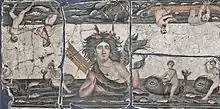 A 5th century Roman mosaic of Thalassa in the Hatay Archaeological Museum | |
| Other names | Thalatta |
| Abode | Sea |
| Personal information | |
| Parents | Aether and Hemera |
| Siblings | Gaia, Uranus |
| Consort | Pontus |
| Offspring | Storm giants and fish; Halia, Aphrodite |
Mythology
Gaius Julius Hyginus described her in the preface to his Fabulae as daughter of Aether and Hemera (Fab. Praef., 2). With her male counterpart Pontus, she spawned the storm gods and the tribes of fish. Fables were devoted to her by Aesop and she was to be depicted in both artistic and literary works during the Common Era. Thallasa's name may be of Pre-Greek origin.[1]
Some rare sources also attribute to her the sea-nymph Halia[2] and the goddess Aphrodite after the severed member of Ouranos was cast into the sea.[3]
Family tree
| Gaia | |||||||||||||||||||||||||||||||||||||||||||||||||||||||||||||||
| Pontus | Thalassa | ||||||||||||||||||||||||||||||||||||||||||||||||||||||||||||||
| Nereus | Thaumas | Phorcys | Ceto | Eurybia | The Telchines | Halia | Aphrodite[4] | ||||||||||||||||||||||||||||||||||||||||||||||||||||||||
| Echidna | The Gorgons[5] | Graeae | Ladon | The Hesperides | Scylla[6] | The Sirens | Thoosa[7] | ||||||||||||||||||||||||||||||||||||||||||||||||||||||||
Literature
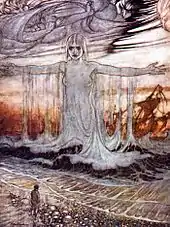
Two rather similar fables are recorded by Babrius. In one, numbered 168 in the Perry Index, a farmer witnesses a shipwreck and reproaches the sea for being “an enemy of mankind”. Assuming the form of a woman, she answers by blaming the winds for her turbulence. Otherwise, “I am gentler than that dry land of yours.”[8] In the other, a survivor from a shipwreck accuses the sea of treachery and receives the same excuse. But for the winds, “by nature I am as calm and safe as the land.”[9]
In yet another fable, Perry’s number 412 and only recorded by Syntipas, the rivers complain to the sea that their sweet water is turned undrinkably salty by contact with her. The sea replies that if they know as much, they should avoid such contact. The commentary suggests that the tale may be applied to people who criticize someone inappropriately even though they may actually be helping them.[10]
In the 2nd century CE, Lucian represented Thalassa in a comic dialogue with Xanthus, the god of the River Scamander, who had been attacked by a rival Greek deity for complaining that his course was being choked with dead bodies during the Trojan War. In this case he had been badly scorched and asks her to soothe his wounds.[11]
Art
While the sea-divinities Tethys and Oceanus were formerly represented in Roman-era mosaics, they were replaced at a later period by the figure of Thalassa, especially in Western Asia. There she was depicted as a woman clothed in bands of seaweed and half submerged in the sea, with the crab-claw horns that were formerly an attribute of Oceanus now transferred to her head. In one hand she holds a ship's oar, and in the other a dolphin.[12]
In 2011, Swoon created a site-specific installation depicting the goddess in the atrium of the New Orleans Museum of Art.[13] In fall 2016, the installation was erected once more in the atrium of the Detroit Institute of Arts.
References
- Beekes, R. S. P. (2009). Etymological Dictionary of Greek. Brill. p. 530.
- Diodorus Siculus, Historic Library 5.55.4
- Orphic Hymns 22, where she's equated with Tethys; Nonnus, Dionysiaca 12.43
- There are two major conflicting stories for Aphrodite's origins: Hesiod (Theogony) claims that she was "born" from the foam of the sea after Cronus castrated Uranus, thus making her Uranus' daughter; but Homer (Iliad, book V) has Aphrodite as daughter of Zeus and Dione. According to Plato (Symposium 180e), the two were entirely separate entities: Aphrodite Ourania and Aphrodite Pandemos.
- Most sources describe Medusa as the daughter of Phorcys and Ceto, though the author Hyginus (Fabulae Preface) makes Medusa the daughter of Gorgon and Ceto.
- Various Greek myths account for Scylla's origins and fate. According to some such as Eustathius, she was one of the children of Phorcys and Ceto. Other sources, including Stesichorus, cite her parents as Triton and Lamia. Hyginus says Scylla was the daughter of the river god Crataeis.
- Homer, Odyssey, 1.70–73, names Thoosa as a daughter of Phorcys, without specifying a mother.
- Babrius II.22
- Babrius I.71
- Aesopica
- ”Confabulations of the Marine Deities XI”, Lucian of Samosata Vol.1, London 1820, pp.355–6
- Şehnaz Eraslan, “Tethys and Thalassa in mosaic art”, Art Sanat 4 (2015)]
- "Swoon: THALASSA (The Great Hall Project)". Retrieved 2013-04-16.
Bibliography
- Babrius, Phaedrus, Fables. Translated by Ben Edwin Perry. Loeb Classical Library 436. Cambridge, MA: Harvard University Press, 1965.
- Diodorus Siculus, Bibliotheca Historica. Vol 1–2. Immanel Bekker. Ludwig Dindorf. Friedrich Vogel. in aedibus B. G. Teubneri. Leipzig. 1888–1890. Greek text available at the Perseus Digital Library.
- Hyginus, Gaius Julius, The Myths of Hyginus. Edited and translated by Mary A. Grant, Lawrence: University of Kansas Press, 1960.
- Nonnus, Dionysiaca; translated by Rouse, W H D, I Books I–XV. Loeb Classical Library No. 344, Cambridge, Massachusetts, Harvard University Press; London, William Heinemann Ltd. 1940. Internet Archive
External links
 Media related to Thalassa (mythology) at Wikimedia Commons
- THALASSA from The Theoi Project