Thalia (Muse)
In Greek mythology, Thalia (/θəˈlaɪə/[1][2] or /ˈθeɪliə/;[3] Ancient Greek: Θάλεια; "the joyous, the flourishing", from Ancient Greek: θάλλειν, thállein; "to flourish, to be verdant"), also spelled Thaleia, was one of the Muses, the goddess who presided over comedy and idyllic poetry. In this context her name means "flourishing", because the praises in her songs flourish through time.
| Thalia | |
|---|---|
Goddess of Comedy | |
| Member of the Muses | |
_01.jpg.webp) | |
| Abode | Mount Olympus |
| Symbols | Comic mask |
| Personal information | |
| Parents | Zeus and Mnemosyne |
| Siblings | Euterpe, Polyhymnia, Urania, Clio, Erato, Calliope, Terpsichore, Melpomene, Aeacus, Angelos, Aphrodite, Apollo, Ares, Artemis, Athena, Dionysus, Eileithyia, Enyo, Eris, Ersa, Hebe, Helen, Hephaestus, Heracles, Hermes, Minos, Pandia, Persephone, Perseus, Rhadamanthus, the Graces, the Horae, the Litae, the Moirai |
| Consort | Apollo |
| Children | the Corybantes |
Appearance
Thalia was portrayed as a young woman with a joyous air, crowned with ivy, wearing boots and holding a comic mask in her hand. Many of her statues also hold a bugle and a trumpet (both used to support the actors' voices in ancient comedy), or occasionally a shepherd's staff or a wreath of ivy.
Family
Thalia was the daughter of Zeus and Mnemosyne, the eighth-born of the nine Muses. According to pseudo-Apollodorus, she and Apollo were the parents of the Corybantes.[4] Other ancient sources, however, gave the Corybantes different parents.[5]
Gallery
 1760
1760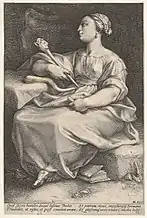 Engraving by Hendrick Goltzius (1558–1617)
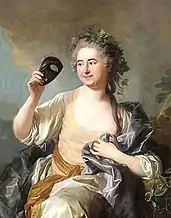 Portrait of Françoise-Marie-Jeanne Picquefeu de Longpré, as Thalia, Muse of Comedy Louis-Michel van Loo, 1765–1766
 (1739)
Notes
- "Thalia". Oxford English Dictionary (Online ed.). Oxford University Press. (Subscription or participating institution membership required.)
- https://www.merriam-webster.com/dictionary/Thalia
- http://www.oed.com/view/Entry/200089
- Apollodorus, Bibliotheca, 1.3.4.
- Sir James Frazer's note on the passage in the Bibliotheca.
References
- Grimal, Pierre, The Dictionary of Classical Mythology, Wiley-Blackwell, 1996, ISBN 978-0-631-20102-1. "Thalia" 1. p. 442.
- Smith, William; Dictionary of Greek and Roman Biography and Mythology, London (1873). "Thaleia" 1.
External links
 Media related to Thalia at Wikimedia Commons
- Warburg Institute Iconographic Database (ca 40 images of Thalia)
Authority control  | |
|---|---|
| General | |
| National libraries | |
| Other | |