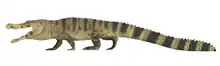
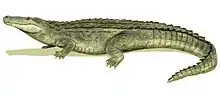
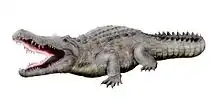
Crocodylus checchiai
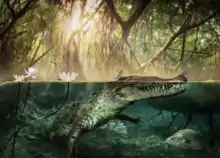
Crocodylus checchiai is an extinct species of crocodile from the Pliocene of Libya and the Miocene of Kenya. C. checchiai was named in 1957 from the Sahabi Formation. It is similar in appearance to the Nile crocodile C. niloticus and may even be the same species. Remains from the lower Nawata Formation in the Turkana Basin of Kenya that were first attributed to the Nile crocodile have now been reassigned to C. checchiai, extending its geographic and temporal range.[1]
| Crocodylus checchiai | |
|---|---|
 | |
Scientific classification  | |
| Kingdom: | Animalia |
| Phylum: | Chordata |
| Class: | Reptilia |
| Order: | Crocodilia |
| Family: | Crocodylidae |
| Genus: | Crocodylus |
| Species: | C. checchiai |
| Binomial name | |
| Crocodylus checchiai Maccagno, 1957 | |
A 2018 tip dating study by Lee & Yates simultaneously using morphological, molecular (DNA sequencing), and stratigraphic (fossil age),[2] along with genetic information collected from extinct Voay [3] produced the tree shown below:
| Crocodylidae |
| ||||||||||||||||||||||||||||||||||||||||||||||||||||||||||||||||||||||||||||||||||||||||||||||||||||||||||||||||||||||||||||||||||||||||||||||||
| (crown group) |


References
- Brochu, C. A.; Storrs, G. W. (2012). "A giant crocodile from the Plio-Pleistocene of Kenya, the phylogenetic relationships of Neogene African crocodylines, and the antiquity of Crocodylus in Africa". Journal of Vertebrate Paleontology. 32 (3): 587. doi:10.1080/02724634.2012.652324.
- Michael S. Y. Lee; Adam M. Yates (27 June 2018). "Tip-dating and homoplasy: reconciling the shallow molecular divergences of modern gharials with their long fossil". Proceedings of the Royal Society B. 285 (1881). doi:10.1098/rspb.2018.1071.
- Hekkala, E.; Gatesy, J.; Narechania, A.; Meredith, R.; Russello, M.; Aardema, M. L.; Jensen, E.; Montanari, S.; Brochu, C.; Norell, M.; Amato, G. (2021-04-27). "Paleogenomics illuminates the evolutionary history of the extinct Holocene "horned" crocodile of Madagascar, Voay robustus". Communications Biology. 4 (1): 1–11. doi:10.1038/s42003-021-02017-0. ISSN 2399-3642.
Extinct crocodilians | |||||||||||||||||||||||||||||||||||||||||
|---|---|---|---|---|---|---|---|---|---|---|---|---|---|---|---|---|---|---|---|---|---|---|---|---|---|---|---|---|---|---|---|---|---|---|---|---|---|---|---|---|---|
| |||||||||||||||||||||||||||||||||||||||||
| |||||||||||||||||||||||||||||||||||||||||
| |||||||||||||||||||||||||||||||||||||||||
| |||||||||||||||||||||||||||||||||||||||||
| |||||||||||||||||||||||||||||||||||||||||