Necrosuchus
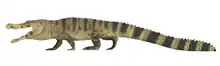
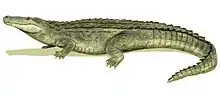
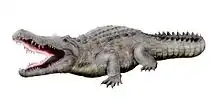
Necrosuchus is an extinct genus of caiman from modern day Argentina that lived during the Paleocene epoch (Selandian age, about 60 million years ago).[3][4]
| Necrosuchus | |
|---|---|
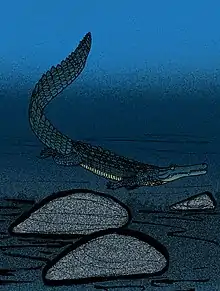 | |
| Artist's restoration | |
Scientific classification  | |
| Kingdom: | Animalia |
| Phylum: | Chordata |
| Class: | Reptilia |
| Order: | Crocodilia |
| Family: | Alligatoridae |
| Subfamily: | Caimaninae |
| Genus: | †Necrosuchus Simpson, 1937[2] |
| Type species | |
| †Necrosuchus ionensis Simpson, 1937 | |
Description
Necrosuchus had a long jaw, with slender teeth. The first two sets of teeth was large, the third is smaller, the fourth very large, the fifth through 10th small, the 11th through 13th increasing in size, with the 13th being nearly as large as the fourth, the remaining 14th through 18th teeth decrease in size.[2]
Distribution
Fossils of N. ionensis have been found in the Salamanca Formation near Malaspina, Chubut, in Argentina.[2]
Etymology
G. Simpson explains the meaning of the generic name as being a compound word of "necros" meaning "dead," and "suchus" meaning crocodile, in reference to during its collection, "a well-meaning lady asked if it were dead."[2]
References
- Rio, Jonathan P.; Mannion, Philip D. (6 September 2021). "Phylogenetic analysis of a new morphological dataset elucidates the evolutionary history of Crocodylia and resolves the long-standing gharial problem". PeerJ. 9: e12094. doi:10.7717/peerj.12094. PMC 8428266. PMID 34567843.
- Simpson, George Gaylord (1937). "An ancient eusuchian crocodile from Patagonia" (PDF). American Museum Novitates (965): 1–20.
- "†Necrosuchus Simpson 1937". Paleobiology Database. Fossilworks. Retrieved 5 April 2021.
- Brochu, C.A. (2011). "Phylogenetic relationships of Necrosuchus ionensis Simpson, 1937 and the early history of caimanines". Zoological Journal of the Linnean Society. 163: S228–S256. doi:10.1111/j.1096-3642.2011.00716.x.
Extinct crocodilians | |||||||||||||||||||||||||||||||||||||||||
|---|---|---|---|---|---|---|---|---|---|---|---|---|---|---|---|---|---|---|---|---|---|---|---|---|---|---|---|---|---|---|---|---|---|---|---|---|---|---|---|---|---|
| |||||||||||||||||||||||||||||||||||||||||
| |||||||||||||||||||||||||||||||||||||||||
| |||||||||||||||||||||||||||||||||||||||||
| |||||||||||||||||||||||||||||||||||||||||
| |||||||||||||||||||||||||||||||||||||||||