Christianization of the Roman Empire
Christianization of the Roman Empire occurred during the first five centuries of the common era, overlapping in both time and space with the decline of Greco-Roman polytheism (commonly called paganism). Whether or not these two major cultural revolutions contributed to one another, and if so "how", are among the many questions these events have raised. The problem of identifying what exactly Christianization involved is not simply a matter of charting the impact of Christianity on society. The Roman Empire had a robust city–based religious system that both pre-existed Christianity and remained active for centuries alongside Christianity. Yet Christianity began, amidst opposition, with less than 1000 people in about 35 CE, grew at an average rate of approximately 3.4 percent per year, compounded, becoming the religion of about half the empire by 350 CE, encompassing the majority of the empire's population in the fifth century.
.jpg.webp)
Support for paganism had begun to slowly decline in the two centuries before the appearance of Christianity, yet it continued into the sixth and seventh centuries when the western Roman empire came to its final end. Decline was most likely due to a combination of external factors, such as war and invasions, and internal factors, such as traditional polytheism's formal nature and frequent political manipulation. The open nature of Roman polytheism and the importing of foreign cults may have also contributed to its slow decline. Other possible reasons include the effects of nature through plague, earthquakes and other natural disasters, the rise of secularism, and the impact of Christianity.
While the growth of Christianity in its first three centuries "cannot be simply explained by the decline of paganism",[1] it is the fourth century that has attracted the most debate. Until the end of the twentieth century, the primary theory for what caused the dramatic cultural and religious change that constituted the Christianization of the Roman Empire revolved around Constantine the Great (r. 306 to 337). As the first Christian emperor, early historians thought Constantine imposed his religious views on the rest of the empire, and that Christianity owed its eventual "triumph" entirely to that imposition. This is referred to as the "top-down" model. Seeing the third century, instead of the fourth, as the critical century for Christian growth,[2] and Constantine as an influencer but not a determiner, has led Peter Brown and most modern scholars to move away from the top-down model and look elsewhere for a more complete explanation.[3]
For the Roman Empire, early Christianity was not only a new religion, it was a new kind of religion: a movement of highly appealing and powerful new ideas, similar to ideas that had previously been exclusively reserved for the philosophical schools.[4] [5] These new ideas were promoted at all levels of community, and they generated debate within the varied ranks of Roman society. That contributed to social change as it swept away the old distinction between the educated elite and the masses.[5] In this modern sociological model, it was "the coupling together of the gospel" with the social force of the church's practices, attitudes, and discourse, that formed "the fulcrum for the conversion of Rome".[6]
Background
Roman religion
| Religion in ancient Rome |
|---|
 |
| Practices and beliefs |
| Priesthoods |
| Deities |
Deified emperors: |
| Related topics |
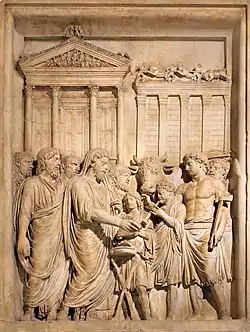
Roman religion at the beginning of the Roman Empire (27 BCE - 476 CE) was polytheistic and local. Each city worshipped its own set of gods and goddesses that had originally been derived from ancient Greece and become Romanized.[7] This polis-religion was embedded in, and inseparable from, "the general structures of the ancient city; there was no religious identity separate from political or civic identity, and the essence of religion lay in ritual rather than belief".[7] Private religion and its public practices were under the control of public officials, primarily, the Roman Senate.[8] Religion was central to being Roman, its practices widespread and intertwined with politics.[9][10] Members of a polytheistic group were expected to demonstrate 'piety' by observing acknowledged and inherited protocols identified as ancestral custom. According to Fredrikson: "One did not 'believe' or 'believe in' these customs; one 'respected' them, meaning that one kept them and (perhaps just as important) was seen to keep them".[11]
Support for this form of traditional Roman polytheism had begun to decline by the first century BCE, when it was seen, according to various writers and historians of the time, as having become empty and ineffectual.[12] A combination of external factors such as war and invasions, and internal factors such as the formal nature and political manipulation of traditional religion, is said by modern historians to have created the slow decline of polytheism.[13] This left a vacuum in the personal lives of people that they filled with other forms of worship.[14][15]
These other forms included the imperial cult which had formally begun with Augustus and saw the Roman emperor as the mediator between the state and the divine.[16][17][18] Various Greco-Roman mysteries such as the Dionysian Mysteries, the Eleusinian Mysteries and the cult of Cybele were imported Hellene religions, while the worship of Mithras first made its way to Rome from Persia in the late first century CE.[19] The worship of Isis had been in Roman culture since the Republican era, while Christianity arrived in Rome sometime in the first half of the first century represented by a small minority group of Jews.[15]
Politically, the empire needed and required religious unity, but culturally, religious identity became increasingly separated from civic and political identity, progressively giving way to the plurality of religious options rooted in other identities, needs and interests.[20] In the later Roman Empire, the early civic model of religion became "increasingly out of place".[21]
The Roman approach to empire building included a cultural permeability that allowed foreigners to become a part of it, and Roman religion frequently adopted foreign gods into its pantheon along with the people; but not all gods were welcomed.[22] Some foreign gods and practices were rejected and opposed as a threat to Roman identity.[22][23] The pattern for the Roman state's response to whatever was seen as a religious threat was established in 186 BC when the Roman state dissolved Bacchic associations, arrested and executed their leaders, forbid women to hold important positions in the cult, and determined that no Roman citizen could be a priest.[24] In the first century CE, there were "periodic expulsions of astrologers, philosophers and even teachers of rhetoric ... as well as Jews and ...the cult of Isis".[25] Druids received the same treatment, as did Christians, occasionally and sporadically, for their first 300 years.[26][25]
Christianity
| Part of a series on |
| Christianity |
|---|
 |
 Christianity portal Christianity portal |
Christianity began in Roman Palestine (Judaea) with perhaps a thousand people in the 40s AD, growing rapidly at what sociologists Rodney Stark and Keith Hopkins describe as an "exponential rate".[27] Christianity and traditional Roman polytheism soon clashed. From the 2nd century onward, the Church Fathers condemned the diverse non-Christian religions practiced throughout the empire as "pagan" advocating a separateness from Roman practices and attitudes.[note 1] Fredrickson explains that "From roughly the end of the lst century until 250 CE, these Gentile Christians could be the object of local resentments and anxieties precisely because they were not honoring the gods upon whom their city's prosperity depended".[29]
The third century saw the empire's greatest persecution of Christians while also being the critical century of church growth.[30][31][32] Among contemporary historians of the Roman world there is a general consensus that, by the time Christianity was legalized in 315, approximately ten percent of the population of the empire, (somewhere between five – seven million people), had already become Christian. According to Seth Schwartz, this shows that "Christianity's success predated what many scholars refer to as the formal Christianization of the empire in the fourth and fifth centuries".[33]
Growth rate
Stark suggests an exponential growth rate for Christianity from its beginnings continuing at the same rate after the reign of Constantine the Great (reigned 306 –337).[27][34] Keith Hopkins uses what he calls "parametric probability" to estimate Christian population and its growth, reaching the same percentage rate Stark uses (3.4% compounded), adding that rapid growth in absolute numbers occurred only in the third and fourth centuries.[35][36]
If this average growth rate continued after Constantine the Great, the percentage of Christians in the empire would have risen to about half of the population of the ancient Mediterranean world by the year 350.[27] Five to seven million in the year 300, at 3.4%, compounded annually, reaches thirty million in less than half a century.[32] Robert Couzin,[note 2] who has studied numbers of Christian sarcophagi in Rome, explains that "more sophisticated mathematical models (for the shape of the expansion curve) could affect certain assumptions, but not the general tendency of the numerical hypotheses".[37]
Roger S. Bagnall found that, by isolating Christian names of sons and their fathers, he could trace the growth of Christianity in Roman Egypt.[38][39] While Bagnall cautions against extrapolating from his work to the rest of the Roman Empire, Stark writes that a comparison of the critical years 239–315 shows a correlation of 0.86 between Stark's own projections for the overall empire and Bagnall's research on Egypt.[40][38]
Possible causes of pagan decline
Context
J. A. North, Roman historian, explains that Roman imperial culture began in the first century with religion "embedded in the city-state", and throughout the imperial period, gradually shifted to "religion as a choice" with different groups offering different characteristics, experiences, insights, and stories.[41][42]
Roman authorities had unknowingly created the context in which this shift occurred.[21] This change is tied to Roman religion's willingness to adopt foreign gods and practices into its pantheon, which was probably its defining trait and greatest strength.[43] Traders and other travelers brought to the empire religions that had originated in Egypt, Greece, Iberia, India and Persia. Some were religions with initiation ceremonies of intense personal significance, similar to Christianity.[44] The military settlement of various 'barbarians' within the empire, and at its borders, conscripting them, and granting them citizenship, brought their cults into the Roman military, which then carried and spread them, building altars wherever they went.[45] By extending Roman citizenship in this way, the Roman Empire created divergence between the diversity in Roman culture and the empire's political need for strength in unity.[44]
For many years it has been axiomatic that the Roman elite ceased to have any real belief in the traditional forms of Roman polytheism, and as a result consigned it to neglect and decline.[46][note 3] From a sociological perspective, the fate of any new religious movement depends entirely upon its environment providing the opportunity for it to develop.[47] Sociologist Rodney Stark asserts that it was that weakness of support for paganism that created the opportunity for Christianity to become the state religion.[47] According to Stark, "The idea that paganism's weakness was caused by Christian political power [under Constantine] fails to explain how Christianity managed to be so successful that it could become the state church [in the first place]. That Christianity was able to wedge out a significant place for itself directs attention to signs of weakness in paganism".[48] Bagnall asserts that the church did not replace paganism as much as it gradually filled the gaps left by the declining observance of the pagan cults.[49]
Nature
Prolonged intensive warfare unavoidably results in the migration of local populations. As the Roman Empire expanded its boundaries through conquest, it also forced migration, depopulation and repopulation for military purposes.[50] This expanding empire was built on the fringes of the tropics, and its brilliant Roman roads, which produced an abundance of trade, also unknowingly created an interconnected disease ecology that unleashed pathogenic evolution. The empire was soon engulfed.[51] Pandemic contributed to even more massive demographic changes, which in turn, quickly led to economic crises as evidenced in the real price levels of agricultural products, land and the debasement of silver coin.[52][53] Mischa Meier writes that the "short-term demographic and economic consequences of the epidemic must have been catastrophic" throughout the empire, but its effects were especially felt in its impact on religion in the East. The plague and its demographic changes reinforced the cultural and religious processes that were changing the eastern Roman Empire into the Christian Byzantine empire.[54]
Failure of polytheistic revival
For over 60 years there has been a thesis of the demise of paganism that includes a short attempt at revival at the end of the fourth century. The failure of Quintus Aurelius Symmachus' requests to Gratian and Valentinian II for the restoration of the Altar of Victory has been seen as the precursor that prompted this revival.[55] This thesis has revival spearheaded by the aristocracy of Rome, culminating in the "last pagan stand" in the Battle of the Frigidus (394), where paganism was, finally, violently defeated by the orthodox Christian emperor Theodosius I.[55]
Alan Cameron explains it: "In 391 Theodosius I (it is claimed) decided that the time had come to go beyond these half measures [of previous emperors] and eliminate paganism. So he issued a comprehensive ban ...which was rigorously enforced. This was the last straw for pagan aristocrats who rallied behind the western usurper Eugenius ... In return for their support, Eugenius (supposedly) restored both altar and subsidies, leading to a fully fledged revival of paganism in Rome, directed by his praetorian prefect Nicomachus Flavianus. [According to Cameron] Very little of this story survives serious scrutiny".[56]
For example, Flavianus' role has, in the past, been supported by an anonymous poem dated to 394 that was discovered in 1868. Cameron writes that "New evidence and new arguments prove beyond a shadow of a doubt that the prefect [mentioned in the poem] is Praetextatus, in which case the poem belongs in 384 rather than 394 ... At one stroke, we lose not only virtually all the evidence there ever was for a pagan revival in the 390s but also for the belief that Flavianus was its ringleader and inspiration".[57] James J. O'Donnell describes the evidence for a 'revival of paganism' as "a scholar's fantasy and nothing more".[58]
There is no evidence that anyone saw the battle of the Frigidus as a religious contest at the time it happened.[57] Historian Michele Renee Salzman explains that "two newly relevant texts — John Chrysostom's Homily 6, adversus Catharos (PG 63: 491–92) and the Consultationes Zacchei et Apollonii – have been re-dated to the 390s, and both reinforce the view that religion was not the key ideological element in the events at the time".[59] According to Maijastina Kahlos[note 4] the notion that pagan aristocrats, united in a "heroic and cultured resistance", rose up against the ruthless advance of Christianity in a final battle near the river Frigidus (modern Vipava) in 394, is a romantic myth.[60]
Emperors and aristocrats
Scholars tend to see the conversion of the proud, pagan senatorial aristocracy to the new religion of "the poor and powerless" as either an early fourth century phenomenon that happened fast, from the "top–down", because Constantine the Great and his enthusiastic and powerful successors pressured and coerced them, (out of ambition, greed or indifference);[61] or they see it as taking place more slowly,[62] happening at the end of the fourth century and beginning of the fifth, as a result of ordinary horizontal social influences.[63][61]
Michelle Salzman asserts that the top–down model underestimates the strength and independence of the senate while it also over-estimates the influence of the emperors which was "more limited and more diffuse than many have argued".[64] The senatorial aristocracy of 284 – 423 was composed of "at least 36,000 men and women" who shared a culture based on status, wealth, power, and prestige, wielding significant influence with tremendous resources.[65] Salzman asserts that no emperor had the ability to force religious change on this group "even if they wanted to". In fact, Salzman argues that it was the other way around: "emperors and churchmen alike" had to appeal to the Roman Senate on its own terms.[66][67]
Emperors were influential, but their influence had practical limitations.[68] They could not get too far away from the views of the class they were attempting to influence in order to maintain their legitimacy. This limited what steps could be taken to promote religious change. No emperor of the fourth century legalized force to convert pagans or promoted only Christians to either high or low offices.[69] Randall S. Howarth writes: "There is certainly no evidence of forcing an overall top-down conversion until the sixth century" after Christianity had already become the view of the majority.[70]
Historians have theorized that emperors coerced aristocratic conversion through appointments to public office, but Salzman argues that the sources indicate Christians were not the predominant office-holders from Constantine's time onward, and even the most assertively Christian emperors continued to appoint pagans to positions of high office.[71] Another theory suggests aristocrats were pressured by the laws Christian emperors made, but most anti-pagan laws were reflective – made after behaviors had changed – rather than proactive.[72]
Salzman concludes aristocrats were not converted through coercion. However, by making laws that increased the church's status, and by absorbing aristocratic values and attitudes into Christianity, emperors who modeled Christianity's moral appeal with aristocratic honor made it attractive to the aristocratic class.[73][74] This attractiveness was passed along through aristocratic kinship and friendship networks and patronage ties.[75] The sociological view of conversion is that "conversion tends to proceed along social networks formed by personal attachments".[76] This is not top-to-bottom so much as it is horizontal.[77]
David Novak concludes, as does Salzman, that this process of 'attractive appeal' began with Constantine's tremendous popularity and support, which existed even amongst the pagan aristocrats, and is what prompted individual aristocrats to become informed about their emperor's religion.[78] A very few became Christian right away, but Salzman documents the shift to the predominance of Christians in the aristocracy as not really beginning until the 360s under Gratian.[79][80]
Imperial cult
For many years, the worship of human rulers as though they were gods was regarded by the majority of scholars as both a symptom and a cause of the final decline of traditional Greco-Roman religion. It was assumed this kind of worship could only be possible in a system that had become completely devoid of real religious meaning.[18] It was generally treated as a "political phenomenon cloaked in religious dress". Scholarship of the twenty-first century has shifted toward seeing it more as a religious phenomenon than a political one.[18]
S. R. F. Price draws on anthropological models to show the imperial cult's rituals and iconography are elements of a cognitive system that the worshippers developed as a way of meeting their own need for coming to terms with the power of Rome.[81] According to Rives, "Most recent scholars have accepted Price's approach, and extended it further".[82] The emperor was "conceived in terms of honors ... as the representation of power" personifying the intermediary between the human and the divine.[17][18]
Christian legislation and violence
In his influential and controversial 1984 book, Christianizing the Roman Empire: (A.D. 100-400),[note 5] and again in 1997, MacMullen argues the conflict model of Christianization that asserts it was rampant anti–pagan violence, coercion and armed force from Constantine[88] and his successors that was used to persecute pagans, thereby causing the decline of paganism and the conversion of the Roman Empire in the fourth century.[89] In 2006, H. A. Drake wrote that "a new generation of scholars, working in the emerging field of Late Antiquity, has called into question this standard narrative ... Was it a more violent time than, say, Rome in the Late Republic, or, for that matter, the United States in the 1960's?".[90] Martin Zimmerman makes these comparisons concluding that "well into Late Antiquity there was no increase in the level of violence, and in some ways [there was] an actual decrease".[91] The conflict model of fourth century Christianization has been modified at the very least and has often been completely overturned.[92]
Legislation
Salzman writes that MacMullen bases the majority of his argument on anti-pagan laws in the Theodosian legal code.[93] One of many problems with using the Theodosian Code (which first began being compiled in 429 and was published in 438) as a record of history is that it is difficult to date any of those laws to the time of Constantine 100 years earlier with any confidence.[94][95]
Archaeologists Luke Lavan and Michael Mulryan explain that the Code can be seen to document "Christian ambition" of the fifth century but not the historic reality of the fourth.[96][97] The overtly violent fourth century that one would expect to find from taking the Code at face value is not supported by archaeological evidence from around the Mediterranean Basin.[98][99][100]
Legal anthropologist Caroline Humfress has concluded that, while Roman imperial law, such as the Code, was not irrelevant, it was not the determinant (needed to support MacMullen's model) either.[101] According to Humfress, the whole idea of "an empire-wide 'legal system' being imposed from above" does not accurately reflect the social and legal realities of the Roman Empire.[102] Until the reign of Justinian I (527 – 565) in the sixth century, at the earliest, Humfress asserts there was no single compilation of Roman law capable of being used in this manner.[103] Local politics and culture had produced divergent attitudes and different laws, and as a result, even those laws published as the Theodosian code presented a series of conflicting opinions and not a unified set of commands: for example, some laws in the Code called for the complete destruction of the temples and others for their preservation.[104][note 6] Consequently, the violent penalties prescribed by imperial law against some pagan practices went unenforced.[113][114] For example, there is no record of anyone being executed for violating laws against illegal sacrifices before Tiberius II Constantine (r. 574–582) – some 250 years after Constantine the Great.[115]
Salzman asserts that the laws gathered together as the Theodosian Code could not, therefore, have been the fourth century watershed MacMullen suggests.[93]
Laws on sacrifice

Long before the age of Constantine, imperial laws limited and prohibited some practices of magic. Constantine also restricted access to the temples for any practice involving sacrifice, and most scholars think this is when pagan sacrifice became a capital offence.[116] Peter Brown asserts that such threatened reprisals were not intended to convert pagans or suppress paganism in general. Their intent was to reorder society along religious lines.[117] Romans offered oxen, bull cattle, sheep, and pigs, as sacrifices, first salting them, then slitting their throat, placing them on the fire and eating the meat afterwards. This "blood sacrifice" was the element of pagan culture most abhorrent to Christians.[118][119] The laws were intended to stop this practice by creating terror of extreme consequences for its continuation: "Their language was uniformly vehement, and ... frequently horrifying".[120] If Christians could not stop the private practice of sacrifice, they could at least "hope to determine what would be normative and socially acceptable in public spaces". It apparently worked.[121]
Blood sacrifice was a central rite of virtually all religious groups in the pre-Christian Mediterranean, and its gradual disappearance is one of the most significant religious developments of late antiquity. ... Public sacrifices and communal feasting had declined as the result of a decline in the prestige of pagan priesthoods and a shift in patterns of [private donations] in civic life. That shift would have occurred on a lesser scale even without the conversion of Constantine ... It is easy, nonetheless, to imagine a situation in which sacrifice could decline without disappearing. Why not retain, for example, a single animal victim in order to preserve the integrity of the ancient rite? The fact that public sacrifices appear to have disappeared completely in many towns and cities must be attributed to the atmosphere created by imperial and episcopal hostility.[122]
Violence
Salzman argues that the historical sources, not the legal Code, are the best source of history.[123] The fourth and fifth centuries are richly documented "by Christian sources that have little compunction about recording the violence that broke out between Christians".[124] According to Salzman, this indicates that there was no aversion to recording episodes of violence, yet when looking for incidents of Christian-pagan violence, there are only a handful of cases, none of which include coerced conversion.[125] This is supported by archaeology.[96][note 7]
David Riggs writes that archaeological evidence from North Africa reveals a tolerance of religious pluralism and a vitality of traditional paganism much more than it shows any form of religious violence or coercion. Riggs adds that, "persuasion, such as the propagation of Christian apologetic, appears to have played a more critical role in the eventual "triumph of Christianity" than was previously assumed".[140] Force and compulsion were not seen as constructive, or even realistic options, as much as persuasion was.[141] In light of current evidence, Christian hostility toward pagans is seen by most modern scholars as far from the general phenomenon as might be presumed from a study of late Roman legislation alone.[104] The evidence indicates that both Christian clergy and Roman magistrates preferred the power of words and the use of positive incentives over violence.[142]
Salzman concludes that "focusing on violence in explaining the conversion of the western Roman Empire seriously misrepresents the nature of pagan-Christian conflict in the fourth and fifth centuries".[143] She adds that "scholars ...by and large, concur ..."[144]
The language of fourth and fifth century Law regarding religion runs parallel to the writings of the apologists, such as Augustine of Hippo and Theodoret of Cyrrhus, and heresiologists such as Epiphanius of Salamis in a rhetoric of conquest.[145] After Constantine, in both law and literature, language commonly became hostile and often contemptuous toward a paganism which Christians saw as defeated in heaven.[146][147] The language of the laws, and the rhetoric in the literature, have greatly influenced modern perceptions of this period. The effect has been to create the impression of continuous violent conflict between pagans and Christians on an empire-wide scale.[148] Instead, while rhetoric was often violent, actual physical violence was rare and isolated.[149][150][151][152]
In contrast to the rhetorical claims, non-Christian, non-heretical groups, such as Jews and pagans, enjoyed a tolerance based on contempt throughout the fourth century.[153]
Temples and monuments

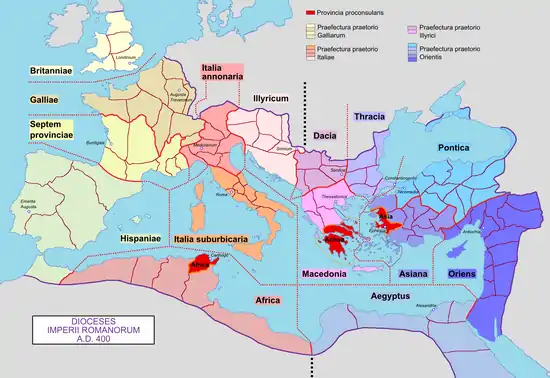
Many scholars of the past have asserted that rampant temple destruction took place at the end of the fourth century as part of the violence used to promote Christianity and destroy paganism. Most destruction is assigned to the reign (r. 379–395) of Theodosius I through the actions of Theodosius' praetorian prefect Cynegius.[104] [154] Cynegius ordered the destruction of temples, using the army under his control, and monks from the territory around Constantinople in the Diocese of the East.[155] Marcellus of Apamea destroyed the temple of Zeus in his town,[156] while Marnas destroyed the one at Gaza City.[157] Peter Brown has written that in 392, inspired by this mood, Theophilus of Alexandria staged a procession ridiculing statues of pagan gods. Rioting soon followed, and it is thought by some that this is when the Serapium in Alexandria, Egypt was destroyed. Some scholars have followed Gibbon in thinking this is also when the philosopher Hypatia was killed, though current research indicates her death happened in 415 instead.[158] These events have been seen by historians Garth Fowden and Ute Deichmann, and others, as the 'tip of the iceberg' demonstrating a tide of violent Christian iconoclasm said to have continued throughout the 390s and into the 400s.[159][104][160]

However, archaeological evidence for the violent destruction of temples in the fourth century, from around the entire Mediterranean Basin, is limited to a handful of sites.[161][162] The Serapium remains the only temple destroyed by violence in this period in all of Egypt.[163] Christianity was thriving there, and the Roman temples in Egypt "are among the best preserved in the ancient world".[164] Leone asserts that active destruction of temples by humans was rare and not often accomplished.[165] Archaeologists Lavan and Mulryan write that, "As a result of recent work, it can be stated with confidence, that temples were neither widely converted into churches nor widely demolished in Late Antiquity".[162][note 8] In Lavan's view, this means: "We must rule out most of the images of [Christian fanatical temple] destruction created by the [written sources]. Archaeology shows the vast majority of temples were not treated this way".[175]
Paganism didn't decline, it evolved
Modern scholars assert that Constantine's accession to the throne and his conversion to Christianity cannot be seen as a fixed beginning of any purported decline of paganism, because the fourth century was not an age of decline. Instead, it was an age of tremendous activity and change; an age where the empire reinvented itself; an age of religious ferment comparable to the Reformation of the fourteenth and fifteenth centuries.[176][177][178]
After Constantine, the borders between pagan and Christian began to blur. Robert Austin Markus explains that, in society before the fourth century, churchmen like Tertullian saw the social order as irredeemably 'pagan' and "hence to be shunned".[179] But the Edict of Milan (313) had redefined the imperial ideology as one of mutual religious tolerance. What counted as pagan had to be rethought.[180] [note 9]
In Markus' reading of events, this shift marked a 'colonization' by Christians of the pagan empire and pagan values.[181] There is a mass of material on the continuation of the circuses, amphitheatres and games on into the sixth century, but Alan Cameron explains this by saying art and culture of the late fourth century had removed its pagan elements (i.e. sacrifice) and become secularized.[182] Late Antiquity witnessed the "vigorous flowering of a public culture that Christians and non-Christians alike could share"; the two religious traditions co-existed and tolerated each other, in social practice, throughout most of the period.[183]
Brown describes this world as one in which "Polytheism itself evolved, often by adopting aspects of the new religion. The Euphemitai of Phoenicia emerged as a new cult in the mountains of Lebanon. Their gatherings, from which blood sacrifice was pointedly absent, were marked by hymn-singing and by blazing lights in buildings that could be mistaken for Christian basilicas".[153]
Brown adds that: "Throughout Antiquity, the religious landscape of the Mediterranean continued to be characterized by a patchwork of religious communities. Regions that boasted a triumphant, long-established Christianity were often flanked by equally tenacious settlements of polytheists".[153]
Possible causes of Christian growth
.jpg.webp)
Constantine
The fourth century empire "shared hardly anything with its first century counterpart".[184] Time alone accounts for some changes, but the relentless pressure of the barbarians to the north, combined with the Persians in the East, had required the evolution of new state mechanisms and social transformations under both Severus and Diocletian to meet these pressing needs. These changes "crystallized" during Constantine's reign.[185] Constantine completed most of Diocletian's reforms while innovating in other areas. He re-opened Senatorial positions and abandoned attempts to fix prices and stabilize silver.[186] He turned away from the Tetrachy, and once he had sole rule, he rejected some of the trends that had shaped the previous century while accentuating those that consolidated his power. According to Pat Southern, "This was not personal selfishness ... He was the embodiment of the State and it was his duty to ensure that it would continue after his death. He ... would not have understood the distaste of the modern world for the concept of autocracy".[186]
He was an autocrat, as were those emperors before and after him, but that did not equate to a demand that everyone become Christian and there was no sudden empire wide conversion to Christianity during his reign.[187] Generally speaking, the empire's inhabitants were unaffected by Constantine's religious change.[187]
Peter J. Leithart writes that Constantine was "a sincere if a somewhat simple believer."[188] He ended the persecution of Christians, restored confiscated property to the churches, and made multiple generous donations to the church. His actions included legislation that not only made Christian priests equal with pagan priests, but favored them. He personally participated in resolving religious disputes such as the schism with the Donatists, and the calling of councils including the Council of Nicaea concerning Arianism.[173]
Constantine's anti-pagan policies are debated because the sources do not agree,[189] and laws are difficult to date accurately,[94][95] but most think Constantine introduced legislation against public sacrifice.[190] Drake asserts that Constantine personally abhorred sacrifice, and he did remove the obligation to participate in them from the list of duties for imperial officials, but evidence of an actual sweeping ban on sacrifice is slight, while evidence of its continued practice is great.[191] There were a few laws created by Constantine against magic, sorcery, and haruspicina which explicitly state it is only "black" magic that is forbidden. Positive applications for health or crops were not only allowed but encouraged by Constantinian law.[192]
He destroyed a few temples, plundered more, used forceful rhetoric against non-Christians, but established only limited regulations against Roman polytheism with toleration.[188] Southern records that during Constantine's reign, "A church council decided that any Christian who was also a flamen of the Imperial cult was not necessarily compromised".[187] "He did not punish pagans for being pagans, or Jews for being Jews, and did not adopt a policy of forced conversion"; he was generally not in favor of suppression of paganism by force.[193][194][188] Pagans remained in important positions at his court.[188] Constantine never engaged in a purge.[195] There were no pagan martyrs during his reign.[196][197]
His main approach to religion was to use enticement by making the adoption of Christianity beneficial.[198] Having begun its growth 300 years before Constantine amidst opposition, the "Imperial patronage, legal rights to hold property, and financial assistance" that Constantine began in the fourth century were important contributions to the church's success over the next hundred years.[199]
Top-down model
_(14774939861).jpg.webp)
Gibbon saw Constantine as driven by "boundless ambition" and personal glory to impose Christianity on the rest of the empire through military threat in a cynical, political move.[200][201] Gibbon's was the first iteration of what is commonly referred to as the "top-down model" of Christianization of the empire; this model became the accepted view for over 200 years.[61] Historian Harold A. Drake writes: "It is difficult to overestimate the influence of Gibbon's interpretation on subsequent scholarship".[202][203][114]
Gibbon worked from printed literary sources that were mostly Christian. He included what other materials were available to him, but in the eighteenth century, the studies of numismatics, epigraphy, archaeology, the social sciences and art history were just beginning.[204] In the absence of such studies, the literary sources available to Gibbon tended to present the rise of Christianity in terms of a succession of Christian emperors from Constantine to Theodosius II (r. 408–450) playing out their "God-given role" of abolishing paganism and replacing it with Christianity.[205] Peter Brown writes that this does not reflect actual history; it is instead a narrative created by "a brilliant generation of Christian writers, polemicists and preachers" of the fourth century claiming the triumph of the church in Roman terms of conquest.[205][206]
Twentieth century developments in numismatics, epigraphy, archaeology, and art history, as well as whole new fields of scholarship such as sociology, legal anthropology and social anthropology, have led to "an abundance of evidence unavailable to Gibbon" inspiring modern scholars toward different conclusions.[207][204] For example, since 1981, T. D. Barnes argues that there have been many advances in both evidence and understanding of Constantine.[208] The fourth century historians Eusebius and Lactantius, who describe Constantine's conversion as sincere, were dismissed as "fiction" until the beginning of the twentieth century (1901) when Lactantius was authenticated beyond doubt, and 1961 when the dependability of Eusebius' Life of Constantine was also established.[209]
In the twenty-first century, the top–down model continues to be challenged.[89] In one example, E. A. Judge provides "a detailed, tabulated and fully up to date (2010) distillation of all that can be deduced about the spread and organization of church life up to AD 324".[210] This has effectively demonstrated that a well developed and organized church system must have existed before 325 when Constantine called the Council of Nicaea. William Vernon Harris writes that "there can be no doubt that the surviving papyrus evidence" points to the conclusion that "the argument Christianity owed its triumph to its adoption by Constantine cannot be sustained".[211]
Socio–economics
The impact of the Third century crisis on the development of Christianity is debated, but one thing scholars agree on is that the Crisis led to a more socially fluid society.[212] The empire required reordering after 300 CE, which led to the fourth century developing new forms of status and wealth.[213] "From Constantine onward, the Roman state flooded the economy with gold".[214] The emperor consolidated loyalty at the top through gold: he was spectacularly generous, and paid his army and his high officials in gold. The imperial bureaucracy soon began demanding that taxes also be paid in gold.[215] Greed became rampant as the ruling elite "drove a primitive system of taxation and markets to its limits" to acquire gold.[216]
Those who obtained gold, rose, while those who were left with silver and bronze and unsold crops, declined in power and prestige.[215] These "newly impoverished" were not truly poor, but were resentful enough that many scholars have concluded it was this group that was largely responsible for the crime and political unrest of the fourth century.[217] "The fourth century scramble for gold ensured that the rural population was driven" hard.[218] Eighty percent of the population provided the labor to harvest 60% of the empire's wealth, very little of which ever trickled down to them.[219] This too caused unrest.[218]
Constantine and his successors reached out to the provincial elite, making membership in the Senate available to them, enlarging the Senate's membership from about 600 to over 2,000.[220] This had a direct affect on the conversion of the aristocracy and the rise of Christianity as these new senators were more likely to accept the new religion.[221] The conversion of the aristocracy had its impact on the conversion of the population in Praet's view because, he asserts, the lower classes simply followed the example of the rich.[222] Old money and new money soon clashed and splintered the leadership of the cities.[223]
In the face of all this unrest and economic struggle, there was a "retreat from the secular" within the church, followed by an "extension of Christian religious values to aspects of society and culture that had hitherto been considered neutral".[224] In the fourth century, bishops became intercessors, taking advantage of the "advocacy revolution" to intervene in society by lobbying the powerful to practice Christian benevolence.[225] There were limits to a bishop's power and influence, but after 370, wealth and cultural prestige began moving toward the Catholics.[226]
New doctrine
Peter Brown has written that the emergence of ethical monotheism in a polytheistic world was the single most crucial change in a culture experiencing many great and tumultuous political, economic, demographic, environmental and other changes.[227] He adds that the content of Christianity was at the center of this age, contributing to both a "behavioral revolution" and a "cognitive revolution".[228] E. A. Judge also asserts that Christianity created two revolutions: a new way of thinking about world history and the place of humanity within it; and what it meant to live a moral life. Judge asserts this is what has shaped "the modern sense of religion as a philosophical commitment of thought and life".[229]
Kerygma (Proclamation of the Church's core teachings about Jesus)
One of the fundamental differences between pagan cults and Christianity was that paganism was an oral culture, while Christianity was, from early on, a religion of written texts. In the first communities, Christians began using a codex (which evolved into the modern book) instead of the traditional scrolls. Made of papyrus, not parchment, the codex was cheap, compact and easy to use. Early Christians were a "people on the move". They carried, copied, spread, and read their books by the hundreds and thousands.[230] The catacombs show Christians arriving at the Last Judgement carrying their books. When one African judge asked the Christians brought before him what they had brought with them to help them in court, they explained they had brought "the texts of Paul".[231]
.jpg.webp)
Keith Hopkins asserts that the centrality of correct dogma (doctrine), derived from these written texts, was a religious innovation of early Christianity and one of its defining characteristics.[232] What exactly this dogma was is harder to define. Early Christian doctrine was not homogenous. Second century church fathers wrote different versions of church doctrine than later fifth century theologians.[233]
Nevertheless, J.N.D. Kelly has asserted that, from the beginning of Christianity, there was a broad outline of doctrine that was seen as sacrosanct; the life and teachings of Jesus, his sacrificial death and physical resurrection were accepted by early believers as handed down from those Apostles who had known Jesus and been taught by him.[234] The Old Testament was also immeasurably important[235] because the gospels and the Apostolic Fathers refer to the Old Testament prophets. This venerable past combined with what was known as "the teaching derived from Christ's Apostles" provided the central doctrine, or kerygma of the early church.[236]
According to historian Wayne Meeks, its broad theme is delineated in the writings of Paul:
One of the things that runs through the Pauline letters, is his conviction that what he calls the Word of the Cross, or the reasoning of the Cross, ought to pervade the whole lives of the congregations which he has founded. So, that ... the way in which one exercises leadership or authority in the congregation... must somehow tally with the notion that the power of God is manifested in this reversal of things, in which the powerful one comes to be crucified in the most shameful form, that the one who is equal with God, gives that up to take on the form of a slave. This becomes the model of what love is. ... love is in some sense being re-defined as this other-regarding sacrificial act, [choosing] to put oneself on the line for the sake of the good of the other, and this is grounded in the claim about the way the ultimate power and structure of the universe manifests itself in human society. I think this must have had a very powerful, emotional appeal to people.[237]
Some scholars have asserted the view that this doctrine was not new but was simply a revision of pagan gods dying and being reborn. Praet says the Olympic gods could take on human appearance, but appearance is as far as most pagans would allow. Even the divinity of the emperor, who was seen as a mediator between the divine and human,[17][18] was not the orthodox Christian version of an actual incarnated god-man which was scandalous to Greco-Roman thinking.[238] Death and rebirth in the mythology of the Roman gods was allegory about nature and its seasons. There was no assurance of any redeeming value in their god's round trip to the underworld for their followers. Praet writes concerning these Roman allegories: "These gods did not die with the purpose of giving life to humanity".[239]
Ancient paganism had a variety of views of an afterlife from a belief in Hades to a denial of eternal life completely.[240] While the Christian teaching of bodily resurrection was new, (and not readily accepted), Praet asserts that most Christian views of an afterlife were not new. What they had was the novelty of exclusivity: right belief became as significant a determiner of the future as right behavior.[241] Ancient Christians backed this up with prophecies from ages old documents and living witnesses, giving Christianity its claim to a historical base which was new and different from previous pagan stories.[239] Anti-Christian polemics of the era never questioned that Christianity had a founder explicitly situated in recent human history. "His birth, teachings, death and resurrection took place in the reigns of the emperors Augustus and Tiberius, and until the end of the first century, the ancient church could produce living witnesses who claimed to have seen or spoken to the Savior".[239] Many modern scholars have seen this as one of the major reasons for Christianity's success.[239]
Afterlife punishments and rewards can be found in other religions preceding Christianity. One scholar has concluded "Hell is a Greek invention".[242] Praet asserts that much of the Roman population no longer believed in Greco–Roman afterlife punishments, so there is no reason to expect they would take the Christian version more seriously.[242] While it may not have been a major cause of conversion, writings from the Christian Justin, the pagan Celsus, Tatian, and the Passio of Ptolemaeus and Lucius are just some of the sources that confirm Christians did use the doctrine of eternal punishment, and that it did persuade some non-believers to convert.[243]
Inclusivity and exclusivity
Koester asserts that "the Christian community in the letters of Paul, begins with a baptismal formula, which says in Christ there is neither Jew nor Greek, neither male nor female, neither slave nor free. This is a sociological formula that defines a new community ... [giving] even the lowliest slave personal dignity and status".[244][245] Keith Hopkins points out that real communities of real people would have diverged from the Christian ideal even though the ideal would have influenced practices.[246] Wayne Meeks asserts that evidence from Pliny the Younger and others demonstrates that early Christian communities were, in fact, highly inclusive in terms of social stratification and other social categories, much more so than were the Roman voluntary associations.[247] From the beginning, the Pauline communities cut across the social ranks. This deliberate breaking of rank was imposed by Paul the Apostle. His understanding of the meaning of the Crucifixion of Jesus and the paradox of Christ created a new order, unprecedented in classical society.[248]
A key characteristic of these communities was the use of belief to construct identity and social boundaries.[249] Believing was the crucial and defining characteristic that set a "high boundary" that strongly excluded the "unbeliever". Trebilco asserts that these high boundaries were set without social distancing or vilification of the outsiders themselves, since context reveals "a clear openness to these 'outsiders' and a strong 'other regard' for them".[250] Strong boundaries for insiders, and openness to outsiders, are both held in very real tension in New Testament and early patristic writings.[251]
The term for sinner (Ancient Greek: αμαρτωλοί), meaning the immoral, is another NT term for those 'on the outside'. Its use was undermined by Jesus, who showed that any 'outsider' could become an 'insider'. Jesus did not classify everyone as sinners, but he did call for those who considered themselves insiders to repent. Paul extended the term's application to everyone, arguing that even 'sinners' can become insiders.[252]
The exclusivity of Christian monotheism formed an important part of its success enabling it to maintain its independence in a society that syncretized religion.[253] E. R. Dodds has suggested that the Crisis of the Third Century led to anxiety that was appeased by a "totalist" creed.[254] According to Praet, this gave Christianity the powerful psychological attraction of elitism.[243]
Several ways of referring to outsiders in the New Testament can be called 'low-boundary' terms which recognize the need to accommodate and converge with wider society.[255] A range of social contacts between insiders and outsiders was seen as permissible, but Paul writes this while at the same time maintaining a high boundary for insiders as differentiated by their moral standards and group purity.[256] Paul did not want Christians divorced from society, and does not call for social withdrawal, but he also wanted Christians to be different from society in the strongest ways possible.[257]
Christianity was unhindered by either ethnic or geographical ties, was open to being experienced as a new start for those who needed one, was open to both men and women, and rich and poor; baptism was free, there were no fees, and it was intellectually egalitarian, making philosophy and ethics available to ordinary people who might not even have known how to read.[258] Many scholars see this inclusivity as the primary sociological reason for Christianity's success.[259]
Challenges to the sociological model
Both the impact and the reality of Christianity's "new morals" are debated. Some have argued Christian morals weren't new, since early Christians often combined their new teachings with the pagan philosophical models they had inherited.[260] As John Whittaker says, "The Christian ideal of morality, lofty though it might be, was well anchored in the Hellenistic tradition".[261] The pagan critic Celsus saw so many similarities between Christian beliefs and the established pagan wisdom of the Roman Empire, that he accused Christians of a lack of originality.[262] Origen does not defend originality in his response to Celsus, instead, he argues that basic moral principles are universal and therefore the same.[262]
Clement does not claim originality either, but he does claim that Christian ideals "rouse pagans to admiration and approval".[262] John Whittaker asserts: "There can, in any case, be no doubt but that the enthusiasm and tenacity required of Christians in the potentially hostile and dangerous climate of the early Roman Empire tended to promote a high standard of moral behavior".[263]
Others have argued such moral differences were not real and therefore could not have been a social force. For Ramsay MacMullen, moral difference must be observable in Roman society at large. It must be more than just "talk" to have acted as a genuine social force of change.[264] MacMullen argues that Christians were not more moral than pagans in four of these five areas: sexual behaviors, slavery, judicial penalties, corruption and the gladiatorial shows.[265] (Other scholars cite additional categories.)
Sexual morality
MacMullen concludes that Christianity did make a moral difference in Roman Empire in the area of sexual conduct: "Here we see an absolutely remarkable impact on manners and morals that was to shape also the whole millennium to come".[266] Classics scholar Kyle Harper states it this way: "the triumph of Christianity not only drove profound cultural change, it created a new relationship between sexual morality and society ... The legacy of Christianity lies in the dissolution of an ancient system where social and political status, power, and the transmission of social inequality to the next generation scripted the terms of sexual morality".[267]
Both the ancient Greeks and the Romans cared and wrote about sexual morality within categories of good and bad, pure and defiled, and ideal and transgression.[268] These ethical structures were built on the Roman understanding of social status. Slaves were not thought to have an interior ethical life because they had no status; they could go no lower socially. They were commonly used sexually, while the free and well-born who used them were thought to embody social honor and the ability to exhibit the fine sense of shame and sexual modesty suited to their station.[269] Sexual modesty meant something different for men than it did for women, and for the well-born, than it did for the poor, and for the free citizen, than it did for the slave — for whom the concepts of honor, shame and sexual modesty were said to have no meaning at all.[269]
In the ancient Roman Empire, shame was a profoundly social concept that was always mediated by gender and status. "It was not enough that a wife merely regulate her sexual behavior in the accepted ways; it was required that her virtue in this area be conspicuous."[270] Men, on the other hand, were allowed live-in mistresses called pallake.[271] This permitted Roman society to find both a husband's control of a wife's sexual behavior a matter of intense importance, and at the same time see that same husband's sex with young boys as of little concern.[272]
The Greeks and Romans said humanity's deepest moralities depended upon social position which was given by fate; Christians advocated the "radical notion of individual freedom centered around ... complete sexual agency".[273] Paul the Apostle and his followers taught that "the body was a consecrated space, a point of mediation between the individual and the divine".[274] This meant the ethical obligation for sexual self-control was to God, and it was placed on each individual, male and female, slave and free, equally, in all communities, regardless of status. It was "a revolution in the rules of behavior, but also in the very image of the human being ... It was a revolution in the nature of society's claims on the moral agent".[275] In the Pauline epistles, porneia was a single name for the array of sexual behaviors outside marital intercourse. This became a defining concept of sexual morality.[274] Such a shift in definition utterly transformed "the deep logic of sexual morality".[276]
Harper concludes that there are risks in over-estimating the changes in old sexual patterns that Christianity was able to promote, but there are risks, too, in underestimating Christianization as a watershed."[275]
Slavery
Early Christianity never openly called for the abolition of slavery, and many of the early Christians were slave owners.[277] G. Francois Wessels [note 10] writes that it "must be conceded" that abolition was not a possibility in Paul's day.[278]
Christians generally advised everyone to accept what could not be changed on Earth, to serve others with a loving attitude, to embrace freedom in the Spirit, and to look forward to true freedom in Heaven.[279] Christians aimed to change the heart of man, not the social order, and did not think of their movement in terms of reversing "the barriers which disfigured pagan society".[280] However, Christians did have some impact on slavery in at least two ways and possibly more.[281]
The first can be seen in Paul's Epistle to Philemon, which indicates that Christianity worked to transform the slave-holding household to recognize Christian brotherhood and manumit (an established Roman practice) accordingly.[282][283][note 11] The cumulative weight of Paul's many suggestive phrases support this view.[286] If the information in Colossians 4:7–9 is historical, the slave Onesimus was accordingly freed.[287] Kyle Harper argues that a "broad religious impulse toward manumission runs as a submerged current through the eastern provinces".[288]
Christianity also impacted the world of slaves through its adoption of slavery as metaphor.[289] There are no ancient sources written from the point of view of the slave,[290] but Christian rhetoric is filled with references to that perspective. John Chrysostom's surviving corpus alone mentions slavery over 5,000 times.[291] Chrysostom, as one example, wrote baptismal instructions for churches in his jurisdiction, telling the officiating priest to stop at various points to remind the catechumens of how the act of baptism affects their "heavenly release from their earthly bondage". In Tate's view, "Through their baptism, the catechumens became not only free, holy, and just, but even sons of God and joint-heirs with Christ. Repeated so often, in such an important context, this message must have made a major impact on the thinking of Christian congregations and those with whom they interacted".[292] Sam Tsang writes that I. A. H. Combes' survey The Metaphor of Slavery in the Writings of the Early Church: From the New Testament to the Beginning of the Fifth Century has fully demonstrated the power and effect the slave metaphor had on early Christianity.[293]
Outside of defeated enemies, there were three primary sources of slaves. The first most prolific was natural reproduction (childbearing), since a child born to a slave was automatically a slave, without option, themselves. Chris L. de Wet writes that Chrysostom attempted to "guard the sexual integrity of the slave by desexualizing the slave's body and criminalizing its violation. Slaves were no longer morally neutral ground - having sex with a slave while married was adultery and if unmarried, fornication".[294] These teachings, along with the proliferation of chastity among slaves who became Christian,[295] and the spread of ascetism through Roman society, may have lessened their sexual use and their reproductive value and impacted slavery directly.[281]
The next best source of slaves was from the abandonment of unwanted children called exposure because the babies were exposed to the dangers of the wilds. These children were often picked up by strangers to be raised and sold as slaves. The third method was kidnapping. Christians interfered with these methods for resupply through new laws and actions taken against them.[296][297][note 12]
Chrysostom supported the obedience of slaves to their masters. He also told his audience, which consisted mostly of wealthy slave holders, that "Slavery is the result of greed, of degradation, of brutality, since Noah, we know, had no slave, nor Abel, nor Seth, nor those who came after them. The institution was the fruit of sin".[306] MacMullen has written that slavery was "rebuked by Ambrose, Zeno of Verona, Gaudentius of Brescia, and Maximus of Turin", among others.[307] Evidence indicates this oft repeated Christian discourse on slavery shaped late ancient feelings, tastes, and opinions concerning it, and this may have indirectly impacted its practice.[281] Both the demand for, and the supply of, slaves dropped after the fourth century; this is generally attributed to economic causes rather than ideological ones.
Judicial penalties and clemency
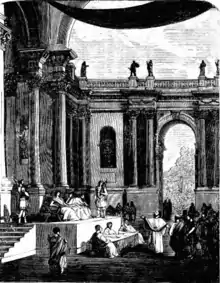
Referring to the legal code as a measure of harshness, MacMullen asserts that "under the Christian emperors cruelty rose" because the number of capital crimes did, and their threatened methods of execution became increasingly harsh.[308] Harries points out that Roman justice was always harsh.[309] It was a common belief of those in the Roman Empire that severity was a deterrent, and that the threat of harsh consequences prevented crime.[310]
However, it is possible to identify a mounting severity in criminal law throughout the entire imperial period, beginning under Augustus and continuing into the sixth and seventh centuries, says Peter Garnsey. This was a result of the political change from Republic to Monarchy.[311] Harries writes of the SC Silanianum, a particularly harsh law passed in 10 CE, which foreshadows and helps to explain how Roman laws of the empire developed and grew harsher.[312] The SC Silanianum was originally aimed at slaves who murdered their masters, but its reach and its harshness grew as time passed.[313][note 13] Ancestral customs – the Mos maiorum – were the most important source of Roman law. The history of the SC Silanianum documents the effect of senatorial self-interest on a specific law, but it also documents the establishment of a legal tradition of increasing harshness.[320]
The fourth century saw competition between the empire's differing views on punishment, and this is linked to the rise of Christianity. On the one hand, increasingly harsh penalties for an ever enlarging number of capital crimes were published by emperors. On the other hand, emperors also wanted to be seen as generous in offering mercy and clemency.[321]
Beginning in the first century under Augustus, the established Roman understanding of mercy and clemency (clementia) began a transformation that was completed in the fourth century.[322] Christian writers had embraced the concept of clemency and used it to express the mercy of God demonstrated in salvation.[323] The use of clementia to indicate forgiveness of wrongs and a mild merciful temper becomes common for writers of the Later Roman Empire.[324]
Christianity ameliorated some of Rome's harsh justice and also adopted some of it.[325][326] Augustine of Hippo urged Donatus (the heretical African bishop) to practice Christian mildness when dealing with enemies.[327] He praised Marcellinus, who presided over an Imperial inquiry into the Catholic-Donatist controversy, for having conducted his investigation without using torture. Ambrose, bishop of Milan, advised his correspondent Studius, a Christian judge, to show clemency, citing as a model Jesus' treatment of the adulteress. However, both Augustine and Ambrose were thoroughly Roman in their views on the occasional necessity for severity in law and punishment, and neither advocated the abolition of torture or the reduction of penalties for law breaking.[325]
Garnsey has recognized that "Augustine, Ambrose, and other church leaders of progressive views clearly had a beneficent influence on the administration of the law, [but] it is evident that they did not attempt to promote a movement of penal reform, and did not conceive of such a movement".[325] "When it came to the central functions of the Roman state, even the vivid Ambrose was a lightweight".[328]
Corruption
Despite corruption having a long history in Roman society, Ramsay MacMullen "attributes to the fourth century ...the spread of an ethos of venality (greed and bribery) and the displacement of aristocratic networks of patronage by the indiscriminate exchange of favors for money". He has asserted that this practice shows the church, and Christians in government, were universally corrupt in the fourth and fifth centuries.[329][330] MacMullen's thesis has produced considerable scholarly criticism that has been dubbed the "corruption debate".[331]
Modern studies have employed many of the same sources as MacMullen, but have arrived at virtually opposite conclusions.[332] For example, in the 1960s, political scientists examined the processes of modernization in the empire, along with those practices considered "corrupt" by modern Western standards, and found that what modern historians have termed "corruption" might in some ways, "and sometimes systematically, have a beneficial impact on a range of important goals: 'nation-building', economic development, administrative capacity, and democratization."[333]
Tim Watson concludes that, "Even if agreement can be reached on what exactly constituted "corrupt" behavior, there is simply not enough data" in the sources to settle the corruption debate. He adds that this, in turn, has given rise to the tendency of modern historians of this ancient period to adopt their own personal perspectives.[334]
Gladiators
"That decree, often referred to by modern scholars, in which Constantine "put an end" to gladiatorial combat" was issued on the first of October in 325 as an official document addressed to Maximus, the governor, declaring he, Constantine, "totally forbid the existence of gladiators", that criminals should no longer become gladiators, and that they should all go to the mines instead.(CT 15.12.1, a. 325).[308][335] Fik Meijer agrees that the decree's long-term effects were negligible, since three years after it was issued, Constantine attended the games in Antioch and made no objection. None of the Christian emperors who followed Constantine seemed inclined to abolish the gladiatorial contests either, since they were still giving permission for them.[335] As a result, MacMullen has written that, "the role of Christianity in the abandoning of most western gladiatorial combat was nil".[308]
However, as Meijer explains, while gladiator shows were never officially politically abolished, Christians did speak out against them, and the rising number of Christians in the population in the late fourth century caused the popularity of the games to decline.[336] It is likely the games ended from this lack of public support before 440.[337]
Women
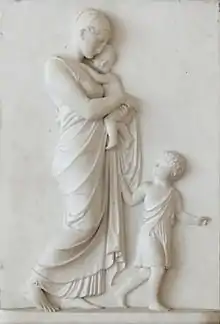
A significant aspect of early Christianity's appeal to women was its ascetic practices of chastity and virginity, which dates from the earliest communities.[338] Exposure of unwanted female infants (and imperfect males) was an accepted fact of Roman life.[339] In 1968, J. Lindsay reported that even in large families "more than one daughter was practically never reared."[340] Stark adds that, "A study of inscriptions at Delphi made it possible to reconstruct 600 families. Of these, only six had raised more than one daughter".[341] There was also a high mortality rate among women from childbirth, and abortion was a major cause of the death of women.[342] Elizabeth Castelli writes that, "The ascetic life, especially the monastic life, may have provided women with a mode of escape from the rigors and dangers of married and maternal existence, with the prospect of an education and (in some cases) an intellectual life, and with access to social and economic power that would otherwise have eluded them".[343][344]
The Pauline epistles in the New Testament provide evidence of women as true missionary partners in expanding the Jesus movement. The women named as leaders contributed directly to that endeavor with roles like those of men.[345][346] Ross Kraemer argues that Christianity offered women a new sense of worth.[347] The activities of women that contributed to the rise of Christianity still tended to revolve around the household: "women meeting together in a house, seeking to build believing homes, or struggling to preserve Christian allegiance in the home of a pagan householder".[348] Women moved in and out of houses and shops and marketplaces, taking risks, leading people, including children, outside the bounds of the "proper authorities". Their combination of boldness, affront, and the natural concealment of going about their ordinary daily business, allowed the everyday friendships and personal interactions of ordinary women to help spread Christianity.[349][note 14]
The conversion of women to ascetic Christianity constituted a true break with Roman tradition. This is evident in the sanctions and labels their antagonists used against them. Power resided with the male authority figure, and he had the right to label any uncooperative female in his household as insane or possessed, to exile her from her home, and condemn her to prostitution.[351] A survey of the literature of the early period all show female converts as having one thing in common: that of being in danger. Women took risks to spread the gospel.[352] Kramer theorizes that "Against such vehement opposition, the language of the ascetic forms of Christianity must have provided a strong set of validating mechanisms".[353] Women were considered one of the marginal classes in the Roman Empire, so it is likely this attracted large numbers of those women who were discontented with their lot.[354][355]
Widows were especially critical to growth in Christianity's first generation, and in the literature from the second century, there is conclusive evidence of groups of women, with some "exercising the office of widow".[356] Nathan explains that "a widow in Roman society who had lost her husband and did not have money of her own was at the very bottom of the social ladder".[357] The practical support the early church provided to those who would, otherwise, have been in destitute circumstances "was in all likelihood an important factor in winning new female members".[356][358]
Charity
MacMullen has written that "There was undoubtedly more talk about commiseration with the poor, charity, and ... caritas (Christian love of mankind) among Christians in the fourth century than among pagans then or earlier – of Christians' behavior toward their chief foes, namely, persons of differing religious preference ...charity to the point of loving one's enemies – hardly a sign".[329]
A universal value
MacMullen applies a "special test" that "must show [Christians] in some opposition to evidently accepted standards. Without that opposition they cannot have produced any difference".[329] There is no evidence from any of the second century Christian texts that their authors regarded the notion of loving one's enemies as peculiar to Christians.[359] The classically educated recognized the same notion in Homer, Socrates and the writings of Seneca the Younger.[360] There might, in the Roman practice of offering clemency to a defeated enemy, even have been an expectation that pagan leadership would actively practice this ideal, but Justin noted that loving one's enemies is "rare enough to be news under any circumstances".[360][361] It was an ethic both pagans and Christians held. Evidence indicates that Christians of the early centuries did not claim it as a distinguishing mark of their religion, "and that such charity was not held by contemporary pagans to be a unique feature of Christianity".[362]
Robin Lane Fox asserts that Christian love for one another was publicly recognized in the early centuries. "When Christians were in prison, fellow Christians gathered to bring them food and comforts: Lucian, the pagan satirist, was well aware of this practice. When Christians were brought to die in the arena, the crowds, said Tertullian, would shout "Look how these Christians love one another". Fox writes that, "Christian love was public knowledge and must have played its part in drawing outsiders to the faith".[363]
Discipline is love
Early Christians (before the fifteenth century) did not see the religious tolerance of diverse belief as an ideal.[232] Augustine of Hippo did not see heretics as enemies to be loved into the kingdom. He saw them as brethren who had gone astray and needed to be brought to repentance, even if that required coercion. Augustine held the view that the state has the right to enforce public order with force, and could, therefore, also use force and coercion against heresy, as heresy contributed to that disorder. According to Augustine, part of the church's purpose is to correct, instruct, and save its brethren from life-threatening error. Therefore, church "discipline" – carried out by the state's application of force – is a form of justice, penance and a saving act of love.[364] He said the church was responsible for disciplining its own people, out of a loving desire to heal them, and that, "once compelled to come in, heretics would gradually give their voluntary assent to the truth of Christian orthodoxy."[365]
Augustine placed limits on the use of coercion, recommending fines, imprisonment, banishment, and moderate floggings. He preferred beatings with rods, which was also a common practice in the home, school and ecclesial court at the time.[366] He opposed the extreme forms of torture and maiming. He was also against the execution of heretics (even if these limits were mostly ignored by Roman authorities), though he continued to believe in the Roman value of severity as a deterrent.[367][368] Frederick H. Russell describes Augustine's teaching on coercion as "precariously balanced".[369] It is this teaching that has most "embarrassed his modern defenders and vexed his modern detractors", as it was used to justify much in the Middle Ages.[370] This has made him appear "to generations of religious liberals as le prince et patriarche de persecuteurs" (the prince and patriarch of persecutors).[371]
Opposition to those whom orthodoxy named as heretics may have inadvertently increased Christianity's attractiveness and its growth. French archaeology has shown that the north African landscape of the fourth century became "covered with a white robe of churches". Both Catholics and Donatists were building church after church, with granaries to feed the poor, as they competed for the loyalty of the people.[372] Donatists survived until the Muslim conquest of the Maghreb in the closing years of the seventh century.[373]
Care for the poor

Prior to Christianity, the wealthy elite of Rome mostly donated to civic programs designed to elevate their status, though personal acts of kindness to the poor were not unheard of. The ancient world has no trace of any organized charitable effort for feeding and clothing the poor, visiting prisoners, or supporting widows and orphan children.[374][375][376] Nevertheless, Salzman asserts that the Roman practice of civic euergetism ("philanthropy publicly directed toward one's city or fellow citizens") influenced Christian charity "even as they remained distinct components of justifications for the feeding of Rome well into the late sixth century".[377]
Christians showed the poor great generosity, and "there is no disputing that Christian charity was an ideology put into practice".[378][note 15] Christian and non-Christian witnesses testify to the zealousness of Christian communities for almsgiving and charity.[380] "That the later church in Rome was actively involved in charity and renowned for its work with the needy is attested".[381][note 16] Hart writes that the emperor Julian, who was hostile to Christianity, is recorded as saying: "It is [the Christians'] philanthropy towards strangers, the care they take of the graves of the dead, and the affected sanctity with which they conduct their lives that have done most to spread their atheism."[385][386]
Steven C. Muir has written that "Charity was, in effect, an institutionalized policy of Christianity from its beginning. Christians had an organized and efficient mutual support network. They looked after one another in times of crisis, and their efforts toward outsiders may have attracted some new members to the group. The pooled efforts of Christians likely resulted in a healthier-than-average group, and over time their numbers would increase significantly. While this situation was not the sole reason for the group's growth, it was a significant factor".[387]
Health care
Christian monasticism emerged toward the end of the third century. By the 330s, evidence shows monastics served as "protectors, mediators, legal advocates, traders, landlords, tax-payers, spiritual patrons and religious healers".[388] It has been recognized since 1776 when Edward Gibbon blamed the Fall of the Western Roman Empire on the "specious demands of charity and devotion" from "the useless multitudes of both sexes who could only plead the merits of abstinence and chastity", that monasticism had impacted both the attractiveness and growth of Christianity.[389] Andrew Todd Crislip observes that the numbers of monks grew, and their asceticism moved into aristocratic society, such that, "by the fifth century, monasticism had become a dominant force impacting all areas of society", especially health care.[390]
Two devastating epidemics, the Antonine Plague in 154 and the Plague of Cyprian in 251, carried off a large number of the empire's population, though there is some debate over the seriousness and impact of these events.[391] Greco-Roman doctors tended largely to the elite, while the poor mostly had recourse to "miracles and magic" at religious temples.[392] Christians, on the other hand, tended to the sick and dying, as well as the aged, orphaned, exiled and widowed.[393][394]
According to Albert Jonsen, a historian of medicine, "the second great sweep of medical history [began] at the end of the fourth century, with the founding of the first Christian hospital for the poor at Caesarea in Cappadocia."[395][396][note 17] By the fifth century, the founding of hospitals had become common for ecclesiastics and ascetic leaders.[399]
Helmut Koester argues that, "One should not see the success of Christianity simply on the level of a great religious message; one has to see it also in the consistent and very well thought out establishment of institutions to serve the needs of the community".[400] Through almsgiving and other acts of charity, Christianity established a realm of mutual social support for those that joined the church. Koester asserts this was part of what made Christianity seem attractive and was "probably an enormously important factor for the success of the Christian mission".[400]
Community
According to Stark, "Christianity did not grow because of miracle working in the marketplaces ... or because Constantine said it should, or even because the martyrs gave it such credibility. It grew because Christians constituted an intense community" which provided a unique "sense of belonging".[401][402] Praet has written that, "in his very influential booklet Pagans and Christians in an Age of Anxiety, E. R. Dodds acknowledged ... 'Christians were in a more than formal sense 'members one of another': I think that was a major cause, perhaps the strongest single cause, of the spread of Christianity".[402]
Prior to the year 100, Christianity was composed of, maybe, one hundred small household churches consisting of around seventy members each. By 200, Christian numbers had grown to over 200,000 people; communities with an average size of 500–1000 people existed in approximately 200–400 towns. The earliest dated church building to survive comes from the mid-third century. Most churches remained house churches.[403] "In the huge cities of Rome and Alexandria, and in Antioch and Carthage, each with a population of above 100,000, Christian communities were probably substantial".[404] In most other towns, Christian communities must have remained quite small.[404]
Christian community was not just one thing. Experience and expression were diverse. Yet early Christian communities did have commonalities in the kerygma and the rites of baptism and the eucharist.[405] As far back as it can be traced, evidence indicates the rite of initiation into Christianity was always baptism.[406] In Christianity's earliest communities, candidates for baptism were introduced by a teacher or other person willing to stand surety for their character and conduct. Baptism created a set of responsibilities within each Christian community, which some authors described in quite specific terms.[407] Candidates for baptism were instructed in the major tenets of the faith, examined for moral living, sat separately in worship, could not receive the Eucharist, and were generally expected to demonstrate commitment to the community and obedience to Christ's commands before being accepted into the community as a full member.[408] Celebration of the Eucharist was the common unifier for Christian communities, and early Christians believed both of these practices came directly from Jesus of Nazareth.[406] According to E. R. Dodds "A Christian congregation was from the first a community in a much fuller sense than any corresponding group of Isis followers or Mithras devotees. Its members were bound together not only by common rites but by a common way of life".[409]
Joseph Hellerman observes New Testament writers as choosing 'family' as the central social metaphor to describe their community. In doing so, they redefined the concept of family.[410] In both Jewish and Roman tradition, genetic families were generally buried together, but an important cultural shift took place in the way Christians buried one another: they gathered unrelated Christians into a common burial space, as if they really were one family, "commemorated them with homogeneous memorials and expanded the commemorative audience to the entire local community of coreligionists".[411]
Community on a larger scale is evidenced by a study of 'letters of recommendation' that Christians created to be taken by a traveler from one group of believers to another.[412] Security and hospitality when traveling had traditionally been undependable for most, being ensured only by, and for, those with the wealth and power to afford them. By the late third and early fourth centuries, Christians had developed a 'form letter' of recommendation, only requiring the addition of an individual's name, that extended trust and welcome and safety to the whole household of faith, "though they were strangers".[412] E. A. Judge writes of the fourth century diary of Egeria which documents her travels throughout the Middle East, seeing the old sites of the Biblical period, the monks, and even climbing Mount Sinai: "At every point she was met and looked after". The same benefits were applied to others carrying a Christian letter of recommendation as members of the community.[412]
The Jewish foundation of community as family is what made "Christianity's power of attraction ... not purely religious but also social and philosophical".[413] The Christian church was modeled on the synagogue. Christian philosophers synthesized their own views with Semitic monotheism and Greek thought. The Old Testament gave the new religion of Christianity roots reaching back to antiquity. In a society which equated dignity and truth with tradition, this was significant.[413] Paula Fredriksen of Boston University asserts that it is "because of Diaspora Judaism, which is extremely well established [in the empirical age], that Christianity itself, as a new and constantly improvising form of Judaism, is able to spread as it does through the Roman world".[414]
Martyrdom
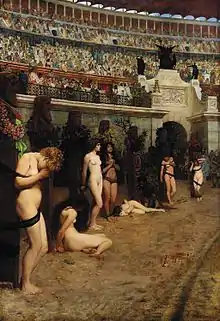
Theologian Paul Middleton writes that:
...accounts of martyrdom are contested narratives. There is no neutral way in which to tell martyr stories, as they inevitably create heroes and villains ... even in the early church, martyrdom has always been contested. Moreover, any quest to distinguish objectively between true and false martyrdom essentially represents the imposition of the values or identity claims of the compiler, narrator or even editor.[415]
Keeping this in mind, it is possible Justin was correct when he wrote: "it is plain that, though beheaded and crucified, and thrown to wild beasts, and chains, and fire, and all other kinds of torture, we do not give up our confession [of Christ]; but the more such things happen, the more do others and in larger numbers become faithful, and worshippers of God through the name of Jesus".[416]
According to cultural anthropology, people of the ancient world had a 'collectivist view' where the welfare of the group had priority over the individual.[417] Keith Hopkins concludes that, "by the time the Roman government finally began to realize that Christianity posed a significant threat, and started systematic persecution of Christian leaders and their property (in 250–51 under Decius, in 257–60 under Valerian, after 303 under Diocletian), Christianity was too embedded to be stamped out easily. And it was particularly in this period of persecutions, in spite of temporary losses, that Christianity grew fastest in absolute terms. In other words, in terms of number, persecution was good for Christianity".[418][note 18]
Miracles
In MacMullen's view, miracles and exorcisms form the most important (and possibly the only) reason for conversion to Christianity in the pre-Constantinian age.[420] These events provide some of the best documented ancient conversions.[421] However, there is a drop-off in the records of miracles in the crucial second and third centuries. Praet writes that "as early as the beginning of the third century, Christian authors admit that the "Golden Age" of miracles is over".[420] Yet Christianity grew most rapidly at the end of that same third century indicating the real impact of miracles is questionable. In Praet's view, even if Christianity had "retained its miraculous powers", the impact of miracles on conversion would still be questionable, since pagans also produced miracles, and no one questioned that those miracles were as real as Christianity's, yet no one converted to paganism because of them.[422]
See also
Notes
- See Peter Brown, in Bowersock et al., Late antiquity: a guide to the postclassical world, University Press, (1999), for "pagan" as a mark of socio-religious inferiority in Latin Christian polemic.[28]
- Faculty University of Toronto, Art History Department, Alumnus. Specializes in Art History and Early Christianity
- "Evidence for neglect and manipulation could readily be found, and a standard list of examples gradually took shape: ancient priesthoods left vacant, ceremonies unperformed, temples allowed to decay, priesthoods sought for personal ends, the religious calendar exploited for political gain. It was also easy enough to find statements from contemporary writers that seemed to confirm that they themselves were aware of this religious decline, such as the passage from the first-century-bce scholar M. Terentius Varro quoted by Cumont. But, as more recent scholars have argued, this evidence has often been cited without proper consideration of its context; at the same time, other evidence that presents a different picture has been dismissed out of hand".[46]
- Finnish historian and Docent of Latin language and Roman literature at the University of Helsinki
- Classicist Ramsey MacMullen is an example of a modern minimalist.[83] Schwarz suggests that minimalism is beginning to show signs of decline because it tends to understate the significance of some human actions, and so makes assumptions that are hard to support.[84] As a result, "MacMullen's account of Christianization as basically an aggregation of accidents and contingencies" is a minority view that is not broadly supported.[85]
- In a review of MacMullen's work, T. D. Barnes has written that MacMullen's book treats "non-Christian evidence as better and more reliable than Christian evidence", generalizes from pagan polemics as if they were unchallenged fact, misses important facts entirely, and shows an important selectivity in his choices of what ancient and modern works he discusses.[86]
- David Bentley Hart also gives a detailed discussion of MacMullen's "careless misuse of textual evidence".[87]
-
- Imperial commands provided magistrates with a license to act, but they could and did choose for themselves how to act.[89][105] Emperors contributed to a body of rules that were, theoretically, valid throughout the empire, but studies show that awareness of imperial laws, and their use, depended largely on one's social position: the elite were more likely to know and use Roman law principles and imperial constitutions.[106] Ordinary people were less likely.[107] Ordinary people had alternatives, such as appealing to the "local 'big man', or opting for personal violence, which was also considered a viable choice by itself or in combination with law".[108] They could appeal to other systems of law, such as Jewish law, or local traditions, that existed alongside Roman law.[109] An individual or a local court had the option of applying one law and excluding others, or using more than one law.[110] The citizenry at all levels could use multiple means – fraud, bribery, collusion, and simply openly flouting the law – to circumvent legislation. Complaints by emperors from Tiberius in the first century to Valentinian III in the fifth show that this was a recurring and ubiquitous feature of public administration.[111]
- One of the first things that is important about imperial laws, in Malcolm Errington's view, is how much anti-pagan legislation was applied and used, which would show how dependable the laws are as a reflection of what actually happened to pagans in history.[100] According to Brown, the large numbers of non-Christians in every region at this time meant that local authorities were "notoriously lax in imposing them". Christian bishops also frequently obstructed their application.[112]
-
- The best-attested incident of pagan-Christian violence in Italy took place in May 397, in the Val di Non, an area just north of ancient Tridentum (modern Trento) in Northern Italy.[126] Three Christians – a priest, Sisinnius, who had used his own money to build a church in the area, Martyrius, a reader for the church, and Alexander, Martyrius's brother, the janitor for the church – went to the Val di Non on a non-aggressive and peaceful mission to organize a pre-existing and growing Christian community.[127] Vigilius is explicit on these points.[128]
- The Christian priest tried to dissuade recent converts from taking part in a pagan purification ritual. This led to a dispute that turned to violence, a night of angry discussion and drinking, and the pagans returning to torch the half-built church. They found the priests and the community engaged in morning prayers, attacked the worshippers, burned the priest, and lynched the others.[129] Salzman says there is no indication in any of the sources that the Christians intended to use armed force to convert the populace there.[128] Gaudentius also recorded that the Christians aimed their efforts only at members of their own Christian community and not at pagans.[130]
- The Christian community in the region did not respond with more violence. Instead, once the murderers were caught, the bishop petitioned the emperor for clemency. The emperor then granted that the imprisoned murderers would not receive the death penalty.[131] "By acting to soothe the wounded community, Vigilius won converts". It was Christian mediation, not violence, that produced conversion in the Val di Non.[131]
- In three cases of violence between pagans and Christians in North Africa, Christians destroyed pagan idols in what Christian leaders condemned as "the thoughtless work of renegade Christians".[132] In all three incidents, pagan reactions to this was violent, and apparently that violence had the support and encouragement of the local municipal elites.[133] The perpetrators believed they could take action and be protected by their local authorities.[134] When the perpetrators were caught, that was not the case, so Augustine intervened, using his episcopal influence on the behalf of the pagans at Calama, to have their punishment reduced to a monetary fine.[135] In none of these cases did the Christian clergy use armed force to bring about conversion.[136]
- In Gaul, some of the most influential textual sources on pagan-Christian violence concerns Martin, bishop of Tours c .371–397.[136] These texts have been criticized for lacking historical veracity, even by ancient critics, but they are still useful for portraying the world of late fourth century Gaul.[137] "Martin of Tours, the Pannonian ex-soldier, is solely credited in the historical record as the militant converter of Gaul".[137] The portion of the sources devoted to attacks on pagans is limited, and they all revolve around Martin's miraculous powers as the means of converting pagans. He used his divine powers to overturn pagan shrines and idols, but did not use them to threaten or harm people.[138]
- Salzman writes that, "None of Martin's interventions led to the deaths of any Gauls, pagan or Christian".[139] Sulpicius, Martin's fervent supporter and biographer, wrote that when Martin was confronted with pagan resistance, it was Martin's "saintly words that softened the hearts of the pagans ... impressing the pagans with 'the power of the God of Martin' in the face of 'idols that could not help themselves'. Even if one doubts the exact veracity of these incidents, the assertion that Martin preferred non-violent conversion techniques says much about the norms for conversion in Gaul when Sulpicius wrote his Life".[139]
- Overall data indicates that a number of elements coincided to end the temples, but none of them were strictly religious.[166] Earthquakes caused much of the destruction of this era.[167] Civil conflict and external invasions also destroyed many temples and shrines.[168] The economy of the third and fourth centuries struggled, and traditional polytheism was expensive. Its temples were large, required regular maintenance and lavish festivals; they were served by professional priests, and were financially dependent upon donations from the state and private elites.[169] Roger S. Bagnall reports that imperial support for the many large pagan temples declined markedly after Augustus, then disappeared altogether in the middle of the third century.[170] Lower budgets meant the physical decline of urban structures of all types. Many temples were left to fall into disrepair. This progressive decay was accompanied by an increased trade in salvaged building materials, as the practice of recycling became common in Late Antiquity.[171] Economic struggles meant a "substantially poorer quality of life" from the fourth century onward, and necessity drove much of the destruction and conversion of pagan religious monuments.[166][172][173] In many instances, such as in Tripolitania, this happened before Constantine the Great became emperor.[174]
- "Were not many civic celebrations simply part of a social world that Christians, too, shared? Could not 'sacred time' be reclaimed either through the replacement of pagan holidays by Christian ones (e.g., Christmas) or by the 'secularization' of festivals that originally had pagan religious overtones (e.g., January 1st)? Thus attempts by a fifth-century pope to denounce the Lupercalia as 'pagan superstition' fell (apparently) on deaf ears: to many Christians, the festival was now simply an enjoyable 'secular' ritual. More-over, the developing cult of the martyrs not only gave post-Constantinian Christians a link to their heroic past, it also gave them a new way of claiming for Christianity sacred time (the fast days) and sacred places (the martyrs' shrines)".[180]
- Faculty of Theology, University of Pretoria, South Africa
- Wessels explains: "Onesimus, a slave, had run away from his master Philemon, but both had become Christians, and Paul sends Onesimus back home with a letter. In that letter Paul insists on Philemon's acceptance of Onesimus, no longer as a slave, but as a 'beloved brother'.
- Wessels says Marianne Thompson argues convincingly that "a reading of the letter to Philemon which views Paul as asking for Onesimus' spiritual reception as a brother in Christ, without the setting free of his body as a slave, assumes a 'dualistic anthropology' in Paul which his writings do not confirm".[284]
- Paul's understanding of the church as a 'body' meant that, once Onesimus was accepted into the group as a brother, it would become impossible to treat him as chattel and sell him off if the price was right".[285] J. H. Roberts also asserts that "The phrase, 'you will do even more than I say', can really only have one meaning: Philemon should set Onesimus free".[278]
-
- Exposed children were a major source of slaves, and changing this did not begin with Constantine. Constantine did strive to assure others that exposure was wrong, and reform the laws concerning them, but his legislation on abandoned children did not deviate markedly from the classical position.[298][299]
- It is in 412, when Honorius issued a constitution containing new rhetoric not previously found in Roman law, that change is first visible.[300] Roman law first evidences Christian influence with the appearance of the word misericordia (compassion) under emperor Honorius and its advancement as a standard under Justinian I.[301][302] The first sentence of Honorius' constitution emphasizes the "compassion" (misericordia) of the one who collects the abandoned child. "This word does not appear in any surviving imperial constitutions until the Christian period, where it is frequently used in the phrases divina misericordia or misericordia dei.[303]
- Justinian added that, since the collection of an exposed infant was an act of pious compassion, therefore, it cannot lead to the enslavement of the child.[304] "Under Justinian, two successive constitutions "reversed the Constantinian rule on the treatment of expositi"(exposed children) and decreed that no exposed child, regardless of its birth status, could be held as a slave, colonus, adscripticus, or freedman: "henceforth, all exposed children were to possess the rights and privileges of freeborn men".[304]
- The constitution is innovative by any reckoning, and cannot be called a return to classical principles, for it goes beyond all classical precedent in permitting even slave children to become free through the act of exposure".[305]
-
- In the first and second centuries, the Roman Senate controlled the implementation of this law.[314] To those who murdered their master, Senators extended the law's application to those who might have prevented it. This was extended again to include any slaves "resident under the same roof"; for slaves, this meant torture. The result was that "slaves who did nothing, and the murderer, faced the same penalty".[315] This led to the execution of 400 slaves in 61 CE on the assumption that "someone must have known something", and did not disclose it, and therefore they all failed to protect their master.[316]
- The law's next expansion is the case of a possible suicide as recorded by Pliny. The Senate proceeded without knowing if a crime had been committed, and without waiting for the questioning to be completed, to address whether the dead man's freedmen were liable for 'failure to protect' along with his slaves. They determined that the master had died under suspicious circumstances, therefore those 'under his roof', including all his freedmen, were deemed liable for 'failure to protect' regardless of the circumstances of what actually happened.[317]
- The absence of reflection or debate on the critical question concerning the rights of freed men is characteristic of court decisions that would later erode even the elite's immunities from judicial torture.[318] "The spectacle is not an edifying one. Little heed seems to have been paid to legal precision or to such residual human rights as slaves might still claim".[309] Procedures designed to ensure that the proper processes of investigation, interrogation and conviction were carried out, in the right order, and punishment inflicted on the right people, seem to have been casually disregarded.[319]
- Clement writes in the second century that women were serving as "helpmates" to missionary men since women had by this time become the only ones who could enter the women's quarters without scandal. This was about the same time as the pagan critic Celsus wrote calling Christianity a religion of women, slaves, and children, and suspicions of Christian "illicit activities" were high.[350]
- Robin Lane Fox provides examples ...In the 250's, it was Christian groups, not the pagan cities, which undertook collections to ransom their members from barbarian captors. During the siege of Alexandria in 262 CE (concurrent with the plague) two Christian leaders arranged to rescue many old and weak people, both Christians and pagans. During the great famine of 311–312 CE, rich pagan donors at first gave, but then withheld dole funds fearing they themselves would become poor. Christians on the other hand, offered last rites to the dying and buried them, and distributed bread to all others who were suffering from hunger.[379]
- It was regarded as an act of love which was itself regarded as redemptive and "able to cover a multitude of sins".[382] Early Christianity demanded a high standard of personal virtue and 'righteousness' in order to enter the kingdom of God, and almsgiving was considered the premier virtue.[383] In his Homilies on St.John, John Chrysostom writes that "It is impossible, though we perform ten thousand other good deeds, to enter the portals of the kingdom without almsgiving".[383] For Chrysostom, this was a statement of "continued redemption" first offered by "the historical Jesus on the cross, and now in the present through the poor. To approach the poor with mercy was to receive mercy from Christ".[384]
- After the death of Eusebius in 370 and the election of Basil as bishop of Caesarea, the new bishop established the early church's first formal soup kitchen, hospital, homeless shelter, hospice, poorhouse, orphanage, reform center for thieves, women's center for those leaving prostitution and many other ministries. Basil was personally involved and invested in the projects and process, giving all of his personal wealth to fund the ministries. Basil himself would put on an apron and work in the soup kitchen. These ministries were given freely regardless of religious affiliation. Basil refused to make any discrimination when it came to people who needed help saying that "the digestive systems of the Jew and the Christian are indistinguishable."[397][398]
- Peter Brown writes that, in the end, "The failure of the Great Persecution of Diocletian was regarded as a confirmation of a long process of religious self-assertion against the conformism of a pagan empire. Freedom to assert a belief not recognized by the State was won and held. 'However much Christian churches and states may have sinned in later times by their religious coercion, the martyrdoms of the Roman Persecutions belong to the history of freedom'. And in this revolution ... the issues at stake were not merely the local grievances of a province; they were nothing less than the place of religion in society."[419]
References
- Praet 1992–1993, p. 24.
- Hopkins 1998, p. 193.
- Brown 2012, p. xxvii.
- Brown 1997, pp. 26–28.
- Judge 2010, pp. 211–218.
- Judge 2010, pp. 217–218.
- Rives 2010, p. 284.
- Rüpke 2007, pp. 22, 29.
- Rüpke 2007, p. 10.
- Rawson 1974, pp. 193–212.
- Fredriksen 2006, p. 235.
- Tripolitis 2002, p. 2.
- Rives 2010, pp. 241–244.
- Clark 1983, p. 80.
- Rives 2010, p. 244.
- Clark 1983, pp. 80–105.
- Price 1986, p. 52.
- Rives 2010, p. 252.
- Hopf 1994, p. 147.
- Fredriksen 2006, p. 237.
- Rives 2010, pp. 272–273.
- Orlin 2010, p. 31.
- Bibliowicz 2019, p. 42.
- Rüpke 2007, pp. 32–33.
- Rüpke 2007, p. 34.
- Beard, North & Price 1998, p. 341.
- Welch & Pulham 2000, p. 197.
- Bowerstock, Brown & Grabar 1999, p. 625.
- Fredriksen 2006, p. 239.
- Hopkins 1998, p. 198.
- Welch & Pulham 2000, p. 199.
- Stark 1996, p. 10.
- Schwartz 2005, p. 145–146.
- Stark 1996, p. 197.
- Hopkins 1998, pp. 205, 222.
- Ekelund Jr. & Tollison 2011, p. 3.
- Couzin 2014, p. 11, fn. 61.
- Bagnall 1993, p. 4.
- Bagnall 1987, p. 248.
- Stark 1996, pp. 12–13.
- North 2013, p. 178.
- Rives 2010, p. 272.
- Orlin 2010, p. 18.
- Rives 1995, p. 9.
- Rüpke 2013, pp. 184, 200.
- Rives 2010, pp. 247–248.
- Stark 2020, p. 196.
- Stark 2020, pp. 196–200.
- Bagnall 2021, p. 270.
- de Blois 2016, p. 255–257.
- Harper 2019, p. 5.
- Harper 2019, p. 112–113.
- Scheidel 2015, p. 97.
- Meier 2016, p. abstract.
- Cameron 2010, p. 4.
- Cameron 2010, p. 5.
- Cameron 2010, pp. 5–6.
- O'Donnell 2017, p. 78.
- Salzman 2010, p. 191.
- Kahlos 2019, p. 2.
- Salzman 2002, pp. 3–5.
- Praet 1992–1993, p. 65.
- Salzman 2005, p. 123.
- Salzman 2002, pp. 4–6.
- Salzman 2002, pp. 4, 6.
- Salzman 2002, p. 4.
- Jones 1986, p. 7.
- Salzman 2002, p. 197.
- Salzman 2002, p. 194.
- Howarth 2003, Chapter 6.
- Salzman 2002, pp. xi, 79, 185, 188, 194.
- Salzman 2002, pp. 195–196.
- Salzman 2002, p. 17;201.
- Novak 1979, p. 274.
- Salzman 2002, pp. xii, 14–15, 197, 199, 219.
- Stark 1995, p. 153;230.
- Salzman 2002, p. xii.
- Novak 1979, pp. 305, 312.
- Novak 1979, p. 305.
- Salzman 2002, p. 5.
- Price 1986, pp. 7–16.
- Rives 2010, p. 255.
- Schwartz 2005, p. 150–151.
- Schwartz 2005, p. 152.
- Schwartz 2005, p. 150–152.
- Barnes 1985, p. 496.
- Hart 2009, p. 148-152.
- MacMullen 1984, p. 50.
- Salzman 2006, p. 265.
- Drake 2006, pp. 1–3.
- Drake 2006, p. 10.
- Drake 2006, p. 8.
- Salzman 2006, pp. 265–266, 285.
- Jordan 1969, p. 73.
- Jones 1986, p. 79.
- Lavan & Mulryan 2011, p. xxii.
- Lepelley 1992, pp. 50–76.
- Mulryan 2011, p. 41.
- Lavan & Mulryan 2011, pp. xxi, 138.
- Errington 1997, p. 398.
- Humfress 2013, p. 88.
- Humfress 2013, p. 83.
- Humfress 2013, p. 86.
- Saradi-Mendelovici 1990, p. 47.
- Bradbury 1994, p. 133.
- Humfress 2013, p. 83,84.
- Humfress 2013, p. 85–86.
- Humfress 2013, p. 85-86.
- Humfress 2013, p. 87–88.
- Humfress 2013, p. 86-88.
- Reinhold 1971, pp. 276–277.
- Brown 1998, pp. 638–639, 640.
- Bradbury 1994, pp. 132–133.
- Brown 1998, pp. 638–639.
- Thompson 2005, p. 93.
- Bradbury 1995, pp. 136–139.
- Brown 1998, pp. 639–640.
- Bradbury 1995, p. 331.
- Cameron 2010, p. 67.
- Brown 1998, p. 638;640.
- Bradbury 1995, p. 343;355-356.
- Bradbury 1995, pp. 355–356.
- Salzman 2006, pp. 266, 285.
- Salzman 2006, p. 266.
- Salzman 2006, p. 266;268-269.
- Salzman 2006, p. 267.
- Salzman 2006, pp. 268–269.
- Salzman 2006, p. 269.
- Salzman 2006, pp. 269–270.
- Salzman 2006, p. 270.
- Salzman 2006, p. 273.
- Salzman 2006, pp. 273, 274.
- Salzman 2006, pp. 274–276.
- Salzman 2006, pp. 274, 276.
- Salzman 2006, p. 276.
- Salzman 2006, p. 278.
- Salzman 2006, p. 279.
- Salzman 2006, p. 280.
- Salzman 2006, p. 282.
- Riggs 2006, p. 297.
- Riggs 2006, p. 308.
- Salzman 2006, pp. 266–267, 272.
- Salzman 2006, p. 285.
- Salzman, Sághy & Testa 2016, p. 2.
- Brown 1998, p. 639–406.
- Hagendahl 1967, pp. 601–630.
- Brown 1998, p. 640.
- Bayliss 2004, p. 68.
- Bayliss 2004, p. 65.
- Salzman, Sághy & Testa 2016, p. 7.
- Cameron 1991, pp. 121–124.
- Trombley 2001, pp. 166–168, Vol I; Trombley 2001, pp. 335–336, Vol II.
- Brown 1998, p. 641.
- Cameron 2010, p. 798; Kahlos 2019, p. 69.
- Haas 2002, pp. 160–162.
- Haas 2002, p. 257.
- Trombley 2001, p. 12.
- Gray 2014, p. 106-110.
- Brown 1992, p. 114.
- Grindle 1892, pp. 29–30.
- Bayliss 2004, p. 110.
- Lavan & Mulryan 2011, p. xxiv.
- Lavan & Mulryan 2011, p. xxv.
- Cameron 2010, p. 799.
- Leone 2013, pp. 2, 30–32.
- Leone 2013, p. 82.
- Leone 2013, p. 28.
- Lavan & Mulryan 2011, p. xxvi.
- Jones 1986, pp. 8–10, 13, 735.
- Bagnall 2021, p. p=261-269.
- Leone 2013, p. 2.
- Bradbury 1995, p. 353.
- Brown 2003, p. 60.
- Leone 2013, p. 29.
- Lavan & Mulryan 2011, p. xxx.
- Kahlos 2019, p. 3.
- Bremmer 2020, p. 9.
- Demarsin 2011, p. 3.
- Markus 1990, p. 103.
- Clark 1992, pp. 543–546.
- Markus 1990, pp. 141–142.
- Cameron 2010, pp. 8–10.
- Leone 2013, pp. 13, 42.
- Southern 2015, p. xii.
- Southern 2015, p. xii–1.
- Southern 2015, p. 407.
- Southern 2015, p. 455.
- Leithart 2010, p. 302.
- Bradbury 1995, pp. 120.
- MacMullen 1984, pp. 95–98.
- Drake 1996, p. 6.
- Praet 1992–1993, p. 96.
- Wiemer 1994, p. 523.
- Drake 1996, pp. 7–9.
- Leithart 2010, p. 304.
- Brown 2012, pp. 74–75.
- Thompson 2005, p. 87,93.
- Bayliss 2004, p. 243.
- Southern 2015, p. 455–457.
- Jordan 1969, p. 83.
- Gibbon 1906, pp. 279, 312.
- Drake 1996, pp. 7–8.
- Oxford Handbooks 2015, p. xx.
- Jordan 1969, p. 93.
- Brown 1995, pp. 4–6.
- Brown 1998, p. 639.
- Salzman 2006, pp. 3–5, 265.
- Barnes 2013, p. x.
- Barnes 2013, pp. 7–8.
- Harris 2005, p. 3.
- Harris 2005, p. 4.
- Praet 1992–1993, p. 63.
- Brown 2012, p. 3.
- Brown 2012, p. 14.
- Brown 2012, p. 15.
- Brown 2012, pp. 146, 15.
- Brown 2012, pp. 23–24.
- Brown 2012, p. 20.
- Brown 2012, p. 11.
- Brown 2012, p. 22.
- Praet 1992–1993, p. 64-65.
- Praet 1992–1993, p. 66.
- Brown 2012, p. 24.
- Brown 2012, p. 514.
- Brown 2012, p. 144.
- Brown 2012, p. 170.
- Brown 1997, p. 26.
- Brown 1997, p. 28.
- Judge 2010, p. 262.
- Fox 1987, pp. 304–305.
- Fox 1987, p. 304.
- Hopkins 1998, p. 218.
- Kelly 2000, pp. 3–4.
- Kelly 2000, p. 4.
- Kelly 2000, p. 32.
- Kelly 2000, pp. 31, 34.
- Meeks 1998.
- Praet 1992–1993, p. 14.
- Praet 1992–1993, p. 38.
- Praet 1992–1993, p. 33.
- Praet 1992–1993, p. 35,36.
- Praet 1992–1993, p. 35.
- Praet 1992–1993, p. 36.
- Koester 1998, A New Community.
- Salzman 2002, p. x.
- Hopkins 1998, p. 199.
- Meeks 2003, p. 79.
- Judge 2010, p. 214.
- Trebilco 2017, p. 85.
- Trebilco 2017, pp. 85, 218.
- Trebilco 2017, p. 282.
- Trebilco 2017, pp. 114–116, 149, 282.
- Praet 1992–1993, p. 68;108.
- Praet 1992–1993, p. 68.
- Trebilco 2017, p. 279.
- Trebilco 2017, p. 92.
- Trebilco 2017, p. 218.
- Praet 1992–1993, p. 45–48.
- Praet 1992–1993, p. 49.
- Wessel 2016, p. ix.
- Whittaker 1979, p. 213.
- Whittaker 1979, p. 212.
- Whittaker 1979, p. 214.
- MacMullen 1986, p. 322.
- MacMullen 1986, p. 337;342.
- MacMullen 1986, pp. 342–343.
- Harper 2013, pp. 4, 7.
- Langlands 2006, p. 10.
- Harper 2013, p. 7.
- Langlands 2006, p. 38.
- Younger 2005, p. 106.
- Langlands 2006, pp. 12, 20.
- Langlands 2006, pp. 10, 38.
- Harper 2013, pp. 88–92.
- Harper 2013, pp. 14–18.
- Harper 2013, pp. 6, 7.
- MacMullen 1986, pp. 324–326.
- Wessels 2010, p. 164.
- Wet 2015, p. 9.
- Fox 1987, p. 298.
- Wet 2015, pp. 10–13.
- Wet 2015, p. 10.
- Wessels 2010, p. 143.
- Wessels 2010, p. 166.
- Wessels 2010, pp. 163, 165.
- Wessels 2010, pp. 163–166.
- Wessels 2010, p. 168.
- Harper 2011, p. 483.
- Combes 1998, pp. 169–170.
- Wet 2015, p. 6.
- Harper 2011, p. 18.
- Tate 2008, p. 129.
- Tsang 2005, p. 2.
- Wet 2015, p. 276.
- Wet 2015, p. 13.
- Wet 2015, p. 142.
- Glancy 2002, p. 79, 85.
- Tate 2008, p. 123.
- Biondi, Biondo. "Il diritto romano cristiano." (Giuffre 1952. volume 1. issue 1.)
- Tate 2008, p. 134.
- Grubbs 2009, p. 120.
- Tate 2008, p. 124.
- Tate 2008, p. 135.
- Tate 2008, p. 138.
- Tate 2008, pp. 138–139.
- Wet 2015, p. 1.
- MacMullen 1986, p. 325, n. 10.
- MacMullen 1986, p. 331.
- Harries 2013, p. 52.
- Garnsey 1968, p. 158.
- Garnsey 1968, pp. 141–144, 162.
- Harries 2013, pp. 51, 52, 60.
- Harries 2013, p. 36;52.
- Harries 2013, pp. 51, 52, 58.
- Harries 2013, pp. 58–59.
- Harries 2013, pp. 60–61.
- Harries 2013, p. 65.
- Harries 2013, pp. 60–65.
- Harries 2013, p. 53.
- Barnes 1968, p. 50.
- Hillner 2015, p. 4.
- Dowling 2006, p. 271.
- Dowling 2006, pp. 221–223, 282.
- Dowling 2006, pp. 6, 271.
- Garnsey 1968, pp. 155–156.
- MacMullen 1986, pp. 331, 334.
- Garnsey 1968, pp. 155, 159–160.
- Brown 2012, p. 146.
- MacMullen 1986, p. 342.
- Watson 2010, p. 3.
- Watson 2010, pp. 3–4, 6.
- Watson 2010, p. 5.
- Watson 2010, p. 4.
- Watson 2010, p. 6.
- Meijer 2005, p. 202.
- Meijer 2005, p. 204.
- Meijer 2005, p. 205.
- Kraemer 1980, p. 298.
- Stark 1995, pp. 231.
- Lindsay 1968, p. 168.
- Stark 1995, pp. 229–231.
- Stark 1995, p. 232.
- Castelli 1998, p. 251.
- Kraemer 1980, pp. 300–301.
- MacDonald 2003, pp. 163, 167.
- Cloke 1995, pp. 5–7.
- Kraemer 1980, pp. 304–306.
- MacDonald 2003, p. 184.
- MacDonald 2003, pp. 157, 168, 184.
- MacDonald 2003, p. 168.
- Kraemer 1980, p. 305.
- MacDonald 2003, pp. 167, 168.
- Kraemer 1980, p. 306.
- Kraemer 1980, p. 307.
- Milnor 2011, p. abstract.
- MacDonald 2003, p. 169.
- Nathan 2002, pp. 116, 120, 127.
- Ng 2008, pp. 679–695.
- Whittaker 1979, p. 210.
- Whittaker 1979, p. 211.
- Dowling 2006, p. 1.
- Whittaker 1979, pp. 217, 222.
- Fox 1987, p. 324.
- Markus 1970, pp. 2, 116.
- Russell 1999, p. 115.
- Hughes & Paffenroth 2008, p. 168.
- Garnsey 1968, p. 155-156.
- Herbermann 1912, p. 768.
- Russell 1999, p. 125.
- Markus 1970, p. 116.
- Brown 1964, p. 107.
- Brown 1964, p. 334.
- Bryant 1993, p. 333.
- Ulhorn 1883, pp. 2–44, 321.
- Schmidt 1889, pp. 245–256.
- Crislip 2005, p. 46.
- Salzman 2017, pp. 65–85.
- Muir 2006, p. 218.
- Vaage 2006, p. 220.
- Garrison 1993, p. 76.
- Garrison 1993, p. 93.
- Garrison 1993, p. 94.
- Garrison 1993, p. 10.
- Brown 2002.
- Hart 2009, p. 154.
- Praet 1992–1993, p. 50.
- Muir 2006, p. 231.
- Crislip 2005, p. 1.
- Gibbon 1776, Chapter 38.
- Crislip 2005, p. 3.
- Vaage 2006, p. 215.
- Vaage 2006, p. 226.
- Wessel 2016, p. 142.
- Stark 1996, p. 204.
- Jonsen 2000, p. 13.
- Crislip 2005, p. 127.
- Bremner 2017, p. 14.
- Clarke 1913, p. 155.
- Crislip 2005, p. 103.
- Koester 1998, Welfare Institutions.
- Stark 1996, pp. 207, 215.
- Praet 1992–1993, p. 73.
- Hopkins 1998, pp. 203, 206.
- Hopkins 1998, p. 202.
- McKinion 2001, pp. 1–3.
- McKinion 2001, p. 5.
- MacCormack 1997, p. 655.
- McKinion 2001, p. 6.
- Dodds 1990, p. 133.
- Hellerman 2009, p. 6.
- Yasin 2005, p. 433.
- Judge 2010, p. 216.
- Praet 1992–1993, p. 108.
- Fredriksen spread.
- Middleton 2020, p. 5.
- Knapp 2017, p. 206.
- Hellerman 2009, pp. 14–16.
- Hopkins 1998, p. 197.
- Brown 1961, pp. 100–101.
- Praet 1992–1993, p. 25.
- Praet 1992–1993, p. 27.
- Praet 1992–1993, p. 26–27.
Bibliography
- Bagnall, Roger S. (1987). "Conversion and Onomastics: A Reply". Zeitschrift für Papyrologie und Epigraphik. 69: 243–250. ISSN 0084-5388. JSTOR 20186672.
- Bagnall, Roger S. (1993). Egypt in Late Antiquity. Princeton, NJ: Princeton University Press. ISBN 978-0-691-06986-9.
- Bagnall, Roger S. (2021). Egypt in Late Antiquity (illustrated, reprint ed.). Princeton University Press. ISBN 978-1-4008-2116-7.
- Barnes, T. D. (1968). "Legislation against the Christians". The Journal of Roman Studies. 58: 32–50. doi:10.2307/299693. JSTOR 299693.
- Barnes, T.D. (1985). "Review of Christianizing the Roman Empire A.D. 100–400 by R. Macmullen". Echos du monde classique: Classical views. 29 (3): 495–496.
- Barnes, T.D. (2013). Constantine: Dynasty, Religion and Power in the Later Roman Empire. John Wiley & Sons. ISBN 978-1-4443-9625-6.
- Bayliss, Richard (2004). Provincial Cilicia and the Archaeology of Temple Conversion. Oxford: Archaeopress. ISBN 978-1-84171-634-3.
- Beard, Mary; North, John S.; Price, Simon (1998). Religions of Rome: Volume 1, A History. UK: Cambridge University Press. p. 341. ISBN 978-0-521-30401-6.
- Bibliowicz, Abel M. (2019). Jewish-Christian Relations-The First Centuries. WA: Mascarat. ISBN 978-1-5136-1648-3.
- Bokenkotter, Thomas (2007). A Concise History of the Catholic Church (Revised ed.). Crown Publishing Group. pp. 23, 28. ISBN 978-0-307-42348-1.
- Bowerstock, G. W.; Brown, Peter; Grabar, Oleg, eds. (1999). Late antiquity : a guide to the postclassical world. Cambridge, Mass.: Belknap Press of Harvard University Press. ISBN 978-0-674-51173-6.
- Bradbury, Scott (1994). "Constantine and the Problem of Anti-Pagan Legislation in the Fourth Century". Classical Philology. 89 (2): 120–139. doi:10.1086/367402. JSTOR 270658. S2CID 159997492.
- Bradbury, Scott (1995). "Julian's Pagan Revival and the Decline of Blood Sacrifice". Phoenix. 49 (4): 331–356. doi:10.2307/1088885. JSTOR 1088885.
- Bremmer, Jan N. (2020). "2". In Raschle, Christian R.; Dijkstra, Jitse H. F. (eds.). Religious Violence in the Ancient World From Classical Athens to Late Antiquity. Cambridge University Press. ISBN 978-1-108-84921-0.
- Bremner, Robert H. (2017). Giving: Charity and Philanthropy in History. New York: Routledge. ISBN 978-1-56000-884-2.
- Brown, Peter (1961). "Religious Dissent in the Later Roman Empire: The Case of North Africa". History. 46 (157): 83–101. doi:10.1111/j.1468-229X.1961.tb02436.x. JSTOR 24405338.
- Brown, Peter (1964). "St. Augustine's Attitude to Religious Coercion". The Journal of Roman Studies. 54 (1–2): 107–116. doi:10.2307/298656. JSTOR 298656.
- Brown, Peter (2002). Poverty and Leadership in the Later Roman Empire. UPNE. p. 95. ISBN 978-1-58465-146-8.
- Brown, Peter (1992). Power and persuasion in late antiquity : towards a Christian empire. Madison, Wis.: University of Wisconsin Press. ISBN 978-0-299-13344-3.
- Brown, Peter (1993). "The Problem of Christianization" (PDF). Proceedings of the British Academy. Oxford University Press. 84: 89–106.
- Brown, Peter (1995). Authority and the Sacred: Aspects of the Christianisation of the Roman World. Cambridge University Press. ISBN 978-0-521-49557-8.
- Brown, Peter (1997). "SO Debate: The World of Late Antiquity Revisited". Symbolae Osloenses. 72 (1): 5–30. doi:10.1080/00397679708590917. ISSN 1502-7805.
- Brown, Peter (1998). "Christianization and religious conflict". In Averil Cameron; Peter Garnsey (eds.). The Cambridge Ancient History XIII: The Late Empire, A.D. 337–425. Cambridge University Press. pp. 632–664. ISBN 978-0-521-30200-5.
- Brown, Peter (2003). The rise of Western Christendom : triumph and diversity, A.D. 200-1000 (2nd ed.). Malden, MA: Blackwell Publishers. ISBN 978-0-631-22137-1.
- Brown, Peter (2012). Through the Eye of a Needle: Wealth, the Fall of Rome, and the Making of Christianity in the West, 350–550 AD. Princeton University Press. ISBN 978-0-691-15290-5.
- Brown, Peter (2014). The Cult of the Saints: Its Rise and Function in Latin Christianity. University of Chicago Press. ISBN 978-0-226-17543-0.
- Bryant, Joseph M. (1993). "The Sect-Church Dynamic and Christian Expansion in the Roman Empire: Persecution, Penitential Discipline, and Schism in Sociological Perspective". The British Journal of Sociology. 44 (2). doi:10.2307/591221. JSTOR 591221.
- Cameron, Alan (2010). The Last Pagans of Rome. Oxford University Press. ISBN 978-0-19-974727-6.
- Cameron, Averil (1991). Christianity and the rhetoric of empire : the development of Christian discourse. Berkeley: University of California Press. ISBN 978-0-520-07160-5.
- Castelli, Elizabeth A. (1998). "Gender, Theory, and The Rise of Christianity: A Response to Rodney Stark". Journal of Early Christian Studies. Johns Hopkins University Press. 6 (2).
- Clark, Mark Edward (1983). "Spes in the Early Imperial Cult: "The Hope of Augustus"". Numen. 30 (1): 80. JSTOR 3270103.
- Clark, Elizabeth A. (1992). "The End of Ancient Christianity". Ancient Philosophy. 12 (2): 543–546. doi:10.5840/ancientphil199212240.
- Clarke, W.K.Lowther (1913). St.Basil the Great A Study in Monasticism. Cambridge, England: Cambridge University Press.
- Cloke, Gillian (1995). This Female Man of God: Women and Spiritual Power in the Patristic Age, 350–450 AD. Routledge. ISBN 978-0-415-09469-6.
- Combes, I.A.H. (1998). The Metaphor of Slavery in the Writings of the Early Church: From the New Testament to the Beginning of the Fifth Century. Sheffield Academic Press. ISBN 978-1-85075-846-4.
- Couzin, Robert (2014). "The Christian sarcophagus population of Rome". Journal of Roman Archaeology. 27: 275–303. doi:10.1017/S104775941400124X.
- Crislip, Andrew T. (2005). From Monastery to Hospital: Christian Monasticism & the Transformation of Health Care in Late Antiquity. Ann Arbor: University of Michigan Press. ISBN 978-0-472-11474-0.
- de Blois, Lukas (2016). "3 Invasions, Deportations, and Repopulation Mobility and Migration in Thrace, Moesia Inferior, and Dacia in the Third Quarter of the Third Century AD". In Lo Cascio, Elio; Ernst Tacoma, Laurens; Olivier, Hekster (eds.). The Impact of Mobility and Migration in the Roman Empire: Proceedings of the Twelfth Workshop of the International Network Impact of Empire. 22. BRILL. ISBN 978-90-04-33480-9.
- Demarsin, Koen (2011). "'Paganism' in Late Antiquity: Thematic studies Introduction". In Lavan, Luke; Mulryan, Michael (eds.). The Archaeology of Late Antique 'Paganism' (volume 7; illustrated ed.). BRILL. ISBN 978-90-04-19237-9.
- Dodds, Eric Robertson (1990). Pagan and Christian in an Age of Anxiety: Some Aspects of Religious Experience from Marcus Aurelius to Constantine (illustrated, reprint ed.). Cambridge University Press. ISBN 978-0-521-38599-2.
- Dowling, Melissa Barden (2006). Clemency and Cruelty in the Roman World. Ann Arbor: University of Michigan Press. ISBN 978-0-472-11515-0.
- Downs, David J. (2016). Alms: Charity, Reward, and Atonement in Early Christianity. Baylor University Press. ISBN 978-1-60258-999-5.
- Drake, H. A. (1 November 1996). "LAMBS INTO LIONS: EXPLAINING EARLY CHRISTIAN INTOLERANCE". Past & Present. 153 (1): 3–36. doi:10.1093/past/153.1.3.
- Drake, H.A., ed. (2006). Violence in Late Antiquity: Perceptions and Practices. Aldershot: Ashgate. ISBN 978-0-7546-5498-8.CS1 maint: ref duplicates default (link)
- Drake, H. A. (2005). "Chapter one: Models of Christian Expansion". In Harris, William (ed.). The Spread of Christianity in the First Four Centuries: Essays in Explanation. Brill. pp. 1–14. ISBN 978-90-04-14717-1.
- Drake, H. A. (2014). "17: The Church, Society and Political Power". In Mirza, Umair (ed.). The Cambridge History of Christianity. 2 (illustrated ed.). Cambridge University Press. ISBN 978-1-107-42505-7.
- Ekelund Jr., Robert B.; Tollison, Robert D. (2011). "Chapter One: Roman Christianity: An Evolving Monopoly". Economic Origins of Roman Christianity. University of Chicago Press. ISBN 978-0-226-20004-0.
- Erdkamp, Paul (2019). "War, Food, Climate Change, and the Decline of the Roman Empire". Journal of Late Antiquity. Johns Hopkins University Press. 12 (2): 422. doi:10.1353/jla.2019.0021.
- Errington, R. Malcolm (1997). "Christian Accounts of the Religious Legislation of Theodosius I". Klio. 79 (2): 398–443. doi:10.1524/klio.1997.79.2.398. S2CID 159619838.
- Errington, R. Malcolm (2006). Roman Imperial Policy from Julian to Theodosius. Chapel Hill: University of North Carolina Press. ISBN 978-0-8078-3038-3.
- Fleury, Philippe (1990). "Les textes techniques de l'Antiquité. Sources, études et perspectives". Euphrosyne. Revista de filologia clássica (in French) (18): 359–394.
- Fox, Robin Lane (1987). Pagans and Christians. Knopf. ISBN 978-0-394-55495-2.
- Fredriksen, Paula (2006). "Mandatory retirement: Ideas in the study of Christian origins whose time has come to go". Sciences Religieuses (. 35 (2): 231–246. doi:10.1177/000842980603500203. S2CID 144478198.
- Fredriksen, Paula. "Spread of Christianity". The Great Appeal. PBS. Retrieved 4 December 2021.
- Garnsey, Peter (1 January 1968). "Why Penalties Become Harsher: The Roman Case, Late Republic to Fourth Century Empire" (PDF). Natural Law Forum: 141–162.
- Garrison, Roman (1993). Redemptive Almsgiving in Early Christianity. Sheffield: JSOT Press. ISBN 978-1-85075-376-6.
- Gibbon, Edward (1776). The History of the Decline and Fall of the Roman Empire. I: The Decline And Fall In The West.
- Gibbon, Edward (1906). "XX". In Bury, J.B. (ed.). The History of the Decline and Fall of the Roman Empire. 3. Fred de Fau and Co.
- Glancy, Jennifer A. (2002). Slavery in Early Christianity. Fortress Press. ISBN 978-1-4514-1094-5.
- Gray, Mary W. (December 2014). "Hypatia of Alexandria by Maria Dzielska: CAMBRIDGE: HARVARD UNIVERSITY PRESS, 1996, 176 PP., US $23.50, ISBN 0674437764". The Mathematical Intelligencer. 36 (4): 106–110. doi:10.1007/s00283-014-9470-4.
- Grindle, Gilbert (1892). The Destruction of Paganism in the Roman Empire from Constantine to Justinian. The Chancellor's essay, 1892. London: B. H. Blackwell.
- Haas, Christopher (2002). Alexandria in Late Antiquity Topography and Social Conflict. Johns Hopkins University Press. ISBN 978-0-8018-7033-0.
- Hagendahl, Harald (1967). Augustine and the Latin Classics, vol. 2: Augustine's Attitude, Studia Graeca et Latina Gothoburgensia. Stockholm: Almqvist & Wiksell.
- Harper, Kyle (2011). Slavery in the Late Roman World, AD 275–425. Cambridge University Press. doi:10.1017/CBO9780511973451. ISBN 978-0-521-19861-5.
- Harper, Kyle (2013). From Shame to Sin: The Christian Transformation of Sexual Morality in Late Antiquity. Cambridge, MA: Harvard University Press. ISBN 978-0-674-07277-0.
- Harries, Jill (2013). "Chapter 4: The Senatus Consultum Silanianum: Court Decisions and Judicial Severity in the Early Roman Empire". In Paul J. du Plessis (ed.). New Frontiers: Law and Society in the Roman World. Edinburgh University Press. pp. 51–70. ISBN 978-0-7486-6817-5.
- Harris, William Vernon (2005). The Spread of Christianity in the First Four Centuries: Essays in Explanation. Brill. ISBN 978-90-04-14717-1.
- Hart, David Bentley (2009). Atheist Delusions: The Christian Revolution and Its Fashionable Enemies (unabridged ed.). Yale University Press. ISBN 978-0-300-15564-8.
- Herbermann, Charles George, ed. (1912). "Toleration, History of". The Catholic Encyclopedia An International Work of Reference on the Constitution, Doctrine, Discipline, and History of the Catholic Church. University of Michigan. pp. 761–772.
- Hebblewhite, Mark (2020). Theodosius and the Limits of Empire. London: Routledge. doi:10.4324/9781315103334. ISBN 978-1-138-10298-9. S2CID 213344890.
- Hellerman, Joseph H. (2009). When the Church Was a Family: Recapturing Jesus' Vision for Authentic Christian Community. B&H Publishing Group. ISBN 978-1-4336-6843-2.
- Hezser, Catherine (2002). "Jennifer Α. Glancy, Slavery in Early Christianity". Scripta Classica Israelica. OUP: 359–362.
- Hillner, Julia (2015). Prison, Punishment and Penance in Late Antiquity. Cambridge University Press. ISBN 978-0-521-51751-5.
- Hopf, Lewis M. (1994). "Archaelogical Indications on the Origins of Roman Mithraism". Uncovering Ancient Stones: Essays in Memory of H. Neil Richardson. Eisenbrauns. pp. 147–156. ISBN 978-0-931464-73-7.
- Hopkins, Keith (1998). "Christian Number and Its Implications". Journal of Early Christian Studies. 6 (2): 185–226. doi:10.1353/earl.1998.0035.
- Howarth, Randall S. (2003). "Howarth on Salzman, 'The making of a Christian aristocracy: Social and religious change in the Western Roman Empire'". H-net (Book review). Harvard Net Services. Retrieved 25 October 2021.
- Hughes, Kevin L.; Paffenroth, Kim, eds. (2008). Augustine and Liberal Education. Lexington Books. ISBN 978-0-7391-2383-6.
- Humfress, Caroline (2013). "5: Laws' Empire: Roman Universalism and Legal Practice". New Frontiers: Law and Society in the Roman World. Edinburgh University Press. ISBN 978 0 7486 6817 5.
- Jonsen, Albert (2000). A Short History of Medical Ethics. New York: Oxford University Press. ISBN 978-0-19-513455-1.
- Jordan, David P. (1969). "Gibbon's "Age of Constantine" and the Fall of Rome". History and Theory. 8 (1).
- Jones, Arnold Hugh Martin (1986). The Later Roman Empire, 284-602: A Social Economic and Administrative Survey. 1 (reprint ed.). JHU Press. ISBN 978-0-8018-3353-3.
- Judge, E.A. (2010). Alanna Nobbs (ed.). Jerusalem and Athens: Cultural Transformation in Late Antiquity. Tübingen: Mohr Siebeck. ISBN 978-3-16-150572-0.
- Kahlos, Maijastina (2019). Religious Dissent in Late Antiquity, 350–450. Oxford University Press. ISBN 978-0-19-006725-0.
- Kelly, J. N. D. (2000). Early Christian Doctrines (reprint ed.). A&C Black. ISBN 978-0-8264-5252-8.
- Kelly, Christopher M. (2012). Hornblower, Simon; Spawforth, Antony; Eidinow, Esther (eds.). Corruption. Oxford Classical Dictionary (Fourth ed.). Oxford University Press. ISBN 978-0-19-954556-8.
- Koester, Helmut (April 1998). "The Great Appeal". The Great Appeal. Retrieved 2 September 2021.
- Knapp, Robert (2017). The Dawn of Christianity: People and Gods in a Time of Magic and Miracles (illustrated ed.). Harvard University Press. ISBN 978-0-674-97646-7.
- Kraemer, Ross S. (1980). "The Conversion of Women to Ascetic Forms of Christianity". Signs. 6 (2).
- Kreider, Alan (2016). The Patient Ferment of the Early Church: The Improbable Rise of Christianity in the Roman Empire. Baker Academic. ISBN 978-1-4934-0033-1.
- Langlands, Rebecca (2006). Sexual Morality in Ancient Rome. Cambridge University Press. ISBN 978-0-521-85943-1.
- Lavan, Luke; Mulryan, Michael, eds. (2011). The Archaeology of Late Antique 'Paganism'. Leiden: Brill. ISBN 978-90-04-19237-9.
- Lavie, Smadar; Swedenburg, Ted, eds. (1996). Displacement, Diaspora, and Geographies of Identity (illustrated, reprint ed.). Duke University Press. p. 8. ISBN 978-0-8223-1720-3.
- Leithart, Peter J. (2010). Defending Constantine The Twilight of an Empire and the Dawn of Christendom. InterVarsity Press. ISBN 978-0-8308-2722-0.
- Leone, Anna (2013). The End of the Pagan City: Religion, Economy, and Urbanism in Late Antique North Africa (illustrated ed.). OUP. ISBN 978-0-19-957092-8.
- Lepelley, C. (1992). "The survival and fall of the classical city in Late Roman Africa". In Rich, J. (ed.). The City in late antiquity. London: Routledge. ISBN 978-0-415-06855-0.
- Linder, Amnon, ed. (1987). The Jews in Roman Imperial Legislation. Wayne State University Press. ISBN 978-0-8143-1809-6.
- Lindsay, Jack (1968). The ancient world: Manners and morals. New York: G. P. Putnam. OL 5602276M.
- MacCormack, Sabine (1997). "Sin, Citizenship, and the Salvation of Souls: The Impact of Christian Priorities on Late-Roman and Post-Roman Society". Comparative Studies in Society and History. 39 (4): 644–673. JSTOR 179363.
- MacDonald, Margaret Y. (2003). "Was Celsus Right? The Role of Women in the Expansion of Early Christianity". In David L. Balch; Carolyn Osiek (eds.). Early Christian Families in Context: An Interdisciplinary Dialogue. Grand Rapids, MI: Wm. B. Eerdmans. pp. 157–184. ISBN 978-0-8028-3986-2.
- MacMullen, Ramsay (1984). Christianizing the Roman Empire : (A.D. 100-400). New Haven. ISBN 978-0-300-03216-1.
- MacMullen, Ramsay (1986). "What Difference Did Christianity Make?". Historia. 35 (3): 322–343. JSTOR 4435970.
- Markus, R. A. (1970). Saeculum : history and society in the theology of St. Augustine. Cambridge [England]. ISBN 978-0-521-07621-0.
- Markus, Robert Austin (1990). The End of Ancient Christianity (illustrated, reprint ed.). Cambridge University Press. ISBN 978-0-521-33949-0.
- McKinion, Steve, ed. (2001). Life and Practice in the Early Church: A Documentary Reader. NYU Press. ISBN 978-0-8147-5648-5.
- Meeks, Wayne A. (2003). The First Urban Christians (second ed.). Yale University. ISBN 978-0-300-09861-7.
- Meeks, Wayne A. (April 1998). "Christians on Love". The Great Appeal. PBS. Retrieved 7 September 2021.
- Meier, Mischa (2016). "The 'Justinianic Plague': the economic consequences of the pandemic in the eastern Roman empire and its cultural and religious effects". Early Medieval Europe. 24 (3): 267–292.
- Meijer, Fik (2005). The Gladiators: History's Most Deadly Sport (illustrated ed.). Macmillan. ISBN 978-0-312-34874-8.
- Middleton, Paul, ed. (2020). Wiley Blackwell Companion to Christian Martyrdom. Wiley. ISBN 978-1-119-09982-6.
- Milnor, Kristina (2011). "Women in Roman Society". In Peachin, Michael (ed.). The Oxford Handbook of Social Relations in the Roman World. doi:10.1093/oxfordhb/9780195188004.013.0029. ISBN 978-0-19-518800-4.
- Muir, Steven C. (2006). "10:"Look how they love one another" Early Christian and Pagan Care for the sick and other charity". Religious Rivalries in the Early Roman Empire and the Rise of Christianity. Wilfrid Laurier Univ. Press. ISBN 978-0-88920-536-9.
- Mulryan, Michael (22 June 2011). "'Paganism' In Late Antiquity: Regional Studies And Material Culture". In Luke Lavan; Michael Mulryan (eds.). The Archaeology of Late Antique 'Paganism'. Brill. pp. 41–86. doi:10.1163/ej.9789004192379.i-643.12.
- Nathan, Geoffrey (2002). The Family in Late Antiquity: The Rise of Christianity and the Endurance of Tradition (reprint ed.). Routledge. ISBN 978-1-134-70668-6.
- Ng, Esther Yue L. (October 2008). "Mirror Reading and Guardians of Women in the Early Roman Empire". Journal of Theological Studies. 59 (2). doi:10.1093/jts/fln051.
- North, J. A. (2013). "'the Development of Religious Pluralism'". In Lieu, Judith; North, John; Rajak, Tessa (eds.). The Jews among Pagans and Christians in the Roman Empire (reprint ed.). Routledge. pp. 174–193. ISBN 978-1-135-08188-1.
- Novak, David M. (1979). "Constantine and the Senate: An Early Phase of the Christianization of the Roman Aristocracy". Ancient Society. 10: 271–310. JSTOR 44079446.
- O'Donnell, James J. (2017). "The Demise of Paganism". Traditio. Cambridge University Press. 35: 45–88. doi:10.1017/S0362152900015002.
- Orlin, Eric (2010). Foreign Cults in Rome: Creating a Roman Empire. Oxford University Press. ISBN 978-0-19-978020-4.
- The Oxford handbook of late antiquity. Oxford. 2016. ISBN 978-0-19-027753-6.
- Praet, Danny (1992–1993). "Explaining the Christianization of the Roman Empire. Older theories and recent developments". Sacris Erudiri. Jaarboek voor Godsdienstgeschiedenis. A Journal on the Inheritance of Early and Medieval Christianity. 23: 5–119.
- Price, S. R. F. (1986). Rituals and Power: The Roman Imperial Cult in Asia Minor (illustrated, reprint, revised ed.). Cambridge University Press. ISBN 978-0-521-31268-4.
- Rawson, Elizabeth (1974). "Religion and Politics in the Late Second Century B. C. at Rome". Phoenix. 28 (2): 193–212. doi:10.2307/1087418. JSTOR 1087418.
- Reinhold, Meyer (1971). "Usurpation of Status and Status Symbols in the Roman Empire". Historia: Zeitschrift für Alte Geschichte. 20 (2/3): 275–302.
- Ramsey, Boniface (1997). Ambrose. London: Routledge. ISBN 978-1-134-81504-3.
- Riggs, David. "Christianizing the Rural Communities of Late Roman Africa: A Process of Coercion or Persuasion?". In Drake (2006), pp. 297–308.
- Rives, J. B. (1995). Oxford University Press (ed.). Religion and Authority in Roman Carthage from Augustus to Constantine (illustrated, reprint ed.). Clarendon Press. ISBN 978-0-19-814083-2.
- Rives, James B. (2010). "Graeco-Roman Religion in the Roman Empire: Old Assumptions and New Approaches". Currents in Biblical Research. 8 (2). doi:10.1177/1476993X09347454.
- Rüpke, Jörg (2007). Gordon, Richard (ed.). The Religion of the Romans (illustrated ed.). Polity. ISBN 978-0-7456-3014-4.
- Rüpke, Jörg, ed. (2013). The Individual in the Religions of the Ancient Mediterranean (illustrated ed.). OUP. ISBN 978-0-19-967450-3.
- Rusche, Philip (January 2001). "Richard Newhauser, The Early History of Greed: The Sin of Avarice in Early Medieval Thought and Literature . Cambridge: Cambridge University Press, 2000. xiv + 246 pages". Ben Jonson Journal. 8 (1): 424–427. doi:10.3366/bjj.2001.8.1.29.
- Russell, Frederick H. (1999). "Persuading the Donatists: Augustine's Coercion by Words". The Limits of Ancient Christianity: Essays on Late Antique Thought and Culture in Honor of R.A. Markus. University of Michigan Press. ISBN 978-0-472-10997-5.
- Salzman, Michele Renee (2002). The Making of a Christian Aristocracy: Social and Religious Change in the Western Roman Empire. Cambridge, MA: Harvard University Press. ISBN 978-0-674-00641-6.
- Salzman, Michelle Renee (2005). "Review: Rejoinder: "The Making of a Christian Aristocracy:" A Response to Ralph Mathisen's Review Article". International Journal of the Classical Tradition. 12 (1): 123–137. JSTOR 30222782.
- Salzman, Michele Renee. "Rethinking Pagan-Christian Violence". In Drake (2006), pp. 265–286.
- Salzman, Michele Renee (2010). "Ambrose and the Usurpation of Arbogastes and Eugenius: Reflections on Pagan-Christian Conflict Narratives". Journal of Early Christian Studies. Johns Hopkins University Press. 18 (2): 191. doi:10.1353/earl.0.0320. S2CID 143665912.
- Salzman, Michele Renee; Sághy, Marianne; Testa, Rita Lizzi, eds. (2016). Pagans and Christians in late antique Rome : conflict, competition, and coexistence in the fourth century. New York, NY. ISBN 978-1-107-11030-4.
- Salzman, Michelle Renee (2017). "From a Classical to a Christian City: Civic Euergetism and Charity in Late Antique Rome". Studies in Late Antiquity. 1 (1). doi:10.1525/sla.2017.1.1.65.
- Saradi-Mendelovici, Helen (1990). "Christian Attitudes toward Pagan Monuments in Late Antiquity and Their Legacy in Later Byzantine Centuries". Dumbarton Oaks Papers. 44: 47–61. doi:10.2307/1291617. JSTOR 1291617.
- Scheidel, Walter (2015). "A model of demographic and economic change in Roman Egypt after the Antonine plague". Journal of Roman Archaeology. Cambridge University Press. 15: 97. doi:10.1017/S1047759400013854. S2CID 160954017.
- Schmidt, Charles (1889). "Chapter Five: The Poor and Unfortunate". The Social Results of Early Christianity. London, England: William Isbister Ltd. pp. 245–256.
- Schwartz, Seth (2005). "Chapter 8: Roman Historians and the Rise of Christianity: The School of Edward Gibbon". In Harris, William Vernon (ed.). The Spread of Christianity in the First Four Centuries: Essays in Explanation. BRILL. ISBN 978-90-04-14717-1.
- Shaw, Brent D. (2018). Spartacus and the Slave Wars (2, illustrated, annotated ed.). Bedford/St. Martin's, Macmillan Learning. ISBN 978-1-319-09482-9.
- Southern, Patricia (2015). The Roman Empire from Severus to Constantine (second, revised ed.). Routledge. ISBN 978-1-317-49694-6.
- Stark, Rodney (1995). "Reconstructing the Rise of Christianity: The Role of Women". Sociology of Religion. 56 (3): 229–244. doi:10.2307/3711820.
- Stark, Rodney (1996). The Rise of Christianity: A Sociologist Reconsiders History. Princeton, NJ: Princeton University Press. ISBN 978-0-691-02749-4.
- Stark, Rodney (2020). "Chapter 9: Opportunity and Organization". The Rise of Christianity: A Sociologist Reconsiders History (illustrated ed.). Princeton University Press. pp. 196–215. ISBN 978-0-691-21429-0.
- Tate, Joshua C. (2008). "Christianity and the Legal Status of Abandoned Children in the Later Roman Empire". Journal of Law and Religion. 24 (1): 123–141. doi:10.1017/S0748081400001958.
- Thompson, Glen L. (2005). "Constantius II and the First Removal of the Altar of Victory". In Jean-Jacques Aubert; Zsuzsanna Varhelyi (eds.). A Tall Order: Writing the Social History of the Ancient World – Essays in honor of William V. Harris. Munich: K.G. Saur. pp. 85–106. doi:10.1515/9783110931419. ISBN 978-3-598-77828-5.
- Trebilco, Paul Raymond (2017). Outsider Designations and Boundary Construction in the New Testament: Early Christian Communities and the Formation of Group Identity. Cambridge University Press. ISBN 978-1-108-31132-8.
- Tripolitis, Antonia (2002). Religions of the Hellenistic-Roman Age (illustrated, reprint ed.). Wm. B. Eerdmans. p. 2. ISBN 978-0-8028-4913-7.
- Trombley, Frank R. (2001) [1995]. Hellenic Religion and Christianization c. 370-529 (2nd ed.). Leiden: Brill. ISBN 978-0-391-04121-9.
- Tsang, Sam (2005). From Slaves to Sons: A New Rhetoric Analysis on Paul's Slave Metaphors in His Letter to the Galatians. Peter Lang Publishers. ISBN 978-0-8204-7636-0.
- Ulhorn, Gerhard (1883). Christian Charity in the Ancient Church. New York: Charles Scribner's Sons.
- Watson, Tim William (2010). The Rhetoric of Corruption in Late Antiquity (Thesis). UC Riverside.
- Vaage, Leif E. (2006). Religious Rivalries in the Early Roman Empire and the Rise of Christianity. Wilfrid Laurier Univ. Press. ISBN 978-0-88920-536-9.
- Welch, John W.; Pulham, Kathryn Worlton (2000). "The Rise of Christianity: How the Obscure, Marginal Jesus Movement Became the Dominant Religious Force in the Western World in a Few Centuries Rodney Stark". BYU Studies Quarterly. 39 (3): 197–204.
- Wessel, Susan (2016). Passion and Compassion in Early Christianity (illustrated ed.). Cambridge University Press. ISBN 978-1-107-12510-0.
- Wessels, G. Francois (2010). "The Letter to Philemon in the Context of Slavery in Early Christianity". In D. Francois Tolmie (ed.). Philemon in Perspective: Interpreting a Pauline Letter. Berlin: De Gruyter. pp. 143–168. doi:10.1515/9783110221749. ISBN 978-3-11-022173-2.
- Wet, Chris L. de (2015). Preaching Bondage: John Chrysostom and the Discourse of Slavery in Early Christianity. Oakland: University of California Press. ISBN 978-0-520-28621-4.
- White, L. Michael (2013). "Sociological Interpretation". In Ferguson, Everett (ed.). Encyclopedia of Early Christianity: Second Edition (Second, reprint ed.). Routledge. ISBN 978-1-136-61158-2.
- Whittaker, John (1979). "Christianity and Morality in the Roman Empire". Vigiliae Christianae. 33 (3): 209–225. JSTOR 1583439.
- Wiemer, Hans-Ulrich (1994). "Libanius on Constantine". The Classical Quarterly. 44 (2): 511–524. JSTOR 639654.
- Yasin, Ann Marie (2005). "Funerary Monuments and Collective Identity: From Roman Family to Christian Community". e Art Bulletin. 87 (3).
- Younger, John (2005). Sex in the Ancient World from A to Z. New York: Routledge. ISBN 978-0-415-24252-3.
Further reading
- Athanassiadi, Polymnia (November 1993). "Persecution and response in late paganism: the evidence of Damascius". The Journal of Hellenic Studies. 113: 1–29. doi:10.2307/632395.
- Bourne, Frank C. (1972). "Reviewed Work: Social Status and Legal Privilege in the Roman Empire by Peter Garnsey". The American Journal of Philology. 93 (4). doi:10.2307/294354. JSTOR 294354.
- Bowman, Alan; Wilson, Andrew, eds. (2011). Settlement, Urbanization, and Population. OUP. ISBN 978-0-19-960235-3.
- Brown, Peter (2016). Treasure in Heaven: The Holy Poor in Early Christianity (Richard Lectures) (2nd Revised ed.). University of Virginia Press. ISBN 978-0-8139-3828-8.
- Egmond, Florike (1995). "The cock, the dog, the serpent, and the monkey. Reception and transmission of a Roman punishment, or historiography as history". International Journal of the Classical Tradition. 2. doi:10.1007/BF02678619.
- Errington, R. Malcolm (1988). "Constantine and the Pagans". Greek, Roman, and Byzantine Studies. 29 (3): 309–318. ISSN 0017-3916.
- Fögen, Thorsten; Lee, Mireille M. (2010). Bodies and Boundaries in Graeco-Roman Antiquity. Walter de Gruyter. ISBN 978-3-11-021253-2.
- Fugger, Verena (2017). "Shedding Light on Early Christian Domestic Cult: Characteristics and New Perspectives in the Context of Archaeological Findings". Archiv für Religionsgeschichte. 18–19 (1). doi:10.1515/arege-2016-0012.
- Greenhalgh, P. A. L.; Eliopoulos, Edward (1985). Deep into Mani: Journey to the Southern Tip of Greece. Faber and Faber. ISBN 978-0-571-13524-0.
- Grubbs, Judith Evans (2009). "Church, State, and Children: Christian and Imperial Attitudes Toward Infant Exposure in Late Antiquity". In Andrew Cain; Noel Lenski (eds.). The Power of Religion in Late Antiquity. Farnham: Ashgate. pp. 119–131. ISBN 978-0-7546-6725-4.
- Harper, Kyle (2017). The Fate of Rome: Climate, Disease, and the End of an Empire (illustrated ed.). Princeton University Press. ISBN 978-1-4008-8891-7.
- Jones, A. H. M. (2012). "Census Records of the Later Roman Empire". The Journal of Roman Studies. 43 (1–2).
- Lamoreaux, John C. (1995). "Episcopal Courts in Late Antiquity". Journal of Early Christian Studies. 3 (2). doi:10.1353/earl.0.0052.
- MacMullen, Ramsay (1981). Paganism in the Roman Empire (unabridged ed.). Yale University Press. p. 129. ISBN 978-0-300-02984-0.
- MacMullen, Ramsay (2019) [1990]. "Judicial Savagery in the Roman Empire (Chiron 1986)". Changes in the Roman Empire: Essays in the Ordinary (Princeton Legacy Library ed.). Princeton, NJ: Princeton University Press. pp. 204–217. ISBN 978-0-691-65666-3.
- McEvoy, Meaghan (2010). "Rome and the transformation of the imperial office in the late fourth–mid-fifth centuries AD". Papers of the British School at Rome. 78: 151–192. doi:10.1017/S0068246200000854. JSTOR 41725293.
- McLynn, Neil B. (1994). Ambrose of Milan: Church and Court in a Christian Capital. Berkeley: University of California Press. ISBN 978-0-520-08461-2.
- Middleton, Paul (2006). Radical Martyrdom and Cosmic Conflict in Early Christianity (Reprint ed.). A&C Black. ISBN 978-0-567-04164-7.
- Miller, Patricia Cox (2005). Women in Early Christianity: Translations from Greek Texts (reprint ed.). CUA Press. ISBN 978-0-8132-1417-7.
- Moore Jr., Barrington (2001). "Cruel and Unusual Punishment in the Roman Empire and Dynastic China". International Journal of Politics, Culture, and Society. 14. doi:10.1023/A:1011118906363.
- Peters, Edward (2018). Torture. University of Pennsylvania Press. ISBN 978-1-5128-2169-7.
- Pharr, Clyde, ed. (1952). The Theodosian Code and Novels, and the Sirmondian Constitutions. Princeton University Press.
- Plummer, Robert L. (2006). Paul's Understanding of the Church's Mission: Did the Apostle Paul Expect the Early Christian Communities to Evangelize?. Wipf and Stock. ISBN 978-1-59752-723-1.
- Scheidel, Walter, ed. (2001). Debating Roman Demography (illustrated ed.). BRILL. ISBN 978-90-04-11525-5.
- Rhee, Helen (2005). Early Christian Literature Christ and Culture in the Second and Third Centuries. Routledge. ISBN 978-0-203-00154-7.
- Stark, Rodney (1991). "Christianizing the Urban Empire: An Analysis Based on 22 Greco-Roman Cities". Sociological Analysis. 52 (1). JSTOR 3710716.
- Stark, Rodney (2003). One True God: Historical Consequences of Monotheism (illustrated, reprint ed.). Princeton University Press. ISBN 978-0-691-11500-9.
- Tellbe, Mikael (2009). Christ-believers in Ephesus: A Textual Analysis of Early Christian Identity Formation in a Local Perspective (illustrated ed.). Mohr Siebeck. ISBN 978-3-16-150048-0.
- Trombley, Frank R. (1985). "Paganism in the Greek World at the End of Antiquity: The Case of Rural Anatolia and Greece". Harvard Theological Review. 78 (3–4): 327–352. doi:10.1017/S0017816000012426.
| Deities (Dii Consentes) |  | |
|---|---|---|
| Legendary figures | ||
| Texts | ||
| Concepts and practices | ||
| Philosophy | ||
| See also | ||