The Internationale
"The Internationale" (French: "L'Internationale", [l‿ɛ̃.tɛʁ.na.sjɔ.nal(ə)]) is a left-wing anthem. It has been a standard of the socialist movement since the late nineteenth century, when the Second International adopted it as its official anthem. The title arises from the "First International", an alliance of workers which held a congress in 1864. The author of the anthem's lyrics, Eugène Pottier, an anarchist, attended this congress.[1][2] In turn, the song was later set to an original melody composed by Pierre De Geyter, a Marxist.[3]
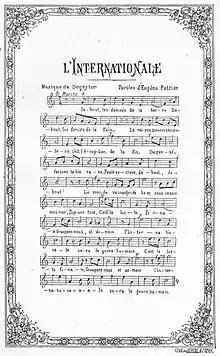 "L'Internationale", original French version | |
International anthem of anarchists, communists, and socialists | |
| Also known as | L'Internationale (French) |
|---|---|
| Lyrics | Eugène Pottier, 1871 |
| Music | Pierre De Geyter, 1888 |
| Audio sample | |
"The Internationale" (instrumental)
| |
History
"The Internationale" has been adopted as the anthem of various anarchist, communist, and socialist movements.[4][5]
From 1918 to 1944, "The Internationale" was used as an anthem of the Bolshevik Party, Soviet Russia and subsequently the USSR, before being replaced with the more nationally-focused State Anthem of the Soviet Union, reflecting Stalinist trends. (In 1917 and early 1918 Worker's Marseillaise was used as such). It was also used as a national anthem by the Chinese Soviet Republic, Bavarian Soviet Republic, Slovak Soviet Republic, and Hungarian Soviet Republic.
"The Internationale" is one of the most universally translated anthems in history.[6]
Copyright
The original French words were written in June 1871 by Eugène Pottier (1816–1887, previously a member of the Paris Commune)[7] and were originally intended to be sung to the tune of "La Marseillaise".[8] In 1888 Pierre De Geyter (1848–1932) set the earlier lyrics to the melody of Chant du depart with slight modifications.[9] De Geyter's melody was first publicly performed in July 1888,[10] and soon thereafter Pottier's lyrics became closely associated with, and widely used with, De Geyter's new melody. Thus "The Internationale" gained an identity that was entirely distinct, and no longer in any way directly tied to the French national anthem, the Marseillaise.
In a successful attempt to save Pierre De Geyter's job as a woodcarver, the 6,000 leaflets printed by Lille printer Bolboduc only mentioned the French version of his family name (Degeyter). In 1904, Pierre's brother Adolphe was induced by the Lille mayor Gustave Delory to claim copyright, so that the income of the song would continue to go to Delory's French Socialist Party. Pierre De Geyter lost the first copyright case in 1914, but after his brother died by suicide and left a note explaining the fraud, Pierre was declared the copyright owner by a court of appeal in 1922.[11]
In 1972 "Montana Edition", owned by Hans R. Beierlein, bought the rights to the song for 5,000 Deutschmark, first for the territory of West Germany, then in East Germany, then worldwide. East Germany paid Montana Edition 20,000 DM every year for its rights to play the music. Pierre De Geyter died in 1932, causing the copyrights to expire in 2002.[12] Luckhardt's German text is public domain since 1984.
As the "Internationale" music was published before 1 July 1909 outside the United States, it is in the public domain in the United States.[13] As of 2013, Pierre De Geyter's music is also in the public domain in countries and areas whose copyright durations are authors' lifetime plus 80 years or less.[14] Due to France's wartime copyright extensions (prorogations de guerre), SACEM claimed that the music was still copyrighted in France until October 2014.[15] Because of this, the "Internationale" is also in public domain within France.
As Eugène Pottier died in 1887, his original French lyrics are in the public domain. Gustave Delory once acquired the copyright of his lyrics through the songwriter G. B. Clement having bought it from Pottier's widow.[16]
First-known French version
 |
Wikisource has original text related to this article: |
There exists the following written version of the poem, which is older than the final version printed on 1887. It was published in 1990 by Robert Brécy:[17]
| French | Literal English translation |
|---|---|
Couplet 1 : |
Verse 1: |
Final French lyrics
| French | Literal English translation |
|---|---|
Debout, les damnés de la terre |
Arise, wretched of the earth |
Translations into other languages
German translation
Here follows the most known version, the 1910 translation by Emil Luckhardt:
| German (1910 version by Emil Luckhardt) |
Literal English translation |
|---|---|
Wacht auf, Verdammte dieser Erde, Auf zum letzten Gefecht! |
Wake up, wretched of this Earth On to the last fight! |
Russian translation
The Russian version was initially translated by Arkady Kots in 1902 and printed in London in Zhizn, a Russian émigré magazine. The first Russian version consisted of three stanzas (as opposed to six stanzas in the original French lyrics and based on stanzas 1, 2, and 6) and the refrain. After the Bolshevik Revolution in Russia, the text was slightly re-worded to get rid of "now useless" future tenses – particularly the refrain was reworded (the future tense was replaced by the present, and the first person plural possessive pronoun was introduced). In 1918, the chief editor of Izvestia, Yuri Steklov, appealed to Russian writers to translate the other three stanzas and in the end, the song was expanded into six stanzas.[18] On 15 March 1944, the Soviet Union adopted the "Hymn of the Soviet Union" as its national anthem. Prior to that time, "The Internationale" served as the principal musical expression of allegiance to the ideals of the October Revolution and the Soviet Union (the "Internationale" continued to be recognized as the official song of the Communist Party of the Soviet Union, and the post-1919 Soviet version is still used by the Communist Party of the Russian Federation). The full song is as follows:
| English: The Internationale | |
|---|---|
| Интернационал | |
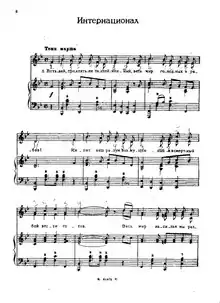 | |
Former national anthem of the .svg.png.webp) Russian SFSR, 1918–22 Russian SFSR, 1918–22
Former national anthem of the .svg.png.webp) Soviet Union, 1922–44 Soviet Union, 1922–44 | |
| Lyrics | Аркадий Коц (Arkady Kots), 1902 |
| Music | Pierre De Geyter, 1888 |
| Published | 1902 |
| Adopted | 1918 (Russian SFSR) 1922 (Soviet Union) |
| Relinquished | 1922 (Russian SFSR) 1944 (Soviet Union) |
| Succeeded by | State Anthem of the Soviet Union (Государственный гимн Советского Союза) |
| Audio sample | |
The Internationale, Russian
| |
| Russian translation | Transliteration | Literal English translation |
|---|---|---|
Вставай, проклятьем заклеймённый, |
Vstavay, proklyatyem zakleymyonny, |
Get up, branded by the curse, |
English translations
The traditional UK version of "The Internationale" is usually sung in three verses, while the American version, written by Charles Hope Kerr with five verses, is usually sung in two.[19][20] The American version is sometimes sung with the phrase "the internationale", "the international soviet", or "the international union" in place of "the international working class". In English renditions, "Internationale" is sometimes sung as /ɪntərnæʃəˈnæli/ rather than the French pronunciation of [ɛ̃tɛʁnasjɔnal(ə)]. In modern usage, the American verison also often uses "their" instead of "his" in "Let each stand in his place", and "free" instead of "be" in "Shall be the Human race."
Pete Seeger asked Billy Bragg to sing "The Internationale" with him at the Vancouver Folk Festival in 1989. Bragg thought the traditional English lyrics were archaic and unsingable (Scottish musician Dick Gaughan[21] and former Labour MP Tony Benn[22] disagreed), and composed a new set of lyrics.[23] The recording was released on his album The Internationale along with reworkings of other socialist songs.
| British version (by Eugène Pottier) | American version (by Charles Hope Kerr) | Billy Bragg version |
|---|---|---|
|
|
|
Bengali translation
"The Internationale" was translated to Bengali by Hemanga Biswas[24] and Mohit Banerji. It was subsequently adopted by West Bengal's Left Front.[25]
| Bengali translation | Transliteration | Literal English translation |
|---|---|---|
(x2) জাগো জাগো জাগো সর্বহারা অনশন বন্দী ক্রিতদাস শ্রমিক দিয়াছে আজি সাড়া উঠিয়াছে মুক্তির আশ্বাস।। সনাতন জীর্ণ কু-আচার চূর্ণ করি জাগো জনগণ ঘুচাও এ দৈন্য হাহাকার জীবন-মরণ করি পণ।। (x2) শেষ যুদ্ধ শুরু আজ কমরেড এসো মোরা মিলি একসাথ ইন্টারন্যাশনাল মিলাবে মানবজাত।। |
(x2)
Jago jago jago sorbohara, Onoshono bondi kritodas, Shromik Diyache aaji saara, Uthiyache muktir ashwas.
Sonaton jirno ku-achar, Churno kori jago janagon, Ghuchao ei dainya hahakar, Jiban maran kori pon.
Sesh juddho suru aaj Comrade, Eso mora mili ek sath Internationale Milabe manobo jaat. |
(x2)
Wake up, wake up, wake up, proletariat, Slaves bent on hunger strike; Workers have responded today, Assurance of liberation has risen.
Break the traditional, worn-out prejudices, And doing so, people - wake up! End this miserable wail, Bet your life and death.
The final war has commenced now comrade, Come let's together unite; The Internationale, Shall unite mankind. |
Chinese translation
"The Internationale" in Chinese (simplified Chinese: 国际歌; traditional Chinese: 國際歌; pinyin: Guójìgē), literally the "International Song", was first translated on 15 June 1923 from the French original by Qu Qiubai (Chinese: 瞿秋白),[24] a leading member of the Communist Party of China in the late 1920s. His translation has transliterated "The Internationale" as Yīngdénàxióngnà'ěr (simplified Chinese: 英德纳雄纳尔; traditional Chinese: 英德納雄納爾) when singing the phrase in Standard Chinese. As he was executed by the Kuomintang in 1935, his Chinese translation is in the public domain wherever the duration of copyright is an author's lifetime plus up to 70 years, including Chinese-speaking Mainland China, Hong Kong, Macau, Taiwan (lifetime plus 50 years in these places), and Singapore (lifetime plus 70 years). The three stanzas of this version roughly correspond to the three stanzas of Arkady Kots' Russian version and the first, second, and sixth French lyrics by Eugène Pottier. The third, fourth and fifth stanzas of the French original are not used in this version.
| Traditional Chinese | Simplified Chinese | Pinyin | Literal English translation |
|---|---|---|---|
起來,饑寒交迫的奴隸, |
起来,饥寒交迫的奴隶, |
Qǐ lái, jī hán jiāo pò de nú lì, |
Arise, slaves afflicted by hunger and cold, |
Xiao San's version
This version was translated from the Russian version in 1923 by the poet Xiao San, friend of Mao Zedong. This version is the most common and is also the anthem of the Communist Party of China.[23] Xiao's version was a revision of Qu's translation, which did not see widespread use due to it being written in Classical Chinese,[26] although the phrase "The Internationale" was similarly transliterated as Yīngtènàxióngnài'ěr (simplified Chinese: 英特纳雄耐尔; traditional Chinese: 英特納雄耐爾). When the Chinese Soviet Republic was established in 1931, it was decided to be its national anthem.[25] The version was officially revised in 1962 by China National Radio and Chinese Musicians' Association.[27][28]
The song was a rallying anthem of the demonstrators at the Tiananmen Square protests of 1989, and was repeatedly sung both while marching to the Square and within the Square.
...many hundreds of people (not only students) appeared on the street. They ran after the trucks and shouted protest slogans. A few stones were thrown. The soldiers opened fire with live ammunition. The crowd threw themselves on the ground, but quickly followed the convoy again. The more shots were fired, the more the crowd got determined and outraged. Suddenly they started singing "The Internationale"; they armed themselves with stones and threw them towards the soldiers. There were also a few Molotov cocktails and the last truck was set on fire.[29]
| Traditional Chinese | Simplified Chinese | Pinyin | Literal English translation |
|---|---|---|---|
起來,饑寒交迫的奴隸, |
起来,饥寒交迫的奴隶, |
Qǐ lái, jī hán jiāo pò de nú lì, |
Arise, slaves afflicted by hunger and cold, |
National Revolutionary Army version
When commemorating the 55th anniversary of the Paris Commune on 18 March 1926, the National Revolutionary Army printed a music sheet with three lyrics of "The Internationale" in Chinese, roughly corresponding to the first, second, and sixth French lyrics by Eugène Pottier. When singing refrain twice after each lyric, "The Internationale" is transliterated first as Yīngtè'ěrlāxióngnà'ěr (Chinese: 英特爾拉雄納爾) and second as Yīngtè'ěrnàxióngnà'ěr (Chinese: 英特爾納雄納爾).
| Traditional Chinese | Simplified Chinese | Pinyin | Literal English translation |
|---|---|---|---|
起來饑寒交迫的奴隸, |
起来饥寒交迫的奴隶, |
Qǐlái, jīhánjiāopò de núlì, |
Arise, slaves afflicted by hunger and cold, |
Shen Baoji's version
The third, fourth, and fifth French stanzas are not sung in Chinese in the above two versions of Qu and the National Revolutionary Army. Chinese translator Shen Baoji (simplified Chinese: 沈宝基; traditional Chinese: 沈寶基; 1908–2002) has made a complete Chinese translation, published in 1957, of all six French stanzas. Shen's translation has transliterated "The Internationale" as Yīngdāi'ěrnàxī'àonà'ěr (simplified Chinese: 因呆尔那西奥纳尔; traditional Chinese: 因呆爾那西奧納爾) in the stanzas, different from the transliterations of Qu and the National Revolutionary Army. As the Copyright Law of the People's Republic of China grants individuals copyright for their lifetime plus 50 years, Shen's translation is expected to remain copyrighted there until the end of 2052.
Other Chinese translations
In addition to the Mandarin version, "The Internationale" also has Cantonese[30] and Taiwanese Hokkien[31] versions, occasionally used in Hong Kong and Taiwan. The word "Internationale" is not translated in either version. Uyghur version, Tibetan version[32] and Mongolian version is also translated for the use of ethnic minorities of China.
Filipino translation
There were three Filipino versions of the song. The first was composed by Juan Feleo of the Partido Komunista ng Pilipinas-1930 under the title "Pandaigdigang Awit ng Manggagawa" (The International Worker's Anthem) which was translated from the English version. The second version was a retranslation of the first two stanzas on the basis of the French original by the Communist Party of the Philippines. The third version, which introduced the third stanza, was derived from both Chinese and French versions and translated by Jose Maria Sison, the CPP's founding chairman.[33]
| PKP-1930 version | 1969 CPP version | 2016 CPP version |
|---|---|---|
|
Bangon sa pagkakagupiling |
Bangon sa pagkakabusabos |
Bangon sa pagkakabusabos |
Greek translation
The Internationale is widely known among Greek people. The Communist Party of Greece is considered one of the most foundational parties in the country, having been founded in 1918. The party was banned in 1936 after the military coup d'etat, but continued to operate underground - communist party members were the main resistance group against the Axis powers during World War II. After the Greek Civil War, the party was banned once again. During the military junta, individuals accused of being communists were imprisoned, tortured, and even executed by the military dictatorship. Anger at the regime finally coalesced in the Athens Polytechnic uprising of 1973, where students, including communist supporters (primarily the educated youth), attempted to resist the dictatorship. These events solidified the Communist Party's reputation as a symbol of left-wing resistance against Nazism and dictatorial governments.
This is the Greek version of The Internationale and the anthem of the Communist Party of Greece:[34]
| Transliteration | Literal English translation | |
|---|---|---|
| Εμπρός της γης οι κολασμένοι Της πείνας σκλάβοι εμπρός-εμπρός. Το δίκιο απ' τον κρατήρα βγαίνει Σα βροντή σαν κεραυνός! Φτάνουν πια της σκλαβιάς τα χρόνια. Όλοι εμείς οι ταπεινοί της γης Που ζούσαμε στην καταφρόνια Θα γίνουμε το παν εμείς.! Στον Αγώνα Ενωμένοι Κι ας μη λείψει κανείς. Ω! Να 'τη, μας προσμένει Στον κόσμο η Διεθνής.! Θεοί, αρχόντοι, βασιλιάδες Με πλάνα λόγια μας γελούν. Της γης οι δούλοι κι οι ραγιάδες Μοναχοί τους, θα σωθούν! Για να σπάσουμε τα δεσμά μας Για να πάψει πια η σκλαβιά. Να νιώσουν πρέπει τη γροθιά μας Και της ψυχής μας τη φωτιά! Στον Αγώνα Ενωμένοι Κι ας μη λείψει κανείς. Ω! Να 'τη, μας προσμένει Στον κόσμο η Διεθνής! Και αν τολμήσουν και αντικρίσουν Της ψυχής μας τους κεραυνούς. θα δούνε τότε αν μπορούνε Πως θα είναι οι σφαίρες μας για αυτούς! |
Emprós tis gis oi kolasménoi Tis peínas sklávoi emprós-emprós. To díkio ap' ton kratíra vgaínei Sa vrontí san keravnós! Ftánoun pia tis sklaviás ta chrónia. Óloi emeís oi tapeinoí tis gis Pou zoúsame stin katafrónia Tha gínoume to pan emeís.! Ston Agóna Enoménoi Ki as mi leípsei kaneís. O! Na 'ti, mas prosménei Ston kósmo i Diethnís.! Theoí, archóntoi, vasiliádes Me plána lógia mas geloún. Tis gis oi doúloi ki oi ragiádes Monachoí tous, tha sothoún! Gia na spásoume ta desmá mas Gia na pápsei pia i sklaviá. Na niósoun prépei ti grothiá mas Kai tis psychís mas ti fotiá! Ston Agóna Enoménoi Ki as mi leípsei kaneís. O! Na 'ti, mas prosménei Ston kósmo i Diethnís! Kai an tolmísoun kai antikrísoun Tis psychís mas tous keravnoús . Τha doúne tóte an boroúne Pos tha eínai oi sfaíres mas gia aftoús! |
Stand up, oppressed of this world Slaves of starvation go ahead. Justice arises from the crater Like lightning, like thunder! Let's stop the years of slavery. All of us, the oppressed on Earth Who lived at the scorn We all, will be everything! At the struggle, united And let everyone fight. Oh there it is, it's waiting for us... The Internationale! Gods, lords and kings Are deceiving us with false words. The slaves and oppressed of this world Are going to be saved without anyone's help! In order to break our chains In order to end slavery. They must feel our fist And the fire of our soul! At the struggle, united And let everyone fight. Oh there it is, it's waiting for us... The Internationale! And if they dare to face The lightning of our souls. They will understand, if they can, That our bullets are for them! |
Korean translation
The Internationale is used in both Koreas, though it is more commonly used in the North. Despite no longer being a Communist State, the DPRK continues to utilize the Internationale in propaganda and music,[35] Party Congresses,[36] and even sports events.[37] In the South, the Internationale has been used by labor unions and protestors but remains less celebrated. As the northern lyrics are often considered too archaic and Communistic by southerners, there are 2 presently used versions of the Korean Internationale - the traditional lyrics, and the newer lyrics. While the northern lyrics borrow heavily from the Russian Internationale, the southern lyrics are completely original. In addition, the Southern refrain is longer and does not repeat.[38]
| Korean (Northern version) | Literal English translation |
|---|---|
일어나라, 저주로 인맞은, 판가림, 싸움이니! |
Awaken, world of the hungry and slaves! And decisive struggle |
| Korean (Southern version) | Literal English translation |
|---|---|
깨어나라, 노동자의 군대, 투쟁의 외침을, |
Arise, army of workers! And the cry of struggle! |
Japanese translation
The first Japanese translation of "The Internationale" was by Kūkoku Kozuka and was published in the newspaper "Labor World" in February 1903 under the title of "The Song of the World Party" as a revolutionary poem. In 1922, the fifth anniversary of the Russian Revolution, Takamaru Sasaki translated it for singing. However, this translation by Sasaki was a verbatim translation of the original poem that was forcibly applied to the notes and was lacking in strength. Therefore, at the beginning of the Showa era, the lyrics other than the refrain part were translated again by Sasaki and Seki Sano, resulting in the song as is currently being sung.
| Japanese | Romaji | English translation |
|---|---|---|
起て飢えたる者よ |
Tate uetaru mono yo |
|
Vietnamese translation
The most widely circulated Vietnamese version, "Quốc tế ca", was translated by composer Đỗ Minh. An earlier translation, adapted by revolutionary leader Hồ Chí Minh using the traditional Vietnamese lục bát verse form, was popular among Việt Minh soldiers during the August Revolution of 1945.
The song is included in the music curriculum for 8th-graders (aged 13) in Vietnam's K-12 education system. Since 2020, members of the Communist Party of Vietnam have been required to sing The Internationale during the flag salute ceremony at the start of Party meetings, after the national anthem.[39]
| Vietnamese (Đỗ Minh's version) |
Literal English translation |
|---|---|
Vùng lên! Hỡi các nô lệ ở thế gian |
Arise, slaves of this Earth |
Indonesian translation
The most used Indonesian version is made by Ki Hajar Dewantara, and already translated to EYD (Ejaan yang Disempurnakaan/Refined word)
| Indonesian (1951 version by Ki Hajar Dewantara) |
English translation |
|---|---|
Bangunlah kaum jang terhina, |
Wake up, the humiliated people, |
Italian version
Criticised for not translating nor adapting the original lyrics ( that in fact are completely different in meaning ), it was written by an unknown author, who presented it in a contest of the socialist satyrical newspaper L'Asino, which this version of the lyrics won. The author signs their name as E. Bergeret, and some theories consider this as a pseudonym for Ettore Marroni, a journalist who used this name in his articles on Il Mattino and La Stampa. Another version was written in the 1970's by the poet Franco Fortini, but it is less known and not commonly used.
| Italian (E. Bergeret's version) |
Literal English translation |
|---|---|
Compagni avanti, il gran Partito |
Comrades arise, the great party |
| Italian (E. Bergeret's version) |
Literal English translation |
|---|---|
Noi siamo gli ultimi del mondo. |
We are the lasts of the earth, |
Other translations
- Versions of the song in South Asian languages, particularly Bengali and Malayalam, have existed since the time of colonial rule. It was translated into Bengali by the national poet of Bangladesh, Kazi Nazrul Islam, and subsequently by Bengali singer Hemanga Biswas. The Assamese version was translated by the poet Bishnu Rabha. The Malayalam version of the song has existed since the 1950s with the translation of the song for the people of the Indian state of Kerala by actor and social activist Premji for the united Communist Party of India (CPI). Pakistani musical group Laal performed a version of this anthem in their translation.
Popular references
- In the 1933 German film Hitler Youth Quex, Heini's father forces him to sing Die Internationale after he returns from a camping trip with the Hitler Youth.
- Both in Soviet poet Yevgeny Yevtushenko's 1961 poem Babiyy Yar as well as composer Dmitri Shostakovich's symphony incorporating its text, the Internationale is referenced: "Let the Internationale thunder, when the last anti-Semite on Earth is buried forever!".[40]
- In David Lean's 1965 film adaptation of Doctor Zhivago, The Internationale is sang by a large crowd of civil protesters in 1913 Moscow.
- In the 1965 film The East Is Red, produced the year prior to the Cultural Revolution, the song is performed at the film's opening and in the last scene.
- In Federico Fellini's 1973 film Amarcord, the song is played on gramophone as part of a cruel prank to get an innocent person arrested by Fascists in 1930s Italy.
- In Warren Beatty's 1981 film Reds, the song is sung by protesting workers in St. Petersburg, over a montage of scenes depicting the Russian Revolution.
- In Alan Dean Foster's 1983 novel Spellsinger, the protagonist Jon-Tom sings the song to placate an enraged Marxist dragon.
- In Michael Cimino's 1987 film The Sicilian, the song is sung by Sicilian peasants right before the Portella della Ginestra massacre.
- In the 1994 film In the Heat of the Sun (阳光灿烂的日子) by Chinese director Jiang Wen, the song plays loudly over a brutal scene where the main character, Ma Xiaojun, repeatedly beats an innocent victim to a state of bloodied unconsciousness. The film is set during the Cultural Revolution (1966–1976), when "The Internationale" was played at official events and at the end of each day's radio broadcast.[41]
- Ken Loach used the Spanish version of this song in his 1995 movie Land and Freedom, set during the Spanish Civil War.[42]
- In 1997 film Air Force One, the song is sung loudly when General Ivan Radek is released.
- The song played during the film The Beautician and the Beast.
- A Music box version of the song can be heard at the start and end of the music video for the Manic Street Preachers 1998 single If You Tolerate This Your Children Will Be Next.[43] The song deals with the topic of the Spanish Civil War and Anti-fascism in general. The single peaked at number 1 in the UK Singles Chart, the band's first single to do so.[44]
References
- Nic Maclellan (2004). Louise Michel: Rebel Lives. Ocean Press. pp. 7, 89. ISBN 9781876175764.
- Donny Gluckstein. "Decyphering 'The Internationale'".
- "Did you know that the composer of 'The Internationale' was Belgian?". Focus on Belgium. 21 April 2017. Retrieved 12 June 2021.
- World Book Encyclopedia, 2018 ed., s.v. "Internationale, The"
- "The International Anarchist Congress, Amsterdam, 1907" (PDF). www.fdca.it. Retrieved 7 December 2018.
- "SovMusic.ru - " Internationale "".
- Gill 1998, 1st paragraph.
- David Walls. "Billy Bragg's Revival of Aging Anthems: Radical Nostalgia or Activist Inspiration?". Sonoma State University.
- Gill 1998, 9th paragraph.
- Gill 1998, 11th paragraph.
- Gill 1998.
- "Ich habe die Kommunisten bezahlen lassen", Die Welt, Hans R. Beierlein, 2014-04-18.
- Peter B. Hirtle. "Copyright Term and the Public Domain in the United States". Archived from the original on 4 July 2012.
- Year 1932 when Pierre De Geyter died, plus 80 years, would get to year 2012.
- Vulser, Nicole (8 April 2005). "Siffloter 'L'Internationale' peut coûter cher". Le Monde (in French). Retrieved 7 December 2015.
- Gill 1998, 16th paragraph.
- Robert Brécy, Florilège de la Chanson Révolutionnaire, De 1789 au Front Populaire, Éditions Ouvrières, Paris, 1990, page 137.
- A. V. Lunacharskiy (ed.). "The International (in Russian)". Fundamental'naya Elektronnaya Biblioteka.
- Walls, David (17 July 2007). "Billy Bragg's Revival of Aging Anthems: Radical Nostalgia or Activist Inspiration?". Sonoma State University.
- Venturi, Riccardo; et al. (8 June 2005). "The Internationale" in 82 languages". Anti-War Songs.
- Gaughan, Dick. "The Internationale". Dick Gaughan's Song Archive. Archived from the original on 29 September 2018.
I can see no more point in trying to 'modernise' it than I would in repainting the Cistine [sic] Chapel or rewriting Shakespeare's plays.
- Benn, Tony (2014). A Blaze of Autumn Sunshine: The Last Diaries. Arrow Books. p. 129. ISBN 978-0-09-956495-9.
- Billy Bragg – Internationale on YouTube, from the Pete Seeger 90th Birthday Concert (The Clearwater Concert) at Madison Square Garden, 3 May 2009.
- "Remembering Hemanga Biswas: An artivist who fought to have it all".
- "জাগো জাগো জাগো সর্বহারা – Bangla Lyrics । বাংলা লিরিক".
- ""国际歌"中文译配版权属瞿秋白 在中国最早公开唱". culture.people.com.cn. Retrieved 7 December 2018.
- "重读《国际歌》感言". www.yhcqw.com. Yanhuang Chunqiu. Retrieved 28 November 2018.
- "《国际歌》中文译词的演变 – 中国共产党新闻 – 中国共产党新闻网". cpc.people.com.cn. Retrieved 28 November 2018.
- Amnesty International, 30 August 1989. Preliminary Findings on Killings of Unarmed Civilians, Arbitrary Arrests and Summary Executions Since 3 June 1989, p. 19
- "Archived copy". Archived from the original on 12 June 2004. Retrieved 12 June 2004.CS1 maint: archived copy as title (link)
- "Archived copy". Archived from the original on 18 January 2006. Retrieved 18 January 2006.CS1 maint: archived copy as title (link)
- The Internationale: Tibetan (རྒྱལ་སྤྱིའི་གླུ་དབྱངས བོད་སྐད་). GETchan. 30 August 2020. Archived from the original on 4 March 2021. Retrieved 5 October 2021 – via YouTube.
- "The Internationale in Filipino". Josemariasison.org. Retrieved 25 October 2018.
- "stixoi.info: Διεθνής ( Διορθώσεις )". stixoi.info. Retrieved 2 February 2021.
- 인터나쇼날. urinore1. 30 April 2014. Archived from the original on 18 March 2021. Retrieved 5 October 2021 – via YouTube.
- "The Internationale" closes the 8th Congress of the Workers' Party of Korea. 푸옹 Phuong DPRK Daily. 12 January 2021. Archived from the original on 22 September 2021. Retrieved 5 October 2021 – via YouTube.
- The Internationale in North Korea (Arirang Mass Games 2013). Pyongyang. 1 August 2013. Archived from the original on 4 February 2017. Retrieved 5 October 2021 – via YouTube.
- 인터내셔널가 - The Internationale Korean version. Daehanminguk31. 1 March 2013. Archived from the original on 12 December 2021. Retrieved 5 October 2021 – via YouTube.
- "Tự hào với những giai điệu "vùng lên"" [Take pride in "uprising" songs] (in Vietnamese). 18 June 2020. Retrieved 27 July 2021.
- Yevtushenko, Yevgeny. "Babi Yar." 1961. The Collected Poems 1952–1990 by Yevgeny Yectushenko. pp. 1–3.
- Braester, Yomi (2001). "Memory at a standstill: 'street-smart history' in Jiang Wen's in the Heat of the Sun". Screen. 42 (4): 350–362. doi:10.1093/screen/42.4.350.
- Soundtrack, Land and Freedom, IMDb
- Manic Street Preachers - If You Tolerate This Your Children Will Be Next. ManicStPreachersVEVO. 25 October 2009. Archived from the original on 17 September 2021. Retrieved 5 October 2021 – via YouTube.
- "Manic Street Preachers". OfficialCharts.com.
External links
- The Internationale (2000 documentary) at IMDb
- Another large collection of downloadable recordings
- "The Internationale": lyrics and tabs
- "The Internationale" in a minor mode by the Prolétariat Mondial Organiseyyy on YouTube (in French)
- Downloadable recordings in more than 40 languages
- Piano arrangements and orchestral MIDI file of "The Internationale"
- IWW Version, translated by Charles Kerr from The Little Red Songbook London, 1916
Giulia Cavaliere,[1]






.svg.png.webp)
Authority control  | |
|---|---|
| General | |
| National libraries | |
| Other | |
- Cavaliere, Giulia. "L'Internazionale: da canto franco-belga a inno dei lavoratori, tra censure e riscritture contemporanee. Versioni in italiano". corriere.it. Giulia Cavaliere. Retrieved 10 December 2021.
- "Marroni, Ettore". treccani.it. Retrieved 10 December 2021.