Kitami
Kitami (北見市, Kitami-shi) is a city in Okhotsk Subprefecture, Hokkaido, Japan. It is the most populous city and the commercial center in the subprefecture, although the subprefectural capital is Abashiri.
Kitami
北見市 | |
|---|---|
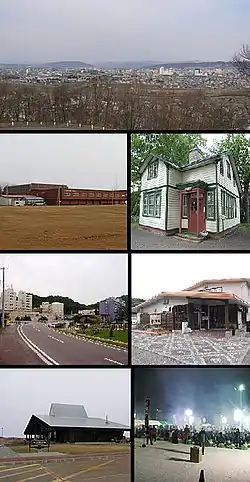 Clockwise from top: View of downtown Kitami from Southhill Forest Park, Pierson Memorial Museum, Takinoyu Spa, Kitami BBQ Festival in February, Wakka Nature Center, Street in Onneyu area, Kitami Municipal Curling Arena | |
 Flag  Emblem | |
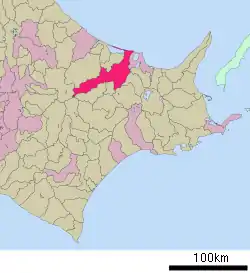 Location of Kitami in Hokkaido (Okhotsk Subprefecture) | |
  Kitami Location in Japan | |
| Coordinates: 43°48′N 143°54′E | |
| Country | Japan |
| Region | Hokkaido |
| Prefecture | Hokkaido (Okhotsk Subprefecture) |
| Government | |
| • Mayor | Makoto Sakurada |
| Area | |
| • Total | 1,427.56 km2 (551.18 sq mi) |
| Population (April 30, 2017) | |
| • Total | 119,135 |
| • Density | 83/km2 (220/sq mi) |
| Time zone | UTC+09:00 (JST) |
| City hall address | 1 Higashi Ni-chōme, Kita Go-jō, Kitami-shi, Hokkaido 090-8501 |
| Website | www |
| Symbols | |
| Flower | Chrysanthemum |
| Tree | Japanese Yew |
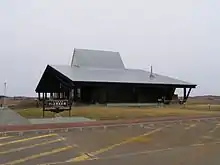
Kitami is in central Okhotsk Subprefecture. The Kitami Mountains are nearby.
As of November of 2021, the city has a population of 115,351,[1] in 61,793 households. The population density is 83 inhabitants per square kilometre (210/sq mi). The total area is 1,427.56 km2 (551.18 sq mi).
Etymology
The name came from a suggestion of the Japanese explorer and cartographer Matsuura Takeshirō during the Meiji Era, when imperial bureaucrats were registering the place for initiate the region's development trough the Hokkaidō Development Commission. Before the imperial intervention, there was no Ainu name for the place.
The meaning of the name consist in the kanji's combinations of characters 北 (North) 見 (See) and 市 (city), which means "City of the North View". The reason behind this is due to the region's mountains that allow to see the sea and the island of Sakhalin.
Originally, the name refers to a vast area between the Mountains and the Sea of Okhotsk . Since the merger of Kitami City with the surrounding Tokoro, Rubeshibe and Tanno Towns in 2006, it often being referred as the area around the Kitami Basin (so-called Kitami Inland Area ), excluding the former Tokoro Town area in the coastal area.
Historical Chronology
- 1872: The village of Notsukeushi-mura (ノツケウシ村) founded
- 1875: Notsukeushi-mura was given the kanji 野付牛村.
- 1910: Train service arrives (then called the Ikeda Railway Line), connecting the village to Sapporo.[2]
- 1915: The villages of Rubeshibe and Oketo were split off.
- 1916: Became Notsukeushi Town.
- 1921: The villages of Tanno and Ainonai were split off.
- June 10, 1942: Kitami becomes a city.
- September 1956: The village of Ainonai was merged into Kitami.
- March 5, 2006: The towns of Rubeshibe, Tanno and Tokoro (all from Tokoro District) merged with the city of Kitami to form the new city of Kitami.
Towns and Autonomous Regions
Kitami is the result of the administrative unification of smalls towns with the main city, which was made in 2006. These small towns still exists as a Autonomous region districts (自治区). There is 4 autonomous regions/towns in tolal.
City of Kitami
Translated as North View (北 見), is the main urban area of the region.The district flourished during prewar era through the production of mint, which at the time accounted for 70% of world production. Nowadays Kitami is the commercial, industrial and service center of the Okhotsk area. The government apply efforts of development through industry-academia-government collaboration involving universities and other higher education institutions that are also based in the district.
Town of Tanno
Translated as Border Field (端野), the district is mainly a farm field with smooth hills and a rural landscape in the Tokoro river basin. The district has an educational zone with elementary and junior high schools, social education facilities and parks in the main centre of the district. The rural landscape is also shaped by farms with urban convenience.
Town of Tokoro
Agriculture and fisheries thrive in this district with abundant nature, including Wakka Wild Flower Park, where flowers stand out on the sandbar between the Sea of Okhotsk and Lake Saroma. It has a year-round curling hall, which is one of the largest of its kind in Japan, as well as historical sites such as the Tokoro Site and the birthplace of scallop cultivation.
Town of Rubeshibe
Translated as Legacy of the Detained Pistils (留辺蘂), the district is surrounded by thick forests at the foot of the Taisetsu mountains and along the Muka River. Its key industries are White Flower (shirohana-mame) beans production, for which it boasts the nation’s largest yield, and the forest products industry, which uses locally produced wood. As a tourist spot, Yama no Aquarium (Kita no Daichi no Aquarium) in the Onneyu Onsen resort is attracting nationwide attention with its unique display tanks.
Economy and industry
Kitami's first economy was the natural production of Mentha (Mint). During at one time (pre-war) the region exported mint (known as hakka locally) in a scale that represented the supply of 70% of the world's mint consumption.[3][4]
Education
Kitami is home to the Kitami Institute of Technology, an engineering university that originally opened in 1960,[5] and the Japanese Red Cross Hokkaido College of Nursing, established in 1999 by the Japanese Red Cross through consolidation of several other institutions.[6]
National
Public
- Hokkaido Kitami Hokuto High School
- Hokkaido Kitami Hakuyou High School
- Hokkaido Kitami Ryokuryo High School
- Hokkaido Kitami Commercial High School
- Hokkaido Kitami Technical High School
- Hokkaido Rubeshibe High School
- Hokkaido Tokoro High School
Private
- Kitami Fuji Girls' High School
Festivals
Sports
Curling
The city has strong associations with the sport of curling, inherited from the former town of Tokoro absorbed into the city in 2006. Interest in the sport grew following a friendship visit in 1980 by a curling team from Alberta in Canada.[10] An outdoor curling rink was built in Tokoro the following year, and it hosted the 1st NHK Cup Curling Championship.[10] In January 1988, the town built a dedicated 5-lane curling hall, the first in Japan.[11] This eventually closed in early 2013, replaced by a new, larger, all-year-round structure.[11]
Curling was introduced in schools in Tokoro as part of the physical education curriculum, and the two produced a number of Olympic curlers.[10] Five members of the Japanese curling team at the 1998 Winter Olympics in Nagano were from Tokoro, three members of the Japanese curling team at the 2006 Winter Olympics in Torino were from Tokoro, and three members of the Japanese curling team at the 2010 Winter Olympics in Vancouver were from Tokoro.[10]
Climate
Kitami has a humid continental climate with cold winters and relatively warm summers. The coldest month is January, with an average low of −14.7 °C (5.5 °F), and the warmest month is August, with an average high of 25 °C (77 °F). Kitami's inland location creates a larger temperature range than some coastal cities. Due to the mountains nearby, the Foehn wind effect occurs in summer when prevailing winds are from the southeast, so that Kitami often has the hottest temperatures in Hokkaido during this season and averages about 5 °C (9 °F) hotter than Kushiro. Traces of snow fall every day during the winter and cover is heavy, usually peaking at 0.82 metres (32.28 in), though Kitami still receives less overall precipitation than any other town in Japan as it is shielded from the heaviest moisture from both the Sea of Japan and Pacific Ocean.
| Climate data for Kitami, Hokkaido (1981–2010) | |||||||||||||
|---|---|---|---|---|---|---|---|---|---|---|---|---|---|
| Month | Jan | Feb | Mar | Apr | May | Jun | Jul | Aug | Sep | Oct | Nov | Dec | Year |
| Record high °C (°F) | 8.0 (46.4) |
7.9 (46.2) |
24.2 (75.6) |
32.2 (90.0) |
38.1 (100.6) |
34.2 (93.6) |
35.9 (96.6) |
37.0 (98.6) |
32.1 (89.8) |
27.7 (81.9) |
22.0 (71.6) |
14.5 (58.1) |
38.1 (100.6) |
| Average high °C (°F) | −2.9 (26.8) |
−1.9 (28.6) |
2.9 (37.2) |
11.3 (52.3) |
17.6 (63.7) |
21.2 (70.2) |
24.3 (75.7) |
25.7 (78.3) |
21.3 (70.3) |
15.4 (59.7) |
7.5 (45.5) |
0.1 (32.2) |
11.9 (53.4) |
| Daily mean °C (°F) | −8.5 (16.7) |
−7.8 (18.0) |
−2.4 (27.7) |
5.0 (41.0) |
10.9 (51.6) |
15.0 (59.0) |
18.7 (65.7) |
20.2 (68.4) |
15.8 (60.4) |
9.1 (48.4) |
2.1 (35.8) |
−5.0 (23.0) |
6.1 (43.0) |
| Average low °C (°F) | −14.7 (5.5) |
−14.1 (6.6) |
−8.1 (17.4) |
−0.7 (30.7) |
4.7 (40.5) |
9.7 (49.5) |
14.1 (57.4) |
15.8 (60.4) |
10.6 (51.1) |
3.4 (38.1) |
−2.9 (26.8) |
−10.6 (12.9) |
0.6 (33.1) |
| Record low °C (°F) | −30.1 (−22.2) |
−30.9 (−23.6) |
−24.3 (−11.7) |
−14 (7) |
−4.8 (23.4) |
−0.9 (30.4) |
3.4 (38.1) |
6.3 (43.3) |
0.3 (32.5) |
−4.6 (23.7) |
−16.3 (2.7) |
−24.6 (−12.3) |
−30.9 (−23.6) |
| Average precipitation mm (inches) | 47.5 (1.87) |
32.4 (1.28) |
42.5 (1.67) |
47.6 (1.87) |
56.7 (2.23) |
57.3 (2.26) |
94.0 (3.70) |
113.2 (4.46) |
106.3 (4.19) |
69.0 (2.72) |
43.9 (1.73) |
49.4 (1.94) |
759.8 (29.92) |
| Average snowfall cm (inches) | 119 (47) |
97 (38) |
101 (40) |
29 (11) |
3 (1.2) |
0 (0) |
0 (0) |
0 (0) |
0 (0) |
0 (0) |
17 (6.7) |
87 (34) |
453 (177.9) |
| Average precipitation days (≥ 1.0 mm) | 11.4 | 9.6 | 11.2 | 10.1 | 9.9 | 9.0 | 10.6 | 10.2 | 10.6 | 9.1 | 9.4 | 10.8 | 121.9 |
| Average snowy days (≥ 5 cm) | 30.9 | 28.2 | 29.4 | 6.3 | 0.1 | 0 | 0 | 0 | 0 | 0 | 1.6 | 20.1 | 116.6 |
| Mean monthly sunshine hours | 114.7 | 128.6 | 166.4 | 164.9 | 179.6 | 167.7 | 154.7 | 155.3 | 145.3 | 155.0 | 129.7 | 115.6 | 1,777.5 |
| Source 1: Japan Meteorological Agency[12] | |||||||||||||
| Source 2: Japan Meteorological Agency[13] | |||||||||||||
Transportation
.png.webp)

Bus
The Hokkaido Kitami Bus Company has a number of inter-city as well as out-of-city routes.[14]
Rail
The JR Hokkaido Sekihoku Main Line that passes through Kitami reached the city on October 19, 1910, when the town was still called Notsukeushi. The largest station is Kitami Station, with Nishi-Kitami Station, Hakuyo Station, and Itoshino Station also located in Kitami.
Air
The city is served by Memanbetsu Airport in the neighboring town of Ōzora.
Sister cities
 Elizabeth, New Jersey, United States. Signed on June 12, 1969.[15]
 Poronaysk, Sakhalin Oblast, Russia. Signed on August 13, 1972.
 Jinju, Gyeongsangnam-do, South Korea
.svg.png.webp) Barrhead, Alberta, Canada (Barrhead Town had a relationship with the former town of Tokoro. In 2006, Tokoro merged into Kitami city so Kitami takes over the relationship.)
Barrhead, Alberta, Canada (Barrhead Town had a relationship with the former town of Tokoro. In 2006, Tokoro merged into Kitami city so Kitami takes over the relationship.) Kōchi, Kōchi, Japan
- Sakawa, Kōchi, Japan
- Marumori, Miyagi, Japan
- Ono, Gifu, Japan
Notable people from Kitami
- Jake Lee, Zainichi Korean professional wrestler (Real Name: Lee Che-Gyong, Hangul: 이 체경)
- Shinya Abe, Japanese curler and curling coach
- Miz, Japanese pop/rock singer and actress (Real Name: Mizuki Watanabe, Nihongo: 渡邊瑞枝, Watanabe Mizuki)
- Whiteberry, five-piece all-girl pop/rock band
- Kosuke Aita, Japanese curler
- Takuya Furuya, Japanese professional baseball pitcher for the Chiba Lotte Marines in Japan's Nippon Professional Baseball
- Chinami Yoshida, Japanese curler and older sister of Yurika Yoshida
- Yurika Yoshida, Japanese curler and younger sister of Chinami Yoshida
- Akira Takase, Japanese footballer (ReinMeer Aomori) and older brother of Megumi Takase
- Megumi Takase, former Japanese football player and younger sister of Akira Takase
- Sayaka Yoshimura, Japanese curler
- Makoto Tsuruga, Japanese curler
- Osamu Uno, Japanese politician of the Liberal Democratic Party and a member of the House of Representatives in the Diet (national legislature).
- Tsuyoshi Ryutaki, Japanese male curler
- Kiyofumi Ohno, Japanese pop singer-songwriter
- Yasumasa Tanida, Japanese curler
- Yoshiyuki Ohmiya, Japanese curler and curling coach
- Ayumi Ogasawara, Japanese curler and curling coach
- Mari Motohashi, Japanese curler
- Akemi Niwa, Japanese curler, a three-time Pacific-Asian champion (1993, 1997, 1998) and a three-time Japan women's champion (1997, 1998, 1999)
- Ami Kikuchi, Japanese gravure idol, tarento, radio personality and J-pop idol, former member of J-pop girlgroup Idoling!!!
- Chiharu Kitaoka, Japanese voice actress
- Yuta Matsumura, Japanese curler
- Taro Kondo, Japanese speed skater
- Tatsuki Nara, Japanese footballer who plays for J1 League club Kashima Antlers.[16]
- Kazuhiko Ikawa, Japanese curler
- Takehiko Itō, Japanese manga artist (NG Knight Ramune & 40, Outlaw Star, among others)
- Mao Ishigaki, Japanese curler
- Yumie Funayama, Japanese curler (Real Name: Yumie Hayashi, Nihongo: 林 弓枝, Hayashi Yumie)
- Satsuki Fujisawa, Japanese curler (Skipper)
- Hiroshi Sato, Japanese curler and curling coach
- Yumi Suzuki, Japanese curler
- Yōsuke Shinoda, Japanese politician of the Liberal Democratic Party and a member of the House of Representatives in the Diet (national legislature).
In pop culture
The 2019 manga series Hokkaido Gals Are Super Adorable! is set in Kitami and its author, Kai Ikada, is a native of the city.[17]
Notes
- "Official website of Kitami City" (in Japanese). Japan: Kitami City. Retrieved May 15, 2017.
- "The Inconvenient Journey between Sapporo and Nokkeushi−the Opening of the Ikeda Railway Line". city.kitami.lg.jp. City of Kitami. Archived from the original on July 21, 2011. Retrieved May 29, 2011.
- "Kitami Mint Commemoration Hall Mint Distillation Hall". kitamikanko.jp. Kitami Tourism. Retrieved May 29, 2011.
- "Peppermint Era Inns". city.kitami.lg.jp. City of Kitami. Archived from the original on July 21, 2011. Retrieved May 29, 2011.
- "Facts about the Kitami Institute of Technology". kitami-it.ac.jp. National University Corporation. Archived from the original on February 24, 2011. Retrieved May 29, 2011.
- "History". rchokkaido-cn.ac.jp. Japanese Red Cross Hokkaido College of Nursing. Archived from the original on October 23, 2011. Retrieved May 29, 2011.
- "Kitami Winter Festival". kitamikanko.jp. Kitami Tourism. Retrieved May 29, 2011.
- "Kitami Bonchi Festival". kitamikanko.jp. Kitami Tourism. Retrieved May 29, 2011.
- "Kitami Chrysanthemum Festival". kitamikanko.jp. Kitami Tourism. Retrieved May 29, 2011.
- "Curling" (in Japanese). Japan: City of Kitakami. Archived from the original on June 29, 2015. Retrieved February 1, 2014.
- 常呂町カーリングホール 今季限り [Tokoro Curling Hall to close at the end of this season]. Asahi Shimbun Digital (in Japanese). Japan: The Asahi Shimbun Company. January 29, 2013. Archived from the original on February 15, 2013. Retrieved February 1, 2014.
- "平年値(年・月ごとの値)". Japan Meteorological Agency. Retrieved March 17, 2010.
- "観測史上1~10位の値(年間を通じての値)". Japan Meteorological Agency. Retrieved March 17, 2010.
- "Hokkaido Kitami Bus Company Inc". h-kitamibus.co.jp. Hokkaido Kitami Bus Company Inc. Retrieved May 27, 2011.
- "Sister Cities and States". sapporo.usconsulate.gov. U.S. Department of State. Archived from the original on July 21, 2011. Retrieved May 29, 2011.
- "Tatsuki Nara at Soccerway". Soccerway. Retrieved March 10, 2012.
- 北見出身の漫画家・伊科田 海さん(25) (in Japanese). Denshobato. December 24, 2019. Retrieved October 8, 2020.
References
- "Selected Essays on the History of Kitami City, Hokkaido, Japan". city.kitami.lg.jp. City of Kitami. Archived from the original on May 15, 2011. Retrieved May 29, 2011.
External links
 |
Wikimedia Commons has media related to Kitami, Hokkaido. |
 Kitami travel guide from Wikivoyage
- Official Website (in Japanese)
|  | |||||||||||
|
| ||||||||||||
| ||||||||||||
| ||||||||||||
| ||||||||||||
| ||||||||||||
| ||||||||||||
| ||||||||||||
| ||||||||||||
| ||||||||||||
| ||||||||||||
| ||||||||||||
| ||||||||||||

Authority control  | |
|---|---|
| General | |
| National libraries | |
| Other | |