Klila
In Mandaeism, the klila is a small myrtle wreath or ring (or "circlet"[1]) used during Mandaean religious rituals. The klila is a female symbol that complements the taga, a white crown which always takes on masculine symbolism.[2][3]
| Part of a series on |
| Mandaeism |
|---|
 |
| Religion portal |
%252C_Maysan%252C_Iraq_-_Mar_17%252C_2019_10.jpg.webp)
Klila being held during a Parwanaya festival on the banks of the Tigris River in Maysan Governorate, Iraq on 17 March 2019
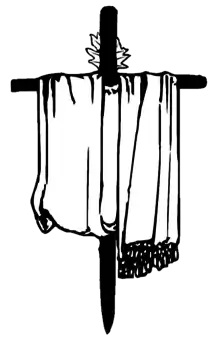
The klila is used to adorn the drabsha, a wooden cross covered with a white cloth that is the main symbol of Mandaeism.[2]
Use in rituals
The klila is used during most Mandaean rituals, including masbuta, masiqta, and priest initiation rituals.[2]
In the Qolasta
Several prayers in the Qolasta are recited when consecrating and putting on the klila, including prayers 46 and 47.[1]
See also
References
- Drower, E. S. (1959). Canonical Prayerbook of the Mandaeans. Leiden: E.J. Brill.
- Buckley, Jorunn Jacobsen (2002). The Mandaeans: ancient texts and modern people. New York: Oxford University Press. ISBN 0-19-515385-5. OCLC 65198443.
- Drower, Ethel Stefana (1937). The Mandaeans of Iraq and Iran. Oxford at the Clarendon Press.
| People | | ||||||||
|---|---|---|---|---|---|---|---|---|---|
| Historical identities | |||||||||
| Priesthood |
| ||||||||
| Literature |
| ||||||||
| Cosmology |
| ||||||||
| Legendary figures | |||||||||
| Concepts | |||||||||
| Objects and symbols | |||||||||
| Rituals | |||||||||
| Buildings and structures | |||||||||
| Calendar | |||||||||
| Language | |||||||||
Category | |||||||||
This article is issued from Wikipedia. The text is licensed under Creative Commons - Attribution - Sharealike. Additional terms may apply for the media files.