Tarmida
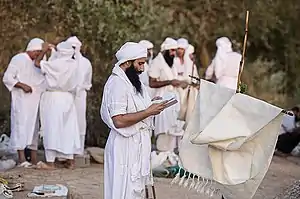
A tarmida (Classical Mandaic: ࡕࡀࡓࡌࡉࡃࡉࡀ, literally 'disciple' in Mandaic; Persian: ترمیدا; Arabic: ترميذة) is a junior priest in Mandaeism. Ganzibras, or head priests, rank above tarmidas.[1]
| Part of a series on |
| Mandaeism |
|---|
 |
| Religion portal |
Ordination
Tarmida initiates or novices (šualia) can come from any "pure" family. Typically, they have been trained as ritual assistants (šganda or ašganda) when they were children. Initiates may or may not be married, although typically they are not yet married.[2]
In order to be ordained as a tarmida, the initiate (šualia) must go through a complex series of initiation rituals lasting 68 days. Various rituals are performed by the initiator priest (rba), who recites from priestly esoteric texts such as The Coronation of the Great Šišlam (Classical Mandaic: Šarh d-Traṣa d-Taga d-Šišlam Rabbā),[3] the Scroll of Exalted Kingship (Classical Mandaic: Diwan Malkuta ʿLaita),[4] The Great Supreme World (Classical Mandaic: Alma Rišaia Rba),[5] and the Qolasta. Ritual helpers (šganda or ašganda), who represent emissaries from the World of Light, also help perform the rituals, many of which are held in a specially constructed priest initiation hut (škinta) and also a nearby temporary reed hut (andiruna).[2]
Stages
- For the first 7 of the 68 days, both the novice and the initiator stay in the škinta without sleeping. This period is concluded by the novice baptizing the initiator.
- Next, the novice goes through 60 days of seclusion, maintains his ritual purity, and cooks his own food. Only the šganda, who visits everyday to exchange kušṭa, is allowed to come in contact with the novice during these 60 days of seclusion. 180 rahmas (devotional prayers) are recited during these 60 days, with 60 prayers each meant for the soul, spirit, and body (hence 3 sets of 60) as the Coronation text explains.
- After the 60 days of seclusion are over, additional rituals are performed with priests, including a zidqa brikha (blessed oblation) ritual meal.
- Finally, the novice baptizes his initiator again, and the 68-day ordination ceremony is complete.[2]
Prayer sequence
Below is the sequence of Qolasta prayer numbers for the tarmida initiation according to both the Coronation and Exalted Kingship. Exalted Kingship contains more detailed descriptions of the rituals, while the Coronation is shorter. During the prayers, pihta (sacramental bread) and mambuha (sacramental water) are also consumed. Ritual handclasps (kušṭa) are often exchanged between the novice and the initiator, and sometimes also with the ritual assistant (šganda). Various names of the deceased (zhara) are also uttered along with the prayers.[2]
Initiation begins
| Coronation | Exalted Kingship |
|---|---|
| 323 | 323 |
| 1–103 (novice’s recital in škinta) | 1–103 |
| 324–327 (coronation prayers) | 324–327 |
| 3, 5, 19 | 3, 5, 19 |
| 79, 81 | 79, 80, 81 |
Preparation for baptizing novice
| Coronation | Exalted Kingship |
|---|---|
| 1, 3, 5, 19 | 1, 3, 5, 19 |
| 32 | 32 |
| 8, 34 (incense prayers) | 8, 34 |
| 75–77 | 75–77 |
| 35 (with zharas) | 35 |
Baptism of novice begins
| Coronation | Exalted Kingship |
|---|---|
| 10–13 | |
| 18 | |
| 414 | |
| 19 | |
| 1st kušṭa | |
| 82 | |
| 20–24 | |
| 2nd kušṭa | |
| 36–45 (pihta and mambuha) | |
| 3rd kušṭa | |
| 25–28 (sealing prayers) | |
| 29, 30, 83–86, 88, 90 | |
| 71–72 (1st concurrence) | |
| 4th kušṭa | |
| 18, 109 (rahmas [devotions]) | |
| 58 (with zhara) | 58 |
| 65 | 65 |
| 168–169 | 168–169 |
| 71–72 | 71–72 (2nd concurrence) |
| 36–45 (pihta and mambuha) | |
| 59–60 | 59–60 |
| 31, 8 | 31, 8 |
| 72 | 72 |
| 171 | |
| mqaimitun ["be raised up!"] (repeated 61 times) | mqaimitun ["be raised up!"] |
| 80 | 80 |
| kušṭa with šganda | 5th kušṭa |
| 63 (masiqta oil) | 63 |
| 178 | 178 |
| 1, 3, 9, 15 | |
| 344–345 | |
| 233–256 (kḏ azil[6]) | 233–256 |
| 330–347 (drabša prayers) |
The Coronation contains 3 sets of prayers during the final part of the ritual that are not listed in Exalted Kingship.
Novice crowned
| Coronation | Exalted Kingship |
|---|---|
| 1, 3, 5, 19 | 1, 3, 5, 19 |
| 35, 9 | 35, 9 |
| 15–17 | 15–17 |
| 25–28 (haṭamtas [sealing prayers]) | 25–28 |
Wine ceremony
| Coronation | Exalted Kingship |
|---|---|
| 180–199 | 180–199 |
| 305–321 (antiphons) | 305–321 |
Cult hut (škinta) period begins
| Coronation | Exalted Kingship |
|---|---|
| 72, 31, 8, 94, 63, kḏ azil | |
| 106–108 | 106–108 |
| 1, 3, 5, 19 | 1, 3, 5, 19 |
| 8, 34 | 8 |
| 165–169 | |
| 113 (a Sunday prayer) | 113 |
| 114–117 | 114–116 |
| 77, 9, 35 | 77, 9, 35 |
| 15–17 | 15–17 |
| 25–28 | 25–28 |
| 58, 65 | 58, 65 |
| 119–122 | |
| 165–169 | 165 |
| 71–72 | 71–72 (3rd concurrence) |
| 36–45 | 36–45 |
| 59–60 | 59–60 |
| 72 | 72 |
| 171 | |
| 80 | 80 |
| kušṭa | kušṭa |
Prayers 34 and 119–122 are included in the Coronation, but not Exalted Kingship.
References
- Drower, E. S. 1960. The Secret Adam: A Study of Nasoraean Gnosis. Oxford: Clarendon Press.
- Buckley, Jorunn Jacobsen (2002). The Mandaeans: ancient texts and modern people. New York: Oxford University Press. ISBN 0-19-515385-5. OCLC 65198443.
- Drower, E. S. 1962. The Coronation of the Great Šišlam: Being a Description of the Rite of the Coronation of a Mandaean Priest according to the ancient Canon. Leiden: Brill.
- Buckley, Jorunn Jacobsen (1993). The Scroll of Exalted Kingship: Diwan Malkuta ʿLaita. New Haven, Connecticut: American Oriented Society.
- Drower, E. S. 1963. A Pair of Naṣoraean Commentaries: Two Priestly Documents, the Great First World and the Lesser First World. Leiden: Brill.
- 24 prayers called kḏ azil bhira dakia ("When the proven, pure one went"), which describe and praise the new priest, now included among his fellow uthras.
External links
| People | | ||||||||
|---|---|---|---|---|---|---|---|---|---|
| Historical identities | |||||||||
| Priesthood |
| ||||||||
| Literature |
| ||||||||
| Cosmology |
| ||||||||
| Legendary figures | |||||||||
| Concepts | |||||||||
| Objects and symbols | |||||||||
| Rituals | |||||||||
| Buildings and structures | |||||||||
| Calendar | |||||||||
| Language | |||||||||
Category | |||||||||