Tiếng Gọi Công Dân
Thanh Niên Hành Khúc (Saigon: [tʰan niəŋ hân xúk], Chữ Nôm: 青年行曲, "March of the Youths"), later known as Call to the Citizens (Vietnamese: Tiếng Gọi Công Dân, Chữ Nôm: 㗂噲公民), and originally the March of the Students (Vietnamese: Sinh Viên Hành Khúc, Chữ Nôm: 生員行曲, French: La Marche des Étudiants), was the national anthem of State of Vietnam from 1948 to 1955 and Republic of Vietnam from 1955 to 1975.
| English: "Call to the Citizens" | |
|---|---|
| Thanh Niên Hành Khúc | |
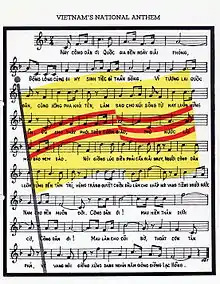 A sheet music notation of "Call to the Citizens", with the South Vietnamese flag in the background (recorded since 1973) | |
Former national anthem of 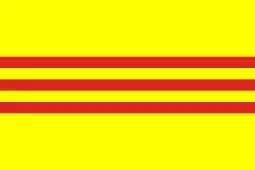 State of Vietnam South Vietnam State of Vietnam South Vietnam | |
| Also known as | "Sinh Viên Hành Khúc" (English: "Song of the Students") "National Anthem of the Republic of Vietnam" |
| Lyrics | Mai Văn Bộ (original lyric), 1939 |
| Music | Lưu Hữu Phước, 1939 |
| Adopted | 1948 (by the State of Vietnam) 1955 (by South Vietnam) |
| Relinquished | 1955 (by the State of Vietnam) 1975 (by South Vietnam) |
| Preceded by | "La Marseillaise" |
| Succeeded by | "Giải phóng miền Nam" |
| Audio sample | |
"Tiếng Gọi Công Dân" (instrumental)
| |
After the end of the Vietnam War in 1975, the South Vietnamese state was disbanded and thus its national anthem was discontinued. It was replaced with Giải phóng miền Nam, which was then replaced with Tiến Quân Ca when South Vietnam was annexed by North Vietnam. However, the song is still used by Vietnamese expatriates living in the United States, among those in other countries where South Vietnamese refugees consequently resided after the war, as the "Anthem of Free Vietnam".
History
The anthem was originally named La Marche des Étudiants (March of the Students), composed by Lưu Hữu Phước and written by Mai Văn Bộ in late 1939, and first adopted by a student club. Phước was a well-known Vietnamese musician and songwriter, who later became a communist and was appointed Minister of Information and Culture of the Provisional Revolutionary Government of the Republic of South Vietnam (National Liberation Front of Southern Viet Nam or Việt Cộng).[1][2] In 1941, it was became the anthem of the Indochina Students General Association, Phước renamed the anthem as Tiếng Gọi Thanh Niên (Call to the Youths), the lyrics was rewritten in Vietnamese and divided into three verses. The first verse was written by Lưu Hữu Phước and Mai Văn Bộ in 1941, and secretly spread until 1945, the second verse (Tiếng Gọi Sinh Viên, Call to the Students) was written by Lê Khắc Thiều and Đặng Ngọc Tốt in late 1941, and published in 1943, the third verse was written by Hoàng Mai Lưu on April 4, 1945, and published before the August Revolution. In 1945 it became the anthem of the Vanguard Youth, the lyrics were small modified and became known as Tiếng Gọi Thanh Niên or Thanh Hiên Hành Khúc.
In 1948, the Provisional Central Government of Vietnam adopted the song as the national anthem. The song was later modified with the name changed to Tiếng Gọi Công Dân (Call to the Citizens) or Công Dân Hành Khúc (March of the Citizens), and became the official national anthem of South Vietnam.[3] Another song by Lưu Hữu Phước, Giải Phóng Miền Nam, was chosen by the National Liberation Front as South Vietnam's anthem.
Thanh Niên Hành Khúc (1948–1956)
Thanh niên Hành Khúc was first adopted as the national anthem by the Provisional Central Government of Vietnam (Pre-government of the State of Vietnam. 1948–1949) on 14 June 1948, and it was inherited as a national anthem by the State of Vietnam (1949–1955) and the Republic of Vietnam (1955–1975). The lyrics of Thanh Niên Hành Khúc were revised by former President Ngo Dinh Diem in 1956.
Tiếng Gọi Công Dân (1956–1975)
Tiếng Gọi Công Dân was used as the third and final official national anthem of South Vietnam from 1956. The earlier lyrics was written anh em instead of công dân.[4] After the Fall of Saigon in 1975, it was superseded by Giải Phóng Miền Nam soon, but is still sung by many overseas Vietnamese.
Legacy (1975–present)
Although Tiếng Gọi Công Dân with the lyrics as revised in 1956 is no longer a national anthem of a country, it is still used by most Vietnamese expatriates residing in the United States, Canada, Australia, western Germany and other countries where South Vietnamese refugees consequently moved to after the Vietnam War, where it is dubbed the "Anthem of Free Vietnam".
Some Vietnamese expatriates use a version of Tiếng Gọi Công Dân, with the lyrics of the first row slightly altered into using: "Này Công Dân ơi! Ðứng lên đáp lời sông núi." ("Oh Citizens! Stand up [and] answer the call [of the] rivers and mountains"), stands for seeking the faith of a non-Communist government for the homeland.
In Vietnam, the song is occasionally performed under the name Thanh Niên Hành Khúc (or Tiếng Gọi Thanh Niên) and the original lyric as written by Lưu Hữu Phước and Mai Văn Bộ as it is considered as a revolutionary and patriotic song.
Lyrics
La Marche des Étudiants – March of the Students (1939)
(French version)
- Étudiants ! Du sol l'appel tenace
- Pressant et fort, retentit dans l'espace.
- Des côtes d'Annam aux ruines d'Angkor,
- À travers les monts, du sud jusqu'au nord,
- Une voix monte ravie:
- Servir la chère Patrie !
- Toujours sans reproche et sans peur
- Pour rendre l'avenir meilleur.
- La joie, la ferveur, la jeunesse
- Sont pleines de fermes promesses.
- Chorus.
- Te servir, chère Indochine,
- Avec cœur et discipline,
- C'est notre but, c'est notre loi
- Et rien n'ébranle notre foi !
Tiếng Gọi Thanh Niên – Call to the Youths
- Verse I.
- Này anh em ơi! Tiến lên đến ngày giải phóng.
Đồng lòng cùng nhau ta đi sá gì thân sống.
Cùng nhau ta tuốt gươm, cùng nhau ta đứng lên.
Thù kia chưa trả xong thì ta luôn cố bền.
Lầm than bao năm ta đau khổ biết mấy.
Vàng đá gấm vóc, loài muông thú cướp lấy.
Loài nó hút lấy máu đào chúng ta.
Làm ta gian nan, cửa nhà tan rã.
Bầu máu, nhắt tời đó, càng thêm nóng sôi.
Ta quyết thề phá tan quân dã man rồi. - Chorus
- Vung gươm lên, ta quyết đi tời cùng!
Vung gươm lên, ta thề đem hết lòng.
Tiến lên đồng tiến, sá chi đời sống.
Chớ quên rằng ta là giống Lạc Hồng! - Verse II.
- Này sinh viên ơi! Đứng lên đáp lời sông núi.
Đồng lòng cùng đi đi đi mở đường khai lối.
Kià non sông nước xưa, truyền muôn năm chớ quên.
Nào anh em Bắc Nam cùng nhau ta kết đoàn.
Hồn thanh xuân như gương trong sáng.
Đừng tiếc máu nóng, tài xin ráng.
Thời khó, thế khó, khó làm yếu ta.
Dù muôn chông gai, vững lòng chi sá.
Đường mới, kíp phóng mắt, nhìn xa bốn phương.
Tung cánh hồn thiếu niên, ai đó can trường. - Chorus
- Sinh viên ơi, mau tiến lên dưới cờ.
Anh em ơi, quật cường nay đến giờ.
Tiến lên cùng tiến, gió tung nguồn sống.
Cháy trong lòng ta ngàn mớ lửa hồng. - Verse III.
- Này thanh niên ơi! Tiến lên đến ngày giải phóng.
Đồng lòng cùng đi đi đi sá gì thân sống.
Nhìn non sông nát tan, thù nung tâm chí cao.
Nhìn muôn dân khóc than, hờn sôi trong máu đào.
Liều thân xông pha, ta tranh đấu.
Cờ nghĩa phấp phới, vàng pha máu.
Cùng tiến, quét hết những loài dã man.
Hầu đem quê hương thoát vòng u ám.
Thề quyết, lấy máu nóng mà rửa oán chung.
Muôn thuở vì núi sông nêu tiếng anh hùng. - Chorus
- Anh em ơi, mau tiến lên dưới cờ.
Sinh viên ơi, quật cường nay đến giờ.
Tiến lên cùng tiến, gió tung nguồn sống.
Cháy trong lòng ta ngàn mớ lửa hồng.
Thanh Niên Hành Khúc – Song of the Youths (1948–1956)
Vietnamese lyricsNày thanh niên ơi! Đứng lên đáp lời sông núi. Thanh niên ơi! Ta quyết đi đến cùng.
Thanh niên ơi! Ta nguyền đem hết lòng. |
English translationYouth of Vietnam, arise! And at our Country's call |
- Source: National Anthems of the World (2nd and revised ed.), 1963.
Tiếng Gọi Công Dân – Call to the Citizens (1956–1975)
Vietnamese lyricsNày Công Dân ơi! Quốc gia đến ngày giải phóng.[5] |
Chữ Nôm呢公民𠲖!國家𦥃𣈜解放。 |
English translationOh citizens! Our country has reached the day of liberation. |
References
- Robert Trando (2010). Letters of a Vietnamese Émigrê. Page 32. "[1945] The Cochin-Chinese musicians, Lưu Hữu Phước, Mai Văn Bộ, and Nguyễn Thành Nguyên, composed patriotic songs chanting the victories of Bạch-Đằng and Chi-Lăng ... Then the Vietnamese version of the "March of Students" was written. ... President Hòa raised his conductor stick for the "March of Students." Nonetheless, instead of the usual opening in French language, "É-tu-di-ants," the Vietnamese words were heard, "Này-sinh-viên-ơi," followed by the Vietnamese text calling "
- Mai Nguyễn (2000). Đọc hồi ký của các tướng tá Sài Gòn xuất bản ở nước ngoài [Reading the memoirs of generals of Saigon published abroad]. Page 324. "..tượng trưng dòng máu dân của ba miền và lấy bài "Thanh niên hành khúc" của Lưu Hũu Phước làm quốc ca vì lời ca"
- Đình Hoà Nguyễn (1999). From the City Inside the Red River: A Cultural Memoir of Mid-Century Vietnam. Page 100. "Lưu Hữu-Phước, Mai Văn-Bộ, and Nguyễn Thành-Nguyên, the three medical students who shared living quarters on Wiele ... The first of these songs, composed in 1943, had a stirring rhythm and was quickly adopted as the official march of ..."
- The Military Assistance Institute. "Country Study and Station Report: Republic of Vietnam" (PDF). Archived from the original (PDF) on 26 August 2016. Retrieved 3 November 2021.
- "South Vietnam (1948-1975)". nationalanthems.info. Retrieved 9 January 2015.
External links
- "Ethnic Music" Room ("Words" is Japanese version only)
- Quốc kỳ, Quốc ca (Vietnamese language only)
- Sheet music of Tiếng Gọi Thanh Niên
- Tiếng Gọi Công Dân