Ginza Rabba
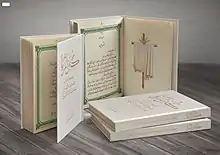
The Ginza Rabba (Classical Mandaic: ࡂࡉࡍࡆࡀ ࡓࡁࡀ, romanized: Ginzā Rbā, lit. 'Great Treasury'), Ginza Rba, or Sidrā Rbā (Classical Mandaic: ࡎࡉࡃࡓࡀ ࡓࡁࡀ) "Great Book", and formerly the Codex Nasaraeus, is the longest and the most important holy scripture of Mandaeism. It is also occasionally referred to as The Book of Adam.
| Ginza Rabba ࡂࡉࡍࡆࡀ ࡓࡁࡀ | |
|---|---|
 | |
| Information | |
| Religion | Mandaeism |
| Language | Mandaic language |
| Period | 1st century |
| Part of a series on |
| Mandaeism |
|---|
 |
| Religion portal |
Language, dating and authorship
The language used is classical Mandaic, a variety of Eastern Aramaic written in the Mandaic script (Parthian chancellory script), similar to the Syriac script. The authorship is unknown, and dating is a matter of debate. Some scholars place it in the 2nd-3rd centuries,[1] while others such as S. F. Dunlap place it in the 1st century.[2]
The earliest confirmed Mandaean scribe was Shlama Beth Qidra, a woman, who copied the Left Ginza sometime around the year 200 CE.[3]
Structure
The Ginza Rabba is divided into two parts – the Right Ginza, containing 18 books, and the Left Ginza, containing 3 books. In Mandaic studies, the Right Ginza is commonly abbreviated as GR, while the Left Ginza is commonly abbreviated as GL.
The book traditionally contains the Right Ginza on one side, and, when turned upside-down and back to front, contains the Left Ginza (the Left Ginza is also called "The Book of the Dead"). The Right Ginza part of the Ginza Rabba contains sections dealing with theology, creation, ethics, historical, and mythical narratives; its six colophons reveal that it was last redacted in the early Islamic Era. The Left Ginza section of Ginza Rabba deals with man's soul in the afterlife; its colophon reveals that it was redacted for the last time hundreds of years before the Islamic Era.
There are various manuscript versions that differ from each other. The versions order chapters differently from each other, and textual content also differs.
Contents
The book is a compilation of various oral teachings and written texts, most predating their editing into the two volumes. It includes literature on a wide variety of topics, including liturgy and hymns, theological texts, didactic texts, as well as both religious and secular poetry.
Summaries of each book (or tractate), based mostly on Häberl (2007), are provided below.[4][5]
The Right Ginza
- Book 1 and Book 2, prose texts, contain two versions of a very stylized history of creation and of Mandaeism. Book 2 has a total of four sections, since it also contains three small appended pieces.[6] These books summarize many of the basic teachings of Mandaeism.
- Chapter 2.1 is a chronology of the world containing creation stories and the four epochs of the universe.
- Chapter 2.2 is a confession of sins.
- Chapter 2.3 has exhortations from the messenger of light.
- Chapter 2.4 contains teachings on marriage.
- Book 3, The Book of the Living First Teachings, is the longest book in the Ginza. It is a reconstructed poem also dealing with creation themes but concentrating more on the origin of evil. Aldihisi (2008) gives an English translation and detailed commentary for Book 3. The Mandaic title of Book 3 is Raza u sidra qadmaia ḏ-šuta haita qadmaita ḏhuat mn laqadmaia ("The Mystery and the First Book of the First Living Doctrine from the Aforetime" (or "the Very Beginning")).[5]
- Book 4 is a small text connected to the story of Hibil Ziwa's descent into the underworld (World of Darkness). Before descending into the underworld, Hibil Ziwa, along with Sheetil and Anush, are baptized by Manda d-Hayyi and Mara ḏ-Rabuta ("The Lord of Greatness").
- Book 5 contains 5 separate prose texts. The first one, which is also the largest, deals with a journey to the Underworld. The Al-Saadi translation treats this as three separate books, leading in book numbering in the Drabsha edition diverging from some other editions from this point onward. The 5 sections are:
- Chapter 5.1 (Book 5 in the Drabsha edition) covers the savior spirit Hibil Ziwa's descent into the underworld.
- Chapter 5.2 (6.1 in the Drabsha edition), The Destruction of the Idols of the House, details the destruction of the world's idols by Manda d-Hayyi.
- Chapter 5.3 (6.2 in the Drabsha edition) is an account of the masiqta, the journey of the soul to the World of Light as it passes through maṭarta (stations)
- Chapter 5.4 (6.3 in the Drabsha edition) recounts the story of Manda d-Hayyi's baptism by John the Baptist, and John the Baptist's death and ascension to the World of Light.
- Chapter 5.5 (Book 7 in the Drabsha edition), The Book of Šilmai, Lord of the House, is about Šilmai (or Šalmai), an uthra identified in the chapter as the ruler of the material world and a member of Ruha's entourage.
- Book 6 (8 in the Drabsha edition), The Book of Dinanukt is about Dinanukt, who is half-man and half-book, and his journey to the World of Light.
- Book 7 (9 in the Drabsha edition) consists of John the Baptist's words.
- Book 8 (10 in the Drabsha edition) deals briefly with creation and evil, and contains Manda d-Hayyi's warnings against Ruha.
- Book 9 has 2 parts. Part 1 deals with other religions and the nature of the Godhead; a smaller part 2 deals with the Holy Unique One.
- Chapter 9.1, The Destruction of the Seven Planets (qarqalta ḏ-šuba kukbia), is a critique of other religions such as Christianity and Islam.
- Chapter 9.2 (Book 11 in the Drabsha edition) is about the Great Mana creating a young boy ("only-begotten son") from the heavenly Jordan [river].
- Book 10 (12 in the Drabsha edition), The Book of the Radiance that Shines Forth from the Pihta, deals with the sacrament of the bread (pihta) and also continues the creation story.
- Book 11 (13 in the Drabsha edition), The Mystery and the Book of the Great Anush (Enosh), deals with battles between the forces in the World of Light and World of Darkness led by Ruha. The text is difficult to interpret.
- Book 12 (14 in the Drabsha edition), in seven parts, mixes poetry and prose and provides a basic introduction to Mandaean beliefs.
- Chapter 12.1 (14.1 in the Drabsha edition) is an address by Anush (Enosh).
- Chapter 12.2 (14.2.1 in the Drabsha edition) is an acrostic (alphabetical) hymn, corresponding to Prayer 179 in the Qolasta. This hymn is also at the beginning of the Code Sabéen manuscripts 25 and 15.
- Chapter 12.3 (14.2.2 in the Drabsha edition) is an acrostic hymn.
- Chapter 12.4 (14.2.3 in the Drabsha edition) is an acrostic hymn that is identical to Prayer 214 in the Qolasta.
- Chapter 12.5 (14.2.4 in the Drabsha edition) is an acrostic hymn.
- Chapter 12.6 (14.3 in the Drabsha edition) is about the World of Darkness, its king Ur, and its inhabitants.
- Chapter 12.7 (14.4 in the Drabsha edition) is about the directions (North, etc.) and the cosmic ocean.
- Book 13 (15 in the Drabsha edition), The Prayer of the Tarmidia to the Pious, comprises a short interim conclusion to what seems to be the original version of the Ginza.
- Book 14 (16 in the Drabsha edition), The Book of the Great Nbaṭ, a prose text containing a creation myth, deals with material from Book 3 such as the various emanations.
- Book 15 (17 in the Drabsha edition) is a collection of poems. Numbering differs between editions since Lidbarski's text includes 20 poems, Gelbert's includes 21 (with Gelbert's 15.18-21 corresponding to Lidzbarski's 15.17-20) and Al-Saadi's translation covers only nine.
- Chapter 15.1 (17.1 in the Drabsha edition): "The Word" (Anush), descends into the material world on behalf of the Great Life to teach the believers.
- Chapter 15.2 (17.2 in the Drabsha edition): The Great Life sends Hibil Ziwa to Taruan. There, he teaches the uthras. Hibil Ziwa also visits Yushamin and Ptahil.
- Chapter 15.3 (17.3 in the Drabsha edition) is about the Living Water's lamentations about the material world. Šilmai and Nidbai, the guardian uthras of the Living Water, console him.
- Chapter 15.4 describes the Moon (known as Sin in Mandaic).
- Chapter 15.5: The Great Life sends Sam Ziwa (Shem) to be a guardian for the believers in the material world.
- Chapter 15.6: Yukabar Kušṭa goes to the material world to teach the believers.
- Chapter 15.7 (17.4 in the Drabsha edition): The Great Life sends a messenger who is either Manda d-Hayyi or Yawar to the material world to teach the Nasoreans.
- Chapter 15.8 (17.5 in the Drabsha edition) is about the messenger Yawar.
- Chapter 15.9 is about the soul's lamentation upon being sent into a material body.
- Chapter 15.10 (17.6 in the Drabsha edition) is about the creation of the uthras by the Great Mana (Mana Rabba).
- Chapter 15.11 consists of a story about Anush's battle with Ruha. Jerusalem is built and settled by the Jews. Anush gains many followers in Jerusalem, but they are killed by the Jews. Anush then destroys Jerusalem.
- Chapter 15.12: The Great Life sends an uthra to the material world to teach the believers.
- Chapter 15.13 (17.7 in the Drabsha edition) is a creation story similar to Book 3.
- Chapter 15.14: The Great Life sends an uthra to the material world to teach the believers. Namrus (Ruha) tries to tempt the uthra without success.
- Chapter 15.15 consists of Ptahil's lamentation and his threat of starting a war.
- Chapter 15.16 covers Manda d-Hayyi's debate with Yushamin. Afterwards, Manda d-Hayyi sends Hibil Ziwa to visit Ptahil, then Abatur, and then Yushamin, after which Hibil Ziwa finally returns to the heavens.
- Chapter 15.17 is a poem.
- Chapter 15.18 (17.8 in the Drabsha edition) is an admonition that is also found in chapter 170 of the Mandaean Book of John.
- Chapter 15.19 (17.9 in the Drabsha edition) is a song about the descent of the soul that is also found in chapter 173 of the Mandaean Book of John.
- Chapter 15.20 is a brief creation story.
- Book 16 contains 10 or 11 mostly shorter poems, depending on the manuscript version, of which Al-Saadi's translation covers four. Many are comparatively simple and straightforward.
- Chapter 16.1 is similar to Chapter 15.2, in which Manda d-Hayyi visits the world of Yushamin, the Second Life.
- Chapter 16.2 consists of an uthra's admonitions for Adam. The first part of this chapter is also found in the Mandaean Book of John.
- Chapter 16.3 consists of Manda d-Hayyi's admonitions for his friends.
- Chapter 16.4 contains the messenger of light's announcement to the faithful.
- Chapter 16.5 (18.1 in the Drabsha edition) is about the masiqta (ascent of the soul to the World of Light) with the help of gifts from Truth (Kušṭa).
- Chapter 16.6 teaches that only pious works, not earthy possessions, leads to grace.
- Chapter 16.7 (18.2 in the Drabsha edition) is an uthra's lamentation about the soul's imprisonment in the material body.
- Chapter 16.8 is about the wicked's unsuccessful attempt to trick the descended savior into becoming disloyal.
- Chapter 16.9 (18.3 in the Drabsha edition) is a prayer to Kushta (Truth) for help in Tibil and during the masiqta. It is also identical to section 178 (or chapter 48) of the Mandaean Book of John.
- Chapter 16.10 is about the Great Life granting prayers for help to survive in Tibil and during the masiqta.
- Chapter 16.11 (18.4 in the Drabsha edition) consists of Manda d-Hayyi's warnings to his chosen people, who do not want listen to it. It not present in the Parisian manuscripts and Petermann's version, but is included in the Leiden codex and Mubaraki version.
- Book 17 contains 2 poems. The Al-Saadi translation does not cover this book.
- Chapter 17.1 is about the Great Mana (Mana Rabba Kabira) and his teachings. It also describes the Great First Mana and the Great Occult Eggs that existed before Mar ḏ-Rabuta (The Great Lord) came into being.
- Chapter 17.2 contains a poem with wisdom instructions from a "being" of the Great Life. It also talks about how the seven planets and the twelve constellations of Ruha oppress the nišmata (souls).
- Book 18 contains a chronology of the world plus an apocalypse. It gives a duration of 480,000 years to the world. Abraham, Noah, and Jesus are mentioned in the book. It also contains lists of Parthian and Sasanian kings and mentions the Arab invasion of Persia. (The Drabsha edition includes only the deluge account, which it numbers 19.)
There are 7 colophons in the Ginza Rabba, including 6 in the Right Ginza. There are colophons after books 13 (for books 1-13), 14, 15, 16, 17, and 18, suggesting that these had all originally been separate books before they were compiled into a single codex. Some colophons are also followed by tarik (postscripts).[6]
The Left Ginza
- Book 1 is a four-part prose text on the salvation process, beginning with the ascension to heaven of Seth, in advance of his father Adam (compare Sethian Gnosticism).
- Chapter 1.1 is about Adam and his three sons. One of Adam's sons, Sheetil (Seth), volunteers to die before his father.
- Chapter 1.2 continues the story of Adam after his soul is cast into a material body.
- Chapter 1.3 is about Hawa (Eve) mourning the death of her husband and her encounters with the uthras. It also describes the death of Hawa.
- Chapter 1.4 is a detailed description of the masiqta and the maṭarta (stations) that lie between Earth and the World of Light.
- Book 2, poetic, comprises 28 hymns.
- Chapters 2.1-2.28
- Book 3, poetic, comprises 62 hymns.
- Chapters 3.1-3.62
The last two books of the Left Ginza, especially the third, seem to have a more rudimentary doctrinal content than found in the Right Ginza.
Book 3 of the Left Ginza is followed by a colophon.
Manuscript versions
Manuscript versions of the Ginza include the following. Two are held in the Bodleian Library at Oxford, three in the British Library in London, four in the Bibliothèque nationale de France in Paris, and others are in private ownership.[7]
- Bodleian Library manuscripts
- DC 22
- Huntington Ms. 6
- British Library manuscripts catalogued under the same title, Liber Adami Mendaice
- Add. 23,599
- Add. 23,600
- Add. 23,601
- Paris manuscripts, Bibliothèque nationale de France (consulted by Lidzbarski for his 1925 German translation)
- Paris Ms. A
- Paris Ms. B (also called the "Norberg version," since it was used by Norberg during the early 1800s)
- Paris Ms. C
- Paris Ms. D
For his 1925 German translation of the Ginza, Lidzbarski also consulted other Ginza manuscripts that were held at Leiden and Munich.[8]
Buckley has also found Ginza manuscripts that are privately held by Mandaeans in the United States (two in San Diego, California; one in Flushing, New York; and one in Lake Grove, New York).[7] A version of the Ginza by Mhatam Yuhana was also used by Gelbert in his 2011 English translation of the Ginza. Another manuscript known to Gelbert is a privately Ginza manuscript in Ahvaz belonging to Shaikh Abdullah Khaffaji,[8] the grandson of Ram Zihrun.[6]
Printed versions of the Ginza in Mandaic include:
- Norberg version (Mandaic): A printed Ginza in Mandaic was published by Matthias Norberg in 1816.
- Petermann version (Mandaic): A printed Ginza in Mandaic was published by Julius Heinrich Petermann in 1867.
- Mubaraki version (Mandaic): The full Ginza Rabba in the Mandaic script was first printed by the Mandaean community in Sydney, Australia in 1998.[9] At present, there are two published Mandaic-language editions of the Ginza published by Mandaeans themselves.
Translations
Notable translations and printed versions of the Ginza Rabba include:
- Norberg version (Latin): From 1815 to 1816, Matthias Norberg published a Latin translation of the Ginza Rabba, titled Codex Nasaraeus liber Adami appellatus (3 volumes). The original Mandaic text was also printed alongside the Latin translation.[10]
- Petermann version (Latin): In 1867, Julius Heinrich Petermann published a Latin translation of the Ginza Rabba, which was based on four different Ginza manuscripts held at Paris.[11]
- Lidzbarski version (German): In 1925, Mark Lidzbarski published the German translation Der Ginza oder das grosse Buch der Mandaer. Lidzbarski translated an edition of the Ginza by Julius Heinrich Petermann from the 1860s, which in turn relied upon four different Ginza manuscripts held at Paris. Lidzbarski was also able to include some material from a fifth Ginza which was held at Leiden.
- Baghdad version (Arabic, abridged): An Arabic translation of the Ginza Rabba was first published in Baghdad in 2001.[12]
- Gelbert version (English translation in 2011; Arabic translation in 2021): The first full English translation of the Ginza Rba was published by Carlos Gelbert in 2011, with the collaboration of Mark J. Lofts and other editors.[8] It is mostly based on the Mhatam Yuhana Ginza Rba from Iran (transcribed in the late 1990s under the supervision of Mhatam Yuhana, the ganzibra or head-priest of the Mandaean Council of Ahvaz in Iran) and also on Mark Lidzbarski's 1925 German translation of the Ginza.[13] Gelbert's 2011 edition is currently the only full-length English translation of the Ginza that contains detailed commentary, with extensive footnotes and many original Mandaic phrases transcribed in the text. An Arabic translation of the Ginza was also published by Gelbert in 2021, with the book also containing the original Mandaic text transcribed in Arabic script.[14]
- Al-Saadi (Drabsha) version (English, abridged): Under the official auspices of the Mandaean spiritual leadership, Drs. Qais Al-Saadi and Hamed Al-Saadi published an English translation of the Ginza Rabba: The Great Treasure in 2012. In 2019, the second edition was published by Drabsha in Germany. The translation, endorsed by the Mandaean Patriarch Sattar Jabbar Hilo, is designed for contemporary use by the Mandaean community and is based on an Arabic translation of the Ginza Rabba that was published in Baghdad.[15][16][17] However, it has been criticized for being overly abridged and paraphrased.[18]
See also
 |
Wikiquote has quotations related to: Ginza Rabba |
 |
Wikisource has original text related to this article: |
References
- The Mandaeans of Iraq and Iran: Their Cults, Customs, Magic Page 20 E. S. Drower, Jorunn Jacobsen Buckley - 2002 "Their authorship and the date at which each fragment, possibly originally memorized, was committed to writing is even more problematic. Even such a book as the Ginza Rabba cannot be regarded as homogeneous, for it is a collection of ...."
- "Sod, The Son of the Man" Page iii, S. F. Dunlap, Williams and Norgate - 1861
- Buckley, Jorunn Jacobsen. The Mandaeans: Ancient Texts and Modern People. Oxford University Press, 2002. Page 4.
- Häberl, Charles G. (2007). Introduction to the New Edition, in The Great Treasure of the Mandaeans, a new edition of J. Heinrich Petermann's Thesaurus s. Liber Magni, with a new introduction and a translation of the original preface by Charles G. Häberl. Gorgias Press, LLC. doi:10.7282/T3C53J6P
- Aldihisi, Sabah (2008). The story of creation in the Mandaean holy book in the Ginza Rba (PhD). University College London.
- Buckley, Jorunn Jacobsen (2002). The Mandaeans: ancient texts and modern people. New York: Oxford University Press. ISBN 0-19-515385-5. OCLC 65198443.
- Buckley, Jorunn Jacobsen (2010). The great stem of souls: reconstructing Mandaean history. Piscataway, N.J: Gorgias Press. ISBN 978-1-59333-621-9.
- Ginza Rba. Translated by Gelbert, Carlos. Sydney: Living Water Books. 2011. ISBN 9780958034630.
- Majid Fandi al-Mubaraki, Haitham Mahdi Saaed, and Brian Mubaraki (eds.), Ginza Rabba: The Great Treasure (Sydney: Majid Fandi al-Mubaraki, 1998).
- Norberg, Matthias. Codex Nasaraeus Liber Adami appellatus. 3 vols. London, 1815–16.
- Petermann, Heinrich. 1867. Sidra Rabba: Thesaurus sive Liber Magnus vulgo "Liber Adami" appellatus, opus Mandaeorum summi ponderis. Vols. 1–2. Leipzig: Weigel.
- Yūsuf Mattī Qūzī; Ṣabīḥ Madlūl Suhayrī; ʻAbd al-Razzāq ʻAbd al-Wāḥid; Bashīr ʻAbd al-Wāḥid Yūsuf (2001). گنزا ربا = الكنز العظيم : الكتاب المقدس للصابئة المندائيين / Ginzā rabbā = al-Kanz al-ʻaẓīm: al-Kitāb al-muqaddas lil-Ṣābiʼah al-Mandāʼīyīn. Baghdad: اللجنة العليا المشرفة على ترجمة گنزا ربا / al-Lajnah al-ʻUlyā al-mushrifah ʻalá tarjamat Ginzā Rabbā. OCLC 122788344. (Pages 1-136 (2nd group: al-Yasār) are bound upside down according to Mandaean tradition.)
- "About the author". Living Water Books. Retrieved 2021-09-05.
He has translated Lidzbarski's books from the German to two different languages: English and Arabic.
- گینزا ربَّا = Ginza Rba (in Arabic). Translated by Gelbert, Carlos. Edensor Park, NSW, Australia: Living Water Books. 2021. ISBN 9780648795407.
- Ginza Rabba: The Great Treasure. An equivalent translation of the Mandaean Holy Book. Translated by Al-Saadi, Qais Mughashghash; Al-Saadi, Hamed Mughashghash. Drabsha. 2012.
- "Online Resources for the Mandaeans". Hieroi Logoi. 2013-05-30. Retrieved 2017-12-27.
- Al-Saadi, Qais (2014-09-27). "Ginza Rabba "The Great Treasure" The Holy Book of the Mandaeans in English". Mandaean Associations Union. Retrieved 2021-09-21.
- The Teachings of the Mandaean John the Baptist. Translated by Gelbert, Carlos. Fairfield, NSW, Australia: Living Water Books. 2017. ISBN 9780958034678. OCLC 1000148487.
External links
- German translation (1925) at the Internet Archive
- Volumes 1 and 2 and Volume 3 of Codex Nasaraeus: liber Adami appellatus, syriace transscriptus ... latineque redditus (an 1815 edition in Syriac transcription, with Latin translation, by Matthias Norberg)
- Book seven of the Ginza Rabba (Words of John the Baptist) – English Translation on Wikisource
- Ginza Rabba (Mandaic text from the Mandaean Network)
- Ginza Rabba (Mandaic text from the Mandaean Network)
- Ginza Rabba concordance (Mandaic text from the Mandaean Network)
| People | | ||||||||
|---|---|---|---|---|---|---|---|---|---|
| Historical identities | |||||||||
| Priesthood |
| ||||||||
| Literature |
| ||||||||
| Cosmology |
| ||||||||
| Legendary figures | |||||||||
| Concepts | |||||||||
| Objects and symbols | |||||||||
| Rituals | |||||||||
| Buildings and structures | |||||||||
| Calendar | |||||||||
| Language | |||||||||
Category | |||||||||
Authority control: National libraries  |
|---|