MRT Line 3 (Metro Manila)
The Metro Rail Transit Line 3, also known as the MRT Line 3, MRT-3 or Metrostar Express, is a light rapid transit system line of Metro Manila, Philippines. The line runs in an orbital north to south route following the alignment of Epifanio de los Santos Avenue (EDSA). Although it has the characteristics of light rail, such as with the type of rolling stock used, it is more akin to a rapid transit system owing to its total grade separation and high passenger throughput.
| MRT Line 3 | |||||||||||||||||||||||||||||||||||||||||||||||||||||||||||||||||||||||||||||||||||||||||||||||||||||||||||||||||||||||||||||||||||||||||||||||||||||||||||||||||||||||||||||||||||||||||||||||||||||||||||||||||||||
|---|---|---|---|---|---|---|---|---|---|---|---|---|---|---|---|---|---|---|---|---|---|---|---|---|---|---|---|---|---|---|---|---|---|---|---|---|---|---|---|---|---|---|---|---|---|---|---|---|---|---|---|---|---|---|---|---|---|---|---|---|---|---|---|---|---|---|---|---|---|---|---|---|---|---|---|---|---|---|---|---|---|---|---|---|---|---|---|---|---|---|---|---|---|---|---|---|---|---|---|---|---|---|---|---|---|---|---|---|---|---|---|---|---|---|---|---|---|---|---|---|---|---|---|---|---|---|---|---|---|---|---|---|---|---|---|---|---|---|---|---|---|---|---|---|---|---|---|---|---|---|---|---|---|---|---|---|---|---|---|---|---|---|---|---|---|---|---|---|---|---|---|---|---|---|---|---|---|---|---|---|---|---|---|---|---|---|---|---|---|---|---|---|---|---|---|---|---|---|---|---|---|---|---|---|---|---|---|---|---|---|---|---|---|
 | |||||||||||||||||||||||||||||||||||||||||||||||||||||||||||||||||||||||||||||||||||||||||||||||||||||||||||||||||||||||||||||||||||||||||||||||||||||||||||||||||||||||||||||||||||||||||||||||||||||||||||||||||||||
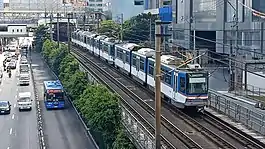 A MRTC 3000 class train near Kamuning station in 2021 | |||||||||||||||||||||||||||||||||||||||||||||||||||||||||||||||||||||||||||||||||||||||||||||||||||||||||||||||||||||||||||||||||||||||||||||||||||||||||||||||||||||||||||||||||||||||||||||||||||||||||||||||||||||
| Overview | |||||||||||||||||||||||||||||||||||||||||||||||||||||||||||||||||||||||||||||||||||||||||||||||||||||||||||||||||||||||||||||||||||||||||||||||||||||||||||||||||||||||||||||||||||||||||||||||||||||||||||||||||||||
| Native name | Tagalog: Ikatlong Linya ng Sistema ng Metro Rail Transit ng Maynila | ||||||||||||||||||||||||||||||||||||||||||||||||||||||||||||||||||||||||||||||||||||||||||||||||||||||||||||||||||||||||||||||||||||||||||||||||||||||||||||||||||||||||||||||||||||||||||||||||||||||||||||||||||||
| Status | Operational | ||||||||||||||||||||||||||||||||||||||||||||||||||||||||||||||||||||||||||||||||||||||||||||||||||||||||||||||||||||||||||||||||||||||||||||||||||||||||||||||||||||||||||||||||||||||||||||||||||||||||||||||||||||
| Owner | Metro Rail Transit Corporation | ||||||||||||||||||||||||||||||||||||||||||||||||||||||||||||||||||||||||||||||||||||||||||||||||||||||||||||||||||||||||||||||||||||||||||||||||||||||||||||||||||||||||||||||||||||||||||||||||||||||||||||||||||||
| Line number | 3 | ||||||||||||||||||||||||||||||||||||||||||||||||||||||||||||||||||||||||||||||||||||||||||||||||||||||||||||||||||||||||||||||||||||||||||||||||||||||||||||||||||||||||||||||||||||||||||||||||||||||||||||||||||||
| Locale | Metro Manila, Philippines | ||||||||||||||||||||||||||||||||||||||||||||||||||||||||||||||||||||||||||||||||||||||||||||||||||||||||||||||||||||||||||||||||||||||||||||||||||||||||||||||||||||||||||||||||||||||||||||||||||||||||||||||||||||
| Termini | North Avenue Taft Avenue | ||||||||||||||||||||||||||||||||||||||||||||||||||||||||||||||||||||||||||||||||||||||||||||||||||||||||||||||||||||||||||||||||||||||||||||||||||||||||||||||||||||||||||||||||||||||||||||||||||||||||||||||||||||
| Stations | 13[1] | ||||||||||||||||||||||||||||||||||||||||||||||||||||||||||||||||||||||||||||||||||||||||||||||||||||||||||||||||||||||||||||||||||||||||||||||||||||||||||||||||||||||||||||||||||||||||||||||||||||||||||||||||||||
| Website | DOTr-MRT3 | ||||||||||||||||||||||||||||||||||||||||||||||||||||||||||||||||||||||||||||||||||||||||||||||||||||||||||||||||||||||||||||||||||||||||||||||||||||||||||||||||||||||||||||||||||||||||||||||||||||||||||||||||||||
| Service | |||||||||||||||||||||||||||||||||||||||||||||||||||||||||||||||||||||||||||||||||||||||||||||||||||||||||||||||||||||||||||||||||||||||||||||||||||||||||||||||||||||||||||||||||||||||||||||||||||||||||||||||||||||
| Type | Light rapid transit | ||||||||||||||||||||||||||||||||||||||||||||||||||||||||||||||||||||||||||||||||||||||||||||||||||||||||||||||||||||||||||||||||||||||||||||||||||||||||||||||||||||||||||||||||||||||||||||||||||||||||||||||||||||
| System | Manila Metro Rail Transit System | ||||||||||||||||||||||||||||||||||||||||||||||||||||||||||||||||||||||||||||||||||||||||||||||||||||||||||||||||||||||||||||||||||||||||||||||||||||||||||||||||||||||||||||||||||||||||||||||||||||||||||||||||||||
| Services | 1[2] | ||||||||||||||||||||||||||||||||||||||||||||||||||||||||||||||||||||||||||||||||||||||||||||||||||||||||||||||||||||||||||||||||||||||||||||||||||||||||||||||||||||||||||||||||||||||||||||||||||||||||||||||||||||
| Operator(s) | Department of Transportation | ||||||||||||||||||||||||||||||||||||||||||||||||||||||||||||||||||||||||||||||||||||||||||||||||||||||||||||||||||||||||||||||||||||||||||||||||||||||||||||||||||||||||||||||||||||||||||||||||||||||||||||||||||||
| Depot(s) | North Avenue | ||||||||||||||||||||||||||||||||||||||||||||||||||||||||||||||||||||||||||||||||||||||||||||||||||||||||||||||||||||||||||||||||||||||||||||||||||||||||||||||||||||||||||||||||||||||||||||||||||||||||||||||||||||
| Rolling stock | MRTC 3000 and 3100 class LRVs[3] | ||||||||||||||||||||||||||||||||||||||||||||||||||||||||||||||||||||||||||||||||||||||||||||||||||||||||||||||||||||||||||||||||||||||||||||||||||||||||||||||||||||||||||||||||||||||||||||||||||||||||||||||||||||
| Daily ridership | 190,000 (December 2021 weekday average)[4] | ||||||||||||||||||||||||||||||||||||||||||||||||||||||||||||||||||||||||||||||||||||||||||||||||||||||||||||||||||||||||||||||||||||||||||||||||||||||||||||||||||||||||||||||||||||||||||||||||||||||||||||||||||||
| History | |||||||||||||||||||||||||||||||||||||||||||||||||||||||||||||||||||||||||||||||||||||||||||||||||||||||||||||||||||||||||||||||||||||||||||||||||||||||||||||||||||||||||||||||||||||||||||||||||||||||||||||||||||||
| Opened | December 15, 1999 | ||||||||||||||||||||||||||||||||||||||||||||||||||||||||||||||||||||||||||||||||||||||||||||||||||||||||||||||||||||||||||||||||||||||||||||||||||||||||||||||||||||||||||||||||||||||||||||||||||||||||||||||||||||
| Technical | |||||||||||||||||||||||||||||||||||||||||||||||||||||||||||||||||||||||||||||||||||||||||||||||||||||||||||||||||||||||||||||||||||||||||||||||||||||||||||||||||||||||||||||||||||||||||||||||||||||||||||||||||||||
| Track length | 16.9 km (10.5 mi) | ||||||||||||||||||||||||||||||||||||||||||||||||||||||||||||||||||||||||||||||||||||||||||||||||||||||||||||||||||||||||||||||||||||||||||||||||||||||||||||||||||||||||||||||||||||||||||||||||||||||||||||||||||||
| Number of tracks | Double-track | ||||||||||||||||||||||||||||||||||||||||||||||||||||||||||||||||||||||||||||||||||||||||||||||||||||||||||||||||||||||||||||||||||||||||||||||||||||||||||||||||||||||||||||||||||||||||||||||||||||||||||||||||||||
| Character | Grade separated | ||||||||||||||||||||||||||||||||||||||||||||||||||||||||||||||||||||||||||||||||||||||||||||||||||||||||||||||||||||||||||||||||||||||||||||||||||||||||||||||||||||||||||||||||||||||||||||||||||||||||||||||||||||
| Track gauge | 1,435 mm (4 ft 8+1⁄2 in) standard gauge | ||||||||||||||||||||||||||||||||||||||||||||||||||||||||||||||||||||||||||||||||||||||||||||||||||||||||||||||||||||||||||||||||||||||||||||||||||||||||||||||||||||||||||||||||||||||||||||||||||||||||||||||||||||
| Minimum radius | 370 m (400 yd) Mainline / 25 m (82 ft) Depot | ||||||||||||||||||||||||||||||||||||||||||||||||||||||||||||||||||||||||||||||||||||||||||||||||||||||||||||||||||||||||||||||||||||||||||||||||||||||||||||||||||||||||||||||||||||||||||||||||||||||||||||||||||||
| Electrification | 750 V DC Overhead lines | ||||||||||||||||||||||||||||||||||||||||||||||||||||||||||||||||||||||||||||||||||||||||||||||||||||||||||||||||||||||||||||||||||||||||||||||||||||||||||||||||||||||||||||||||||||||||||||||||||||||||||||||||||||
| Operating speed | Mainline: 60 km/h (37 mph) Switching tracks: 30 to 40 km/h (19 to 25 mph) | ||||||||||||||||||||||||||||||||||||||||||||||||||||||||||||||||||||||||||||||||||||||||||||||||||||||||||||||||||||||||||||||||||||||||||||||||||||||||||||||||||||||||||||||||||||||||||||||||||||||||||||||||||||
| Signalling | Fixed-block signaling with LED signals (Bombardier)[5][6] | ||||||||||||||||||||||||||||||||||||||||||||||||||||||||||||||||||||||||||||||||||||||||||||||||||||||||||||||||||||||||||||||||||||||||||||||||||||||||||||||||||||||||||||||||||||||||||||||||||||||||||||||||||||
| Train protection system | Automatic train protection | ||||||||||||||||||||||||||||||||||||||||||||||||||||||||||||||||||||||||||||||||||||||||||||||||||||||||||||||||||||||||||||||||||||||||||||||||||||||||||||||||||||||||||||||||||||||||||||||||||||||||||||||||||||
| |||||||||||||||||||||||||||||||||||||||||||||||||||||||||||||||||||||||||||||||||||||||||||||||||||||||||||||||||||||||||||||||||||||||||||||||||||||||||||||||||||||||||||||||||||||||||||||||||||||||||||||||||||||


Envisioned in the 1970s as part of the Metropolitan Manila Strategic Mass Rail Transit Development Plan, the thirteen-station, 16.9-kilometer (10.5 mi) line was the second rapid transit line to be built in Metro Manila when it started full operations in 2000 under a 25-year concession agreement between its private owners and the Philippine government's Department of Transportation (DOTr).
The line is owned by the Metro Rail Transit Corporation (MRTC), a private company operating in partnership with the DOTr under a Build-Lease-Transfer agreement. Serving close to 550,000 passengers on a daily basis when MRTC's maintenance provider, Sumitomo Corporation of Japan, was handling the maintenance of the system, the line is the busiest among Metro Manila's three rapid transit lines, built with essential standards such as barrier-free access and the use of contact-less card tickets to better facilitate passenger access. Total ridership significantly exceeds its built maximum capacity of 350,000 passengers a day, with various solutions being proposed or implemented to alleviate chronic congestion in addition to the procurement of new rolling stock.
Since 2006, the system's private owners had been offering various capacity expansion proposals to the DOTC. In 2014, after the DOTC's handling of the line's maintenance for two years amid questions about the line's structural integrity owing to the poor maintenance and the pronouncements that the system, in general, was safe, experts from MTR HK were commissioned to review the system. MTR HK made the opinion that the rail system was compromised due to the DOTC's poor maintenance.[7][8][9]
It is integrated with the public transit system in Metro Manila, and passengers also take various forms of road-based public transport, such as buses, to and from a station to reach their intended destination. Although the line is aimed at reducing traffic congestion and travel time along EDSA, the transportation system has only been partially successful due to the DOTC's inaction on the private sector's proposals to expand the capacity of the system to take up to 1.1 million passengers a day. Expanding the network's capacity to accommodate the rising number of passengers is currently set on tackling this problem.
Originally referred to as the Blue Line, MRT Line 3 was reclassified to be the Yellow Line in 2012.
Route
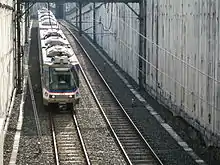
The line has 13 stations on 16.9 kilometers (10.5 mi) of double track,[1][2] spaced on average around 1,300 meters (4,300 ft) apart.[10] The rails are mostly elevated and erected either over or along the roads covered, with cut and underground sections between Buendia and Ayala stations, the only underground stations on the line. The southern terminus of the line is Taft Avenue at Pasay Rotonda, the intersection between Epifanio de los Santos Avenue and Taft Avenue, while the northern terminus is the North Avenue along Epifanio de los Santos Avenue in Barangay Bagong Pag-asa, Quezon City. The rail line serves the cities that Circumferential Road 4 (Epifanio de los Santos Avenue) passes through: Pasay, Makati, Mandaluyong, San Juan and Quezon City. The line crosses South Luzon Expressway (SLEX) at Magallanes Interchange in Makati.
Three stations serve as interchanges with the lines operated by the Light Rail Manila Corporation (LRMC), Light Rail Transit Authority (LRTA), and Philippine National Railways (PNR). Magallanes station is near the PNR's EDSA station, while Araneta Center-Cubao is indirectly connected to the LRT Line 2 station of the same, and Taft Avenue is connected via a covered walkway to the LRT Line 1 EDSA station. No stations are connected to other rapid transit lines within the paid areas, though that is set to change when the North Triangle Common Station, which has interchanges to LRT Line 1 and MRT Line 7, opens in 2022.
Early on during the construction of the line, a plan was drafted for a spur line towards the Makati Central Business District, built between Ayala and Buendia stations. The remaining evidence of this abandoned plan is an underground tunnel between Buendia and Ayala station turning right, heading towards Ayala Avenue. The planned spur line was cancelled due to the Asian financial crisis in 1997, which resulted the spur line area to be abandoned since the line's opening in 1999.
There are plans to temporarily close North Avenue station to facilitate the construction of the North Triangle Common Station. This is to minimize the operational and safety risks to the overhead catenary wires above the turn back siding north of the North Avenue station. Should this closure proposal be approved, Quezon Avenue will be the temporary terminus of the line. The closure will take place for 30 days.[11]
| Name | Distance (km) | Rail/Bus Transfers | Location | |
|---|---|---|---|---|
| Between stations | From North Avenue | |||
| North Triangle Common Station | — | — |  LRT Line 1 LRT Line 1 7 MRT Line 7 MMS Metro Manila Subway |
Quezon City |
| North Avenue | — | 0.000 |  E 4 19 32 North Avenue E 4 19 32 North Avenue | |
| Quezon Avenue | 1.200 | 1.200 | 8 MRT Line 8 via EDSA MMS Metro Manila Subway E 5 6 7 Quezon Avenue | |
| Kamuning | 1.000 | 2.200 | none | |
| Araneta Center-Cubao | 1.900 | 4.100 |  Araneta Center-Cubao Araneta Center-Cubao | |
| Santolan | 1.500 | 5.600 | E Santolan-Annapolis | |
| Ortigas | 2.300 | 7.900 | 4 MRT Line 4 via EDSA E Ortigas |
Mandaluyong |
| Shaw Boulevard | 0.800 | 8.700 | none | |
| Boni | 1.000 | 9.700 | ||
| Guadalupe | 0.800 | 10.500 | 5 Makati Intra-city Subway E Guadalupe ⛴ Guadalupe Ferry Station |
Makati |
| Buendia | 2.000 | 12.500 | E Buendia | |
| Ayala | 0.950 | 13.450 | 5 Makati Intra-city Subway BGC Bus: WX01 EX01 L01 NX01 NR01 EDSA Ayala E 33 35 Ayala 14 15 16 Glorietta 5 | |
| Magallanes | 1.200 | 14.650 | .svg.png.webp) PNR Metro Commuter Line via EDSA PNR Metro Commuter Line via EDSA | |
| Taft Avenue | 2.050 | 16.700 | LRT Line 1 via EDSA E 17 18 Taft Avenue |
Pasay |
| Stations and train systems in italics are either under construction or proposed. | ||||
The line is open from 4:37 a.m. PST (UTC+8) until 10:10 p.m. on a daily basis.[12] It operates almost every day of the year unless otherwise announced. Special schedules are announced via the PA system in every station and also in newspapers and other mass media. During Holy Week, a public holiday in the Philippines, the rail system is closed for annual maintenance, owing to fewer commuters and traffic around the metro. Normal operation resumes after Easter Sunday.[13][14]
It has experimented with extended opening hours, the first of which included 24-hour operations beginning on June 1, 2009 (primarily aimed at serving call center agents and other workers in the business process outsourcing sector).[15] Citing low ridership figures and financial losses, this was suspended after two days, and operations were instead extended from 5:00 a.m. to 1:00 a.m.[16] Operations subsequently returned to the former schedule by April 2010, but services were again extended starting March 10, 2014, with trains running on a trial basis from 4:30 am to 11:30 pm in anticipation of major traffic buildup in light of several major road projects beginning in 2014.[17]
History
Planning and early delays
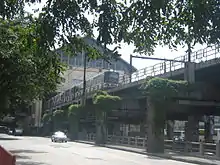
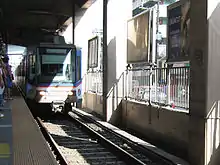
During the construction of the first line of the Manila Light Rail Transit System in the early 1980s, Electrowatt Engineering Services of Zürich designed a comprehensive plan for metro service in Metro Manila. The plan—still used as the basis for planning new metro lines—consisted of a 150-kilometer (93 mi) network of rapid transit lines spanning all major corridors within 20 years,[18] including a line on Epifanio de los Santos Avenue (EDSA), the region's busiest road corridor.
The project (originally known as the LRT-3 project) officially began in 1989, five years after the opening of the LRT Line 1, with the Hong Kong-based EDSA LRT Corporation winning the public bidding for the line's construction during the term of President Corazon Aquino.[10] However, construction could not commence, with the project stalled as the Philippine government conducted several investigations into alleged irregularities with the project's contract.[19] In 1995, the Supreme Court upheld the regularity of the project[20] which paved the way for construction to finally begin during the term of President Fidel V. Ramos. A consortium of local companies, led by Fil-Estate Management was later joined by Ayala Land, and 5 others, later formed the Metro Rail Transit Corporation (MRTC) in June 1995 and took over the EDSA LRT Corporation.[10]
Construction and opening
The MRTC was subsequently awarded a Build-Lease-Transfer contract by the DOTC, which meant that the latter would possess ownership of the system after the 25-year concession period. Meanwhile, the DOTC would assume all administrative functions, such as the regulation of fares and operations, leaving the MRTC responsibility over construction and maintenance of the system as well as the procurement of spare parts for trains. In exchange, the DOTC would pay the MRTC monthly fees for a certain number of years to reimburse any incurred costs.[21]
Construction began on October 15, 1996, with a BLT agreement signed between the Philippine government and the MRTC.[10] An amended turnkey agreement was later signed on September 16, 1997, with a consortium of companies (including Mitsubishi Heavy Industries and Sumitomo Corporation). A separate agreement was signed with ČKD Dopravní Systémy (ČKD Tatra, now part of Siemens AG), the leading builder of trams and light rail vehicles for the Eastern Bloc, on rolling stock. MRTC also retained the services of ICF Kaiser Engineers and Constructors to provide program management and technical oversight of the services for the design, construction management, and commissioning.[22]
During construction, the MRTC oversaw the design, construction, equipping, testing, and commissioning, while the DOTC oversaw technical supervision of the project activities covered by the BLT contract between the DOTC and MRTC. The DOTC also sought the services of SYSTRA, a French consultant firm, with regards to the technical competence, experience and track record in the construction and operations.[22]
On December 15, 1999, the initial section from North Avenue to Buendia was inaugurated by President Joseph Estrada,[23] with all remaining stations opening on July 20, 2000, a little over a month past the original deadline, due to DOTC's inclusion of additional work orders such as the Tramo overpass in Pasay leading to the Ninoy Aquino International Airport.[24] However, ridership was initially far below expectations when the line was still partially open, with passengers complaining of the tickets' steep price and the general lack of connectivity of the stations with other modes of public transportation.[25] Passengers' complaint of high ticket prices pointed to the maximum fare of ₱34, which at the time was significantly higher than a comparable journey on those lines operated by the LRTA and the PNR or a similar bus ride along EDSA. Although the MRTC projected 300,000–400,000 passengers riding the system daily, in the first month of operation the system saw a ridership of only 40,000 passengers daily (the ridership improved quickly, however, when passengers experienced significantly faster and convenient travel along EDSA, which experience soon spread by word of mouth).[26] The system was also initially criticized as a white elephant, comparing it to the Manila Light Rail Transit System and the Metro Manila Skyway.[27] To alleviate passenger complaints, the MRTC later reduced passenger fares to ₱15, as per the request of then President Joseph Estrada and a subsequent government subsidy.
Overcrowding and maintenance issues
By 2004, the line had the highest ridership of the three lines, with 400,000 passengers daily. By early 2012, the system was carrying around 550,000 commuters during weekdays and was often badly overcrowded during peak times of access during the day and night. By October 2012, DOTC removed Sumitomo and replaced it with newly formed local companies. In 2014, the line was overcrowded[28] despite the poor maintenance of the line which contributed to multiple incidents. Problems were again reported in 2017 under the maintenance of Busan Universal Rail, Inc.[29]
Controversy of 2nd-generation trains
In 2016, the MRTC Class 3100 2nd-generation trainsets made from China begun test runs in the line, but test runs were short-lived and were stopped due to compatibility issues. It was later revealed that adjustments should be made to the Class 3100 trains to be able to safely run along the line. On October 27, 2018, the Department of Transportation started the gradual deployment of the 3100 class trains, after various tests and audits.[30]
Rehabilitation plans
To resolve these issues, some companies offered bids to the government to rehabilitate, operate, and maintain Line 3. Metro Pacific Investments Corporation submitted bids in 2011 and 2014,[31] and the Light Rail Manila Corporation submitted a ₱20 billion unsolicited proposal on October 2, 2017.[32] LRMC was granted the original proponent status in the same year, but was eventually rejected by the government in January 2020.[33] The government, on the other hand, looked for maintenance providers from other countries.[34]
After signing contracts with Sumitomo and DOTr in 2018, the firm returned as the maintenance provider of the line on May 1, 2019 and the rehabilitation and upgrading of the existing systems and trains started on the same day.[35] The replacement of railway tracks started in November 2019 and was completed in September 2020. The 3000 class LRVs also underwent a refurbishment. The rehabilitation is expected to be completed in December 2021.[36]
Station facilities, amenities, and services
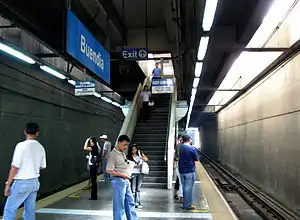
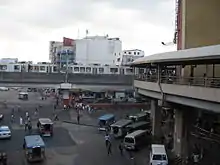
With the exception of Buendia and Ayala stations, and the platform level of Taft Avenue and Boni stations, all stations are situated above ground, taking advantage of EDSA's topology.[37]
Station layout and accessibility
The stations have a standard layout, with a concourse level and a platform level. The concourse is usually above the platform, with stairs, escalators and elevators leading down to the platform level. Station concourses contain ticket booths, which is separated from the platform level by fare gates.[10] Some stations, such as Araneta Center-Cubao, are connected at concourse level to nearby buildings, such as shopping malls, for easier accessibility. Most stations are also barrier-free inside and outside the station, and trains have spaces for passengers using wheelchairs.[10]
Stations either have island platforms, such as Taft Avenue, Buendia, Boni Avenue, and Shaw Boulevard stations, and side platforms, such as from Magallanes station to Ayala stations, Guadalupe, and from Ortigas to North Avenue stations. Due to the very high patronage of the line, part of the platform corresponding to the front car of the train is cordoned off for the use of women, children, elderly and disabled passengers.
The stations are also designed to occupy the entire span of EDSA, allowing passengers to safely cross between one end of the road and the other.[10]
Shops and services
Inside the concourse of all stations are stalls or shops where people can buy food or drinks. Stalls vary by station, and some have fast food stalls. The number of stalls also varies by station, and stations tend to have a wide variety, especially in stations such as Ayala and Shaw Boulevard.
Stations such as Taft Avenue and North Avenue are connected to or are near shopping malls and/or other large shopping areas, where commuters are offered more shopping varieties.
Since November 19, 2001, in cooperation with the Philippine Daily Inquirer, passengers are offered copies of the Inquirer Libre, a free, tabloid-size, Tagalog version of the Inquirer, which is available at all stations.[38] In 2014, Pilipino Mirror also started distributing free tabloid newspapers.
Safety and security
The line has always presented itself as a safe system to travel in, which was affirmed in a 2004 World Bank paper prepared by Halcrow describing the overall state of metro rail transit operations in Manila as being "good".[39] However, in recent years after the DOTr (formerly DOTC) took over maintenance of the train system in 2012, the safety and reliability of the system has been put into question, with experts calling it "an accident waiting to happen", and while several incidents and accidents were reported between 2012 and 2014, that has not deterred commuters from continuing to patronize the system.[40] The Philippine government, meanwhile, continues to assert that the system is safe overall despite those incidents and accidents.[41]
With a daily ridership of around 560,000 passengers in 2014, the line operated significantly above its designed capacity of between 360,000 and 380,000 passengers per day[28] before the COVID-19 pandemic. Operating over capacity from 2004[9] until 2019, government officials have admitted that capacity and system upgrades are overdue,[42] although the DOTr never acted on the numerous capacity expansion proposals of the private owners. In the absence of major investment in improving system safety and reliability, DOTr project management office of the line has resorted to experimenting with and/or implementing other solutions to reduce strain on the system, including crowd management on station platforms,[43] the proposed implementation of peak-hour express train service.[44] However, some of these solutions, such as platform crowd management, are unpopular with passengers.[45]
For safety and security reasons, persons who are visibly intoxicated, insane and/or under the influence of controlled substances, persons carrying flammable materials and/or explosives, and persons carrying bulky objects or items over 1.5 meters (5 ft) tall and/or wide are prohibited from entering the line.[46] Products in tin cans are also prohibited on board, citing the possibility of home-made bombs being concealed inside the cans.[47]
On July 12, 2021, the railway operator allowed passengers bringing pets inside the line, but pets are needed to be placed inside a carrier bag before boarding a train.[48]
In 2000 and 2001, in response to the Rizal Day bombings and the September 11 attacks, security was stepped up on the line. Following a vandalism incident in May 2021,[49] the security personnel deployed across all stations in the line was increased from 580 to 750 and a patrol car was deployed for added security.[50] The Philippine National Police has a special police force,[51] and security police provided by private companies can be found in all stations. All stations have a head guard. Some stations may also have a deployed K9 bomb-sniffing dog. It also employs the use of closed-circuit television inside all stations to monitor suspicious activities and to assure safety and security aboard the line. Passengers are also advised to look out for thieves, who can take advantage of the crowding aboard the trains. Wanted posters are posted at all stations to help commuters identify known thieves.
Ridership
| † | Highest recorded ridership and/or average |
| Year | Daily Average[52] | Yearly Total[52] | Highest Ridership per year[52] |
|---|---|---|---|
| 1999 | 23,057 | 368,916 | No data |
| 2000 |  109,449 109,449 |
39,401,465 |
296,969 (December 22, 2000) |
| 2001 | 250,728 |
90,262,148 |
391,187 (December 14, 2001) |
| 2002 | 282,993 |
102,443,564 |
417,059 (July 1, 2002) |
| 2003 | 312,043 |
112,647,474 |
438,809 (December 19, 2003) |
| 2004 | 338,431 |
122,512,169 |
452,926 (December 16, 2004) |
| 2005 | 356,673 |
128,758,894 |
465,203 (September 7, 2005) |
| 2006 | 374,436 |
135,171,387 |
488,733 (December 15, 2006) |
| 2007 | 395,806 |
142,886,057 |
539,813 (December 21, 2007) |
| 2008 | 413,220 |
149,585,563 |
527,530 (October 15, 2008) |
| 2009 | 419,728 |
151,521,764 |
560,637 (September 15, 2009) |
| 2010 | 424,041 |
153,078,770 |
552,509 (October 15, 2010) |
| 2011 | 439,906 |
158,806,049 |
577,015 (October 14, 2011) |
| 2012 | 481,918 |
174,454,146 |
622,880 (August 17, 2012) † |
| 2013 | 487,696 † |
176,058,278 † |
621,913 (October 25, 2013) |
| 2014 |  464,871 464,871 |
167,818,336 |
614,807 (February 14, 2014) |
| 2015 | 327,314 |
118,160,484 |
455,164 (February 25, 2015) |
| 2016 | 370,036 |
133,952,890 |
517,929 (December 16, 2016) |
| 2017 | 396,522 |
94,761,036 |
506,001 (February 10, 2017) |
| 2018 | 289,654 |
104,275,362 |
390,325 (January 12, 2018) |
| 2019 | 270,794 |
96,932,972 |
359,447 (January 25, 2019) |
| 2020 | 121,839[lower-alpha 1] |
31,799,959[lower-alpha 1] |
324,803 (January 24, 2020) |
- Notes
- Ridership decreased significantly due to the COVID-19 pandemic.
The original designed ridership of the line is 350,000, yet as the years passed, the number doubled from 450,000 daily passengers in 2006–2007 to 490,000 passengers in 2008 and up to 500,000 passengers in 2010–2012, with record numbers reaching as high as 620,000 in 2012–2013, before being reduced to 560,000 in 2014.[28] The high ridership of the line is due to the time consumed when commuting via EDSA, as well as the speed of the trains reaching up to 60 kilometers per hour (37 mph), and connectivity to Metro Manila's major transport hubs, railway lines, and central business districts, which results to a reduced commuting travel time and an increase in ridership. The daily ridership of the MRT 3 can reach as much as 300,000–500,000 passengers from 2012 to 2016, despite poor maintenance and long lines, causing the government to launch bus services, known as MRT Buses, around its stations, to serve as alternatives for 900,000-1 million passengers. The metro line also had a ridership of 96,932,972 passengers throughout 2019, which is lower than the rail line's 2013 record of 176,058,278 passengers.[52] In addition to the rising daily ridership that continues to exceed the line's designed capacity, and as the government continues to implement the metro line's capacity expansion project, it aims to reach a ridership of 800,000 daily passengers as all of the new trains from China will be added to its current fleet.[53]
In 2019, the line served more than 320,000 passengers daily. However, due to the effects of the COVID-19 pandemic in the country, the line currently has a reduced capacity, serving over 70,000-150,000 passengers daily, while running at a maximum speed of up to 60 km/h (37 mph) in 3.5-4 minute intervals, from the previous 30 km/h (19 mph) in 8–10 minute intervals. It previously served almost 40,000 passengers in June 2020,[54] and 150,000 passengers in January 2021.[55] After the government increased the capacity in railway vehicles from 30% to 70% on November 4, 2021,[56] the line served 190,000 passengers by December 2021.[4]
Fares and ticketing
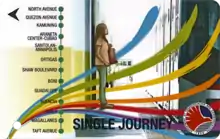
The line, like all other lines in Metro Manila, uses a distance-based fare structure, with fares ranging from 13 to 28 pesos (29 to 63 U.S. cents), depending on the destination. Commuters who ride the line are charged ₱13 for the first two stations, ₱16 for 3–4 stations, ₱20 for 5–7 stations, ₱24 for 8–10 stations and ₱28 for 11 stations or the entire line. Children below 1.02 meters (3 ft 4.4 in) (the height of a fare gate) may ride for free.
Every June 12, which is Independence Day in the Philippines, and on December 30, which is Rizal Day, the line offers free rides to passengers in specific time slots.[57][58][59] The line also offers free rides to students every July to March,[60] but students must register to avail a student pass.[61] However, the free rides for students stopped in 2020 due to the COVID-19 pandemic. On the other hand, every March 8, which is International Women's Day, the line offers free rides to women in specific time slots.[62]
Magnetic tickets (1999–2015)
Two types of tickets exist: a single-journey (one-way) ticket whose cost is dependent on the destination, and a stored-value (multiple-use) ticket for 100 pesos. The 200-peso & 500-peso stored-value tickets were issued in the past, but have since been phased out. The single-journey ticket is valid only on the date of purchase. Meanwhile, the stored-value ticket is valid for three months from date of first use.[46]
The tickets come in several incarnations: these include tickets bearing the portraits of former presidents Joseph Estrada and Gloria Macapagal Arroyo,[63] which have since been phased out, and one bearing the logos of the DOTC and the MRTC. Ticket shortages are common: in 2005, the MRTC was forced to recycle tickets bearing Estrada's portrait to address critical ticket shortages, even resorting to borrowing stored-value tickets from the LRTA[64] and even cutting unusable tickets in half for use as manual passes. Shortages were also reported in 2012,[65] and the DOTC was working on procuring additional tickets in 2014.[66] Because of the ticket shortages, it had become common practice for regular passengers to purchase several stored-value tickets at a time, though ticket shortages still persist.[67]
Although it has partnered with private telecommunications companies in experimenting with RFID technology as an alternative ticketing system in the past,[68][69] these were phased out in 2009.[70]
Beep cards (2015–present)
Currently, inter-operable beep cards with similar-to-the-previous single-journey and stored-value ticket types are now issued, along with the deployment of brand-new ticketing machines that replaced the barely-used ticketing machines that has been in place since the line's inauguration. The beep, tap-and-go tickets, loadable up to ₱10,000 can be used in all three rail lines since December 2015.
Fare adjustment
Adjusting passenger fares was ordered by President Joseph Estrada as a means to boost flagging ridership figures,[71] and the issue of fares both historically and in the present day continues to be a contentious political issue involving officials at even the highest levels of government.
Current fare levels were set on January 4, 2015, as a consequence of DOTr (formerly DOTC) having to increase fares for LRT Line 1 as per their concession agreement with MPIC-Ayala, with fare hikes delayed for several years despite inflation and rising operating costs.[72] Prior to the current fares levels, fares were set on July 15, 2000, under the orders of then President Estrada; this was intended to have the line become competitive against other modes of transport,[73] but had the effect of causing revenue shortfalls which the government shouldered. While originally set to last only until January 2001,[73] the new fare structure persisted due to strong public opposition against increasing fares,[74] especially as ridership increased significantly after lower fares were implemented.[71] These lower fares—which are only slightly more expensive than jeepney fares—ended up being financed through large government subsidies amounting to around ₱45 per passenger,[74][75] and which for both the MRT and LRT reached ₱75 billion for the 10-year period between 2004 and 2014.[76] Without subsidies, the cost of a single trip is estimated at around ₱60,[75] and a ₱10 increase in fares would yield additional monthly revenues of ₱2–3 billion a month.[77]
Passenger fare subsidies are unpopular outside Metro Manila, with subsidy opponents claiming that their taxes are being used to subsidize Metro Manila commuters without any benefit to the countryside, and that the fare subsidies should be used for infrastructure improvements in the rest of the country.[78] In his 2013 State of the Nation Address, President Benigno Aquino III claimed that it would be unfair for non-Metro Manila residents to use their taxes to subsidize the LRT and MRT.[79] However, supporters of the subsidies claimed that the rest of the country benefits economically from efficient transportation in Metro Manila.[80]
Rolling stock
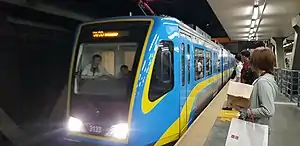
Two train types run in the line, the latest being those purchased from CRRC Dalian, under the Aquino administration.
The deployment of the Dalian trainsets was delayed due to several factors, including weight limits on existing tracks and inconsistencies in production, which has since been corrected. Due to these factors, only 4 trainsets are available for daily revenue services, while the targeted deadline for the full deployment of the Dalian Trainsets are set in 2022.[81]
The maximum speed of these trains is 65 km/h (40 mph), but currently run at a safe speed of 30 to 60 km/h (19 to 37 mph). The trains currently run at a operational maximum speed of 60 km/h (37 mph) since December 7, 2020, due to the completion of the rail replacement program.[82] Previously, following an derailment incident of a train coach at Taft Avenue station, all trains ran at speeds of 40 km/h (25 mph) in August 2014,[83] and was subsequently downgraded to 30 km/h (19 mph) due to worn-out tracks in 2018. However, due to the Enhanced community quarantine in Luzon, the rail replacement works has been fast-tracked and was completed in September 2020, five months ahead of its February 2021 completion target, while finishing the rail replacement on the line's Taft Avenue switch tracks in November 2020.[84][85] Due to the installation of new railway tracks, the maximum speed of the trains were gradually increased, from 30 km/h (19 mph), to 40 km/h (25 mph) on October 1, 2020,[86] and to 50 km/h (31 mph) on November 3.[87]
| Rolling stock | First-generation[88][89] | Second-generation[90][91] |
|---|---|---|
| Image | 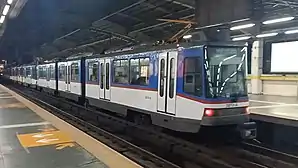 |
 |
| Year | 1999 | 2016 |
| Manufacturer | ČKD Tatra | CRRC Dalian |
| Model | Class 3000/000 RT8D5M | Class 3100 8MLB |
| Number built (cars) | 73 built (63 in service, 21 trains operational in 3 car trainsets) | 48 built (none in service with 4 sets (12 cars) available for service, 36 undergoing evaluation)[92] |
| Length | 33,000 mm (108 ft) (31,720 mm (104.07 ft) without couplers) | |
| Width | 2,480 mm (8.14 ft) | 2,500 mm (8.2 ft) |
| Height (pantograph lowered) | 3,550 mm (11.65 ft) | 3,650 mm (11.98 ft) |
| Door height | 1,900 mm (6.2 ft) | |
| Door width | 1,255 mm (4.117 ft) | |
| Floor height | 925 mm (36.4 in) | |
| Minimum curve radius | 20 m (66 ft) | 25 m (82 ft) |
| Empty weight | 46,800 kg (103,200 lb) | 49,700 kg (109,600 lb)[93] |
| Body shell material | Low alloy high tensile steel (aluminum for ceiling) |
Stainless steel |
| Electrification | 750 V DC overhead lines | |
| Transmission | Right-angle cardan drive | Quill drive |
| Traction control | IGBT chopper (ČKD) | IGBT-VVVF (Voith) |
| Traction motor | 64.5 kW DC motor (ČKD) | 120 kW totally enclosed AC induction motor (Traktionssysteme Austria) |
| Seating capacity | 74 | |
| Standing capacity | 320 (8 passengers/square meter) | |
| Maximum operating speed | 65 km/h (40 mph) | |
| Acceleration | 1.03 m/s2 | at least 1.03 m/s2 |
| Deceleration (normal and emergency) | 1.01 m/s2-1.58 m/s2 | at least 1.01 m/s2-1.58 m/s2 |
| Maximum gradient | 5% | at least 5% |
| Configuration | 3 car sets (4 car planned) | |
| Total capacity (3–4 cars) | 1182/1576 passengers | 1182[93]/1576 passengers |
| Wheel diameter | 700 mm (27.56 in) | |
| Wheelbase | 1,900 mm (6.2 ft) | |
| Status | In service; under rehabilitation | Temporarily out of service or under testing |
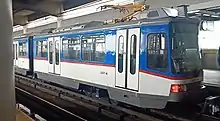
The system has 73 light rail vehicles (LRV) made in the Czech Republic by ČKD (now part of Siemens AG) in a three-car configuration, a number of which are now damaged due to poor maintenance since 2012 by the previous appointed contractor of DOTC (now DOTr).[3] The LRV's were purchased with export financing from the Czech government.[94] Trains have a capacity of 1,182 passengers,[3] which is a little bigger than the normal capacity of LRT Line 1 first generation rolling stock, although trains came with air conditioning. Despite this, it is designed to carry in excess of 23,000 passengers per hour per direction (PPHPD), and is expandable to accommodate 48,000 passengers per hour per direction.[2]
The plans for new rolling stock has been an issue for the MRT during the Aquino Administration under DOTC's leadership of then Secretary Joseph Emilio Abaya, with plans to acquire 52 second-hand LRVs offered from Madrid Metro in Spain with a budget of ₱8.43 billion, along with Inekon Trams in 2013.[95][96] However, undisclosed issues and train incompatibility issues regarding the project, the project was downgraded to 48 LRVs, with the contract having CRRC Dalian supply 48 new LRVs.
Due to poor maintenance by the previous maintenance contractors, the line previously operated with 7–10 minute headways under the DOTr orders,[97] and the system's passenger volume is presently closer to 14,000–18,000 passengers per hour per direction. With the enhancements and rehabilitation, the delays were gradually shortened, but the passenger volume is still limited due to COVID-19 prevention policies still in effect.
In early 2018, the lack of spare parts for the trains decreased the number of usable trains to just 3 operational trains running during peak hours.[98] However, by April 2018, after maintenance works were done, 14–16 trains are now operational in peak and off-peak hours.[99] On October 27, 2018, DOTr started the gradual deployment of the 2nd-generation trains.[30] Three trainsets are set for full deployment by the end of 2019, as signaling upgrades and safety certificates are being made under the takeover of Sumitomo.[100]
Due to aging air conditioning units that have been in place since the line's inauguration and complaints of uncomfortable indoor temperatures from riders, the air-conditioning units for the first-generation trainsets were first replaced in 2008 during the line's first general overhaul in 2008 to 2009.[101] In 2017, the second replacement of the air conditioning units commenced, with new units ordered from Thermo King. The replacement of these units were finished on June 18, 2021, as part of the line's rehabilitation project.[102]
The Passenger Assist Railway Display System (PARDS), a passenger information system powered by LCD screens installed near the ceiling of the train that shows news, advertisements, current train location, arrivals and station layouts, are already installed inside the trains. PARDS is also installed on trains on LRT lines 1 and 2.[103]
Depot
The line maintains an underground depot in Quezon City near North Avenue station. Above the depot is TriNoma, a shopping mall owned by the Ayala Corporation. The depot occupies 84,444 square meters (908,950 sq ft) of space and serves as the center of operations and maintenance. It is connected to the mainline through a spur line. The depot is capable of storing 81 light rail vehicles, with the option to expand to include 40 more vehicles as demand arises.[104] They are parked on nine sets of tracks, which converge onto the spur route and later on to the main network. However, a lot of rail tracks for storage inside the depot were taken by DOTr to repair broken rails, as DOTr's previous maintenance provider did not purchase spare rails. These rails have since been replaced during the rehabilitation done along the entire line by Sumitomo.
Maintenance
| Firm | From | Until | ||
|---|---|---|---|---|
 |
Sumitomo-Mitsubishi-TESP | January 1, 2000 | October 19, 2012 | |
 |
PH Trams-CB&T Joint Venture | October 20, 2012 | September 3, 2013 | |
|
Autre Porte Technique Global Inc. | September 4, 2013 | July 4, 2015 | |
 |
SBI-CB&T Joint Venture | July 5, 2015 | January 8, 2016 | |
 |
Busan Universal Rail, Inc. | January 9, 2016 | November 5, 2017 | |
|
Department of Transportation[34] | November 6, 2017 | April 30, 2019 | |
|
Sumitomo-Mitsubishi-TESP | May 1, 2019[lower-alpha 1] | present | |
| Notes | ||||
| ||||
First years under Sumitomo (1999–2012)
On December 10, 1997, the Metro Rail Transit Corporation signed a maintenance agreement with Sumitomo Corporation and Mitsubishi Heavy Industries. Sumitomo and Mitsubishi designed and built the line from 1997 to 2000. The maintenance agreement was set to expire on June 21, 2010, but was extended multiple times. On November 24, 2010, the responsibility of the procurement of the maintenance provider was transferred from the MRTC to the then Department of Transportation and Communications (Predecessor of DOTr). The maintenance contract expired on October 19, 2012.[105]
Under DOTC Secretary Abaya (2012–2016)
By 2014, the line was seen to have significantly deteriorated due to the removal of tested maintenance provider Sumitomo Corporation in 2012 by the then Department of Transportation and Communications and its persistence in using unqualified maintenance providers. The government of Benigno Aquino III had been planning to buy the line from the MRT Corporation (MRTC), the private concessionaire that built the line, and then bid it out to private bidders. The Aquino government accused the MRTC of neglecting and not improving the services of the line under its watch.[107]
In February 2016, the Philippine Senate released a report stating that DOTC Secretary Jun Abaya and other DOTC officials "may have violated" the Anti-Graft and Corrupt Practices Act in relation to questionable contracts with the subsequent maintenance providers.[108] In a Senate report where the line's condition was found to be in "poor maintenance" as per studies made by MTR HK,[109] DOTC officials were reported to be involved in graft in relation to questionable contracts, especially those for the maintenance of the line.[110]
Under Busan Universal Rail Inc. (2016–2017)
A Korean-Filipino consortium, Busan Universal Rail Inc. (BURI), became the maintenance provider of the line in January 2016. Under the maintenance contract that was supposed to end in January 2019, the contract covers the overhaul of 43 MRTC 3000 class light rail vehicles, upgrades to the signalling system, and maintenance works for three years.[111] However, BURI only refurbished three 3000 class trains.
In 2017, DOTC's succeeding agency, the Department of Transportation (DOTr) attributed the operation's disruptions of the rail system to BURI with Transport Undersecretary noting 98 service interruptions and 833 passenger unloadings (or average of twice daily) as well as train derailments in April–June 2017.[29]
BURI insisted that the disruptions the railway line was experiencing is due to "inherent design and quality concerns" and not to poor maintenance or normal tear or wear. It said that the trains had "excessive lateral movement", the train-protection equipment has a "short delay time", the trains' air conditioning system were "underrated", and other equipment and features such as bogie frames, couplers, line contractors, and tracks are of "poor quality".[112]
The maintenance provider also said that the design flaws in the railway line has been causing disruptions since the first year of operation in the year 2000. According to data cited by BURI, 1,492 glitches were recorded in 2000, 1,927 glitches in 2008, and the figure rose to 2,199 in 2009. MRTC dismissed BURI's claim on the train's lateral movement and said that the issues raised by the firm were absent when the line was maintained by Sumitomo.[112]
The DOTr announced its intentions on August 24, 2017, to terminate its contract with BURI.[113] By October 2017, the government agency issued its termination notice and took over maintenance by November 6, 2017.[34]
Return of Sumitomo (2018–present)
Due to dissatisfaction in performance, the government planned to replace BURI with the maintenance provider of Singapore's MRT, France's RATP, or Sumitomo Corporation back as the maintenance provider.[34] In late November 2017, it was reported that Sumitomo Corporation will return as the maintenance provider for the line with an agreement to formalize the beginning of talks to facilitate the return of the firm within the later-half of December 2017. The DOTr projects that Sumitomo could work with the line again by around October–December 2018.[115]
An exchange of notes was signed between the Philippines and Japan on November 7, 2018 which paved the way for the return of Sumitomo.[116] The loan agreement was signed on the next day.[117] On December 27, 2018, Sumitomo and DOTr signed the contract for the rehabilitation of the line.[118]
In a ceremony on April 30, 2019, the DOTr, through the agency's Maintenance Transition Team, formally turned over the maintenance of the line to Sumitomo Corporation, Mitsubishi Heavy Industries and TES Philippines.[119] The firms started handling the maintenance of the line on May 1, 2019, at the same time the rehabilitation of the line started.[35][120] The rehabilitation is expected to be completed in December 2021.[36] The maintenance deal is worth $32.6 million (₱1.608 billion).[121]
The rehabilitation includes the overhaul of all MRTC Class 3000 vehicles, as well as the deployment of three MRTC Class 3100 train sets, escalator and elevator operations; railway track, communication and signalling system replacement, and upgrades on power supply, overhead systems, maintenance and station equipment.[122] Interest in deploying the rest of the Class 3100 trains were expressed both by DOTr and Sumitomo, but ultimately will be deferred pending railtrack replacement and further equipment rehabilitation.[123] The newer Dalian trains that have not undergone RAMS test are currently stored in the MRT-3 depot. They were previously stored at the LRT-1 depot in Parañaque until the LRT-1 depot expansion compelled the return of the mentioned trains to their original depot. With most of the issues in the line addressed, Sumitomo is currently focusing on the Dalian trains. Currently, Sumitomo sent one unit, 3132, to the Mitsubishi Heavy Industries testing center in Mihara, Hiroshima, Japan for testing and comprehensive examinations.[124]
In his 2021 State of the Nation Address, President Rodrigo Duterte commended MRT-3 for its rehabilitation efforts and massive transformation.[125]
Plans and proposals
Capacity Expansion Project
Due to the high ridership of the line, a proposal under study by the DOTC and NEDA proposed to double the current capacity by acquiring additional light rail vehicles to accommodate over 520,000 passenger a day.[126]
In line with this need, the DOTC secured the procurement of a total of 48 light rail vehicles (LRVs) or 16 trains from Chinese rolling stock manufacturer CRRC Dalian. Delivery began in January 2016 until January 2017. The introduction of the new LRVs will allow the line to now handle over 800,000 passengers.[53]
The first train was scheduled to be in revenue service before April 2016[127][128] but delays in its 5,000 kilometers (3,100 mi) run test had delayed its deployment for Revenue service.[129][130] Moreover, further tests and analysis of the new trains revealed several incompatibilities that made it unable to run along the lines safely, which was a subject of audit from TÜV Rheinland, hired by the DOTr to determine the true usability of the trains.
Later, it was revealed that several adjustments to the Dalian trains are required prior to revenue run deployment.[131] The train manufacturer CRRC Dalian has agreed to amend the train specifications to match the contract terms at no cost, and will do so in the soonest possible time.[132] Due to the Dalian trains undergoing said adjustments, they are now slowly being introduced into revenue runs.
Plans were also laid to increase the number of cars in each train set, from the current 3-car configuration to 4-car configuration, which also increases the number of passengers being accommodated for each trip, from 1182 passengers to 1576 passengers for each train set. The transportation department, along with railway experts also revealed from studies that the MRT system can upgrade the line's entire power supply and signalling systems, for the line to coincide with the high commuting demand and increase the number of trains needed to serve the railway line daily, from 21 trains to 25-32 trains running along the line. The plan to utilize the four-car formation is now being pursued with ongoing upgrades to the power supply system.
Platform screen doors were also planned for each station, with the plans for the platform doors were laid out as early as 2013,[133] however, these plans were delayed until it was reconsidered in 2017.[134]
Southern and Western Extension Project
In a feasibility study on 2009 and on 2015, launched by Japan International Cooperation Agency, along with the Department of Transportation, the Transport and Traffic Planners (TTPI) Inc.[135] and other Japanese and local railway officials, launched a plan to extend the present MRT line's southern end, by constructing a 2.2 kilometers (1.4 mi) at-grade and underground segment, from Taft Avenue station to the SM Mall of Asia complex.[136] Plans were also laid out to add another station, by traversing through Macapagal Boulevard and linking the line to the Parañaque Integrated Terminal Exchange, therefore adding another 3.1 kilometers (1.9 mi) kilometers to the main line. The study also included a planned 7.2 kilometers (4.5 mi) extension project to the northern and western cities of Navotas, Southern Caloocan, and Malabon, which is also included to the planned merging project with the LRT Line 1, and connecting it to the North–South Commuter Railway Caloocan station.[136]
Due to the numerous problems surrounding the project, such as right-of-way and cost issues, the government decided to presumably scrap the extension plans, and look for alternatives instead, such as the planned MRT 3 to SM Mall of Asia monorail project by the Pasay City LGU and SM Investments.[137]
Line merge with LRT Line 1
Although Phase 1 of the line (Taft Avenue to North Avenue) has already been built, the route envisioned by the DOTC and the government, in general, was for it to traverse the entire length of EDSA (from Monumento to Taft Avenue), eventually meeting with the LRT 1 at Monumento in Caloocan (Phase 2) to create a seamless rail loop around Metro Manila. The expansion has been shelved by then President Gloria Arroyo in favor of the LRT Line 1's extension from Monumento to a new common station that it will share with at North Avenue, thus closing the loop. However, this move of President Arroyo to take away Phase 2 had proven to be ill-advised as the ridership is very low at only about 30,000 passengers a day. The southern terminus of the MRT Line 7 (originally Line 4 along Quezon Avenue., but had since changed route several times), which will link Quezon City, Caloocan (north), and San Jose del Monte City, Bulacan will be sharing the same station.
The National Economic and Development Authority as well as then President Arroyo herself have said that the link at North Avenue is a national priority, since it would not only provide seamless service between the LRT 1 and MRT 3, but would also help decongest Metro Manila.[138] It is estimated that by 2010, when the extension is completed, some 684,000 commuters would use the line every day from the present 400,000, and traffic congestion on EDSA would be cut by as much as 50%.[139]
Proposals to fully unite LRT 1 and MRT 3 operations and systems have been pitched but has not been pursued so far. Feasibility tests for this proposition included LRT 1 trains visiting MRT 3 depot facilities and running them on the entire line. It has since been shelved for undisclosed reasons, but may be a possibility should Manny Pangilinan's Metro Pacific attempts to purchase the entire system succeed. If and when this happens, the system may be theoretically controlled or connected to LRT 1's current operating concessionaire, Light Rail Manila Corporation, of whom Pangilinan has a controlling stake, paving the way to a possible line merger.
Transfer of operations from MRTC to LRTA
A new study for the Metro Manila Rail Network has been unveiled by DOTC Undersecretary for Public Information Dante Velasco that LRT 1, LRT 2, and MRT 3 will be placed under the management of the Light Rail Transit Authority (LRTA). This is due to maintenance cost issues for LRT 1's maintenance cost, which is approximately ₱35 million, along with LRT Line 2's ₱25 million and MRT Line 3's ₱54 million maintenance costs. Another reason for this study is for the unification of the lines. According to DOTC Undersecretary for Rails Glicerio Sicat, the transfer was set by the government in June 2011.[140] However, it is unlikely that the private owners, MRTC, will approve this plan.
On January 13, 2011, Light Rail Transit Authority Chief Rafael S. Rodriguez took over as officer-in-charge of the line in preparation for the integration of operations of the three lines,[141] but with the entry of a new leadership into the MRTC that year and in 2012, the transfer was deemed not likely to happen; however, in April 2012, a LRT 1 trainset made the first trial journey to the MRT 3 depot.[142]
On May 26, 2014, the line's general manager Al Vitangcol was sacked by Transportation and Communication Secretary Joseph Emilio Abaya, and was replaced by LRTA Administrator Honorito Chaneco as officer-in-charge. The move came after Vitangcol was accused by the ambassador of the Czech Republic of extortion and for awarding an anomalous deal, the maintenance contract, to an uncle-in-law.[143]
North Triangle Common Station
On November 21, 2013, the NEDA board, chaired by then Former President Benigno Aquino III, approved the construction of a common station within North Avenue between SM City North EDSA and TriNoma Mall. It is estimated to cost 1.4 billion pesos. It will feature head-to-head platforms for LRT 1 and MRT 3 trains with a 147.4 m (484 ft) elevated walkalator to MRT 7.[144] SM Investments Corporation posted 200 million pesos for the naming rights of the common station.[145] This is inconsistent with the original plan of having seamless connectivity to Monumento and is also an unusual arrangement of having two train stations beside each other. However, the project was shelved indefinitely due to disputes over cost, engineering issues and naming rights.[146] Even if the physical infrastructure connecting the two rail systems are in place and successfully tested, commuters have to go down at the Roosevelt station of LRT Line 1 and walk over or take a tricycle or jeepney for the one kilometer distance to the Trinoma terminal of MRT Line 3.[147] The Supreme Court halted the construction of the project in August 2014 after SM Prime Holdings contested the new location near Trinoma.[148][149] An agreement was later reached under the administration of President Rodrigo Duterte in 2016, and the common station finally begun construction in 2017.[150] Partial operations of the station will begin in December 2021 and full operations will begin in the 4th quarter of 2022.[151]
Incidents
During the testing period of the system, the MRT–3 has been prone to numerous disruptions and breakdowns due to technical problems in the overall systems and design since its opening in 1999, due to many factors, such as the humid conditions in the country, lack of accessibility to the stations, and incompatible problems in the rolling stock, causing major adjustments to the system.
However, problems start to arise in 2012, due to poor maintenance causing train glitches, lack of spare parts, and negligence, the system has faced numerous interruptions and accidents. This in turn has caused lower ridership, frequent unloading of passengers and passenger inconvenience.[152]
In 2021, the train line had its first vandalism incident[49] and first stoning incident.[153] There were reported incidents of railway safety violations in 2018[154] and 2021.[155][156]
- On November 3, 2012, a train from the Araneta Center-Cubao Station caught fire as it approached GMA-Kamuning Station, causing passengers to scramble to the exits, and having two women injured. The train caught fire due to electrical short-circuit technical failure.[157]
- On March 19, 2013, operations were halted between the Taft Avenue and Magallanes Stations due to two high-voltage breakers being tripped off, which was caused by a Surge arrester being snapped. This, together with the lack of spare parts, caused disruption of power in the whole northbound system.[158]
- On March 26, 2014, at 10:50 am, a southbound train at Guadalupe Station suddenly stopped due to the train driver not observing the red light status at the Guadalupe Station and accelerated southbound without getting prior clearance from the Control Center, causing the automatic train stop system to trigger, resulting in 8 injuries.[159]
- On June 3, 2014, a lightning strike hit the MRT's overhead lines between GMA-Kamuning and Quezon Avenue station. The situation normalized two hours later.[160]
- On August 13, 2014, a southbound train heading to Taft Avenue station derailed and overshot to the streets. The train first stopped after leaving Magallanes station due to a technical problem. Later on, the train broke down altogether, so another train was used to push the stalled train. During this process, however, the first train got detached from the rails and overshot towards Taft Avenue, breaking the concrete barriers and falling to the street below. At least 38 people were injured. The accident was blamed on 2 train drivers and 2 control personnel for failing to follow the proper coordination procedures and protocol.[161][162]
- On September 2, 2014, a train continued with one of its doors left open after a train door failed to close at the Guadalupe station. The passengers were then evacuated after the train arrived at Boni station.[163]
- On August 14, 2015, a signalling system problem limited the operations of the MRT-3 between North Avenue and Shaw Boulevard stations.[164]
- On September 18, 2017, at 6:00 am, a seat inside 3000 class LRV no. 066 caught fire at the Santolan-Annapolis station with no injuries reported.[165]
- On October 23, 2017, at 6:16 am, a thrown used adult diaper was seen at the overhead catenary lines between Ayala and Buendia Stations. On the same morning at 8:16 AM, a south-bound train from Shaw Boulevard unloaded passengers due to a train door malfunction.[166]
- On November 14, 2017, at 2:30 pm, an alighting passenger at the Ayala station suddenly fell down to the tracks. The passenger was caught between the first and second cars of a train, and her arm was cut off. Operations were disrupted but was resumed shortly.[167] The injured passenger was then brought to a nearby hospital and her arm was reconnected by surgeons the following day.[168] Following this incident, the government reconsidered the use of platform screen doors in MRT-3 stations to prevent such incident.[169]
- On November 16, 2017, at 11:30 am, at least 140 passengers were evacuated from a "detached train" coach between the railway lines of Buendia and Ayala Avenue Stations.[170]
- On December 31, 2017, a signalling system problem halted the operations of Line 3. Operations resumed at 7:54 am, but after a few minutes, an EBI screen, a computer-based train regulation system allowing the line's control center to monitor trains, malfunctioned.[171]
- On February 20, 2018, at 6:32am, an electrical failure in a train caused passengers to walk on the railtracks between Shaw Boulevard and Ortigas stations. The electrical failure was caused by old and worn-out parts in the train.[172]
- On August 7, 2018, an aircon leak caused "rain" inside a train and caused passengers inside to open their umbrellas. The train was removed from service to fix the air conditioning unit and the train involved in the incident returned to service the following day.[173]
- On August 15, 2018, at around 8:47 am, a man was spotted walking in the railway tracks between Magallanes and Ayala station. The man reportedly threw rocks at MRT-3 personnel and cars passing by EDSA. The man was shot in the ankle and was brought to the hospital.[154]
- On September 26, 2018, at 3:15 am, two maintenance vehicles collided between Buendia and Guadalupe stations while doing a routine track maintenance, injuring 7 people. This resulted in a one-hour delay of the deployment of trains, causing long lines at stations.[174]
- On November 17, 2018, a northbound train at Buendia station unloaded 650 passengers because of an electrical failure in one of the train's motors. The unloaded passengers were able to board the next train after six minutes.[175]
- On March 18, 2019, at 6:02 pm, a southbound train was stopped after smoke caused by a short circuit fire at the train's traction motors was being emitted while in between the Araneta Center-Cubao and Santolan stations.[176]
- On September 6, 2019, an overhead line section snapped at Guadalupe Station, causing a power supply glitch in the whole line affecting over 7,000 passengers. Partial operations were implemented from North Avenue Station to Shaw Boulevard Station. The situation normalized at 5:00 pm.[177] The incident was caused by a defective and old Protection and Control Unit (PTU) that was overdue for replacement, after an investigation was made. Train preparation and daily maintenance were among the factors that failed to prevent this incident.[178]
- On October 2, 2019, a power supply problem caused a train to stall at 10:17am. 508 passengers were forced to walk on the railtracks between the Ayala and Taft Avenue stations. The power supply was restored several minutes later.[179]
- On November 4, 2019, at 4:08 pm, a train suddenly emitted smoke while on the northbound track of the line. Around 530 passengers were unloaded. Around two hours after the incident, the operation of the line was back to normal.[180]
- On February 5, 2020, at 7:18 AM, a northbound train at Ayala station unloaded some 700 passengers because of a door failure. The unloaded passengers were able to board the next train after 5 minutes.[181]
- On February 16, 2020, a stretcher bar was broken at the North Avenue turnback siding, and it caused partial operations between Shaw Boulevard and Taft Avenue stations. The operations returned to normal at 12:22 PM.[182]
- On December 16, 2020, at 7:20 PM, an MRTC Class 3100 train arriving Boni station stopped due to a technical glitch.[183] Partial operations between North Avenue and Shaw Boulevard stations were implemented, and around 3,500 commuters were affected. Normal operations resumed the following day.[184][185]
- On May 7, 2021, a car of the MRTC 3000 class was vandalized by an unidentified culprit near Taft Avenue station. The authorities discovered the vandalized train on May 12, 2021. Investigations were conducted and initial reports state that the culprit had cut the perimeter fence near Taft Avenue station, which may have caused the vandalism.[49]
- On May 9, 2021, two men were arrested after they were caught going down the railway tracks at Quezon Avenue station to take a selfie.[155]
- On August 12, 2021, at around 5:35 am, an undressed foreigner passenger, later to be identified as a Chinese passenger, was spotted walking along the railway tracks between Boni and Shaw Boulevard stations, causing disruption in the line's operations for 20 minutes. The man was arrested at 5:42 am and was brought back to Boni station for investigation. According to an eyewitness, there was a tension between the Chinese passenger and the security guards inspecting the passenger's bag before the passenger removed his clothes and started running along the tracks.[156]
- On October 9, 2021, at 9:12 p.m., a 3000 class LRV no. 032 caught fire near the Guadalupe station. A provisional service was implemented between North Avenue and Shaw Boulevard station, and the site of the incident was declared fire out at 9:51 p.m. As a result of the incident, 8 passengers sustained minor injuries.[186][187] Normal operations resumed the following day.[188]
- On November 21, 2021, at 6:51 a.m., a window in a 3000 class LRV was damaged due to a stoning incident, with one injury reported.[153] The suspect was later identified as a garbage collector and was subsequently arrested and charged.[189]
- On December 7, 2021, a signalling problem halted the operations of MRT Line 3 before 12:00 p.m. Operations were later resumed at 12:45 p.m.[190]
References
- "About Us – MRT3 Stations". Metro Rail Transit. Archived from the original on January 22, 2013. Retrieved June 8, 2014.
- "About Us – Background". Metro Rail Transit. Archived from the original on May 8, 2014. Retrieved June 8, 2014.
- "About Us – Trains". Metro Rail Transit. Archived from the original on May 8, 2014. Retrieved June 8, 2014.
- Cayabyab, Marc Jayson (December 13, 2021). "MRT passengers reach 190,000 amid pandemic". The Philippine Star. Archived from the original on December 13, 2021. Retrieved December 14, 2021.
- Bacungan, VJ (February 8, 2018). "Gov't signs deal to procure MRT-3 signalling system parts". CNN Philippines. Retrieved November 18, 2021.
- "Procurement of MRT3 Capacity Expansion Project Lot 2 : Upgrade of Ancillary Systems" (PDF). 2016. p. 95. Archived (PDF) from the original on September 1, 2021. Retrieved September 1, 2021.
- Salazar, Irineo B. R. (January 31, 2016). "On a clear day you can see the MRT". The Society of Honor by Joe America. Retrieved July 20, 2016.
- Mendez, Christina (August 11, 2015). "Poe's Senate panel to resume hearing on Line 3". Retrieved July 20, 2016.
- Amojelar, Darwin G. (August 14, 2014). "DERAILED | 5 things you should know about MRT3 and the mess it's in". InterAksyon. TV5 News and Information. Archived from the original on August 16, 2014. Retrieved August 17, 2014.
- Anonas, Alma S. (June 10, 1999). "On track and heading for Year 2K on MRT-3". Manila Standard. Kamahalan Publishing Corporation. Retrieved January 21, 2014 – via Google News Archive.
- Ombay, Giselle (December 9, 2021). "DOTr: Mitigating measures will be placed in case EDSA-North Avenue station temporarily closes". GMA News. Retrieved December 9, 2021.
- @dotrmrt3 (April 5, 2021). "LOOK: MRT-3 Daily Operating Hours #DOTrPH 🇵🇭 #DOTrMRT3 #SulongMRT3" (Tweet) – via Twitter.
- Ronda, Rainier Allan (March 31, 2010). "LRT, MRT closed for Holy Week". The Philippine Star. PhilStar Daily, Inc. Retrieved August 21, 2014.
- "No MRT-3 operations from March 30 to April 4 for Holy Week maintenance works". CNN Philippines. March 16, 2021. Retrieved March 16, 2021.
- Olchondra, Riza T. (May 29, 2009). "MRT-3 rides to go 24 hours starting June 1". Philippine Daily Inquirer. Philippine Daily Inquirer, Inc. Archived from the original on May 30, 2009. Retrieved May 31, 2009.
- Kwok, Abigail (June 3, 2009). "MRT-3 stops 24-hour run". Philippine Daily Inquirer. Philippine Daily Inquirer, Inc. Archived from the original on October 27, 2014. Retrieved March 11, 2014.
- Camus, Miguel R.; Calleja, Niña P. (February 21, 2014). "DOTC extends MRT-3 operating hours". Philippine Daily Inquirer. Philippine Daily Inquirer, Inc. Retrieved March 11, 2014.
- "Light Rail Transit Authority Company History". Light Rail Transit Authority. Archived from the original on September 24, 2014. Retrieved September 13, 2014.
- Macaspac, Joem H.; Garcia, Ma. Luisa M. (March 28, 1996). "First phase of Edsa metro rail transit system under way". Manila Standard. Kamahalan Publishing Corporation. Retrieved January 21, 2014 – via Google News Archive.
- "G.R. No. 114222". April 6, 1995. Archived from the original on February 23, 2018. Retrieved November 19, 2021.
- "Metrostar Express - History (Background)". dotcmrt3.gov.ph. Archived from the original on June 26, 2006. Retrieved July 7, 2006.
- "Metrostar Express - History (Construction)". dotcmrt3.gov.ph. Archived from the original on June 26, 2006. Retrieved July 7, 2006.
- "Miracle rail project to rid Edsa of jams". New Straits Times. The New Straits Times Press (M) Bhd. December 15, 1999. Retrieved January 21, 2014 – via Google News Archive.
- "MRT 3 Fully Completed; Inauguration, Turnover Set on July 20". Manila Bulletin. Manila Bulletin Publishing Corporation. July 16, 2000. Archived from the original on July 13, 2021 – via Questia Online Library.
- Trinidad, Andrea H. (January 2, 2000). "Metrostar Express proves a big disappointment". Philippine Daily Inquirer. Philippine Daily Inquirer, Inc. Retrieved January 21, 2014 – via Google News Archive.
- Rivera, Blanche S. (January 13, 2000). "Metro trains on EDSA running almost empty". Philippine Daily Inquirer. Philippine Daily Inquirer, Inc. Retrieved January 21, 2014 – via Google News Archive.
- Katigbak, J.R. (January 8, 2000). "New white elephants in Metro Manila". Philippine Daily Inquirer. Philippine Daily Inquirer, Inc. Retrieved January 21, 2014 – via Google News Archive.
- de Fiesta, Ria (February 27, 2014). "Abaya: MRT-3 operating at overcapacity". ABS-CBN News and Current Affairs. Retrieved August 17, 2014.
- Dela Paz, Chrisee (August 28, 2017). "Busan Universal Rail calls DOTr's move to end contract 'unfair'". Rappler. Retrieved November 21, 2017.
- "Department of Transportation – Philippines". www.facebook.com. Retrieved October 27, 2018.
- Dela Paz, C.J.V. (December 15, 2014). "Metro Pacific to renew offer for MRT-3 rehab". BusinessWorld. Retrieved September 27, 2021 – via ppp.gov.ph.
- Dela Paz, Chrisee (October 2, 2017). "Metro Pacific group eyes P20 billion for MRT3 takeover". Rappler. Retrieved September 27, 2021.
- Mercurio, Richmond (January 28, 2020). "Government rejects Metro Pacific offer for MRT-3 takeover". The Philippine Star. Retrieved September 27, 2021.
- "DOTr: Gov't to take over MRT3 maintenance". CNN Philippines. November 6, 2017. Retrieved November 21, 2017.
- Magsino, Dona (May 1, 2019). "MRT3 rehab, maintenance starts". GMA News Online. Retrieved June 16, 2021.
- Amojelar, Darwin G. (July 11, 2021). "MRT 3 rehabilitation completed December". Manila Standard. Retrieved July 13, 2021.
- Satre, Gary L. (June 1998). "The Metro Manila LRT System—A Historical Perspective" (PDF). Japan Railway and Transport Review. 16: 33–37. Archived from the original (PDF) on May 5, 2006. Retrieved August 14, 2014.
- Ulanday, Abelardo S. (December 9, 2001). "The best things in life are Libre". Philippine Daily Inquirer. Philippine Daily Inquirer, Inc. Retrieved August 14, 2014 – via Google News Archive.
- World Bank (December 2, 2004). "A Tale of Three Cities: Urban Rail Concessions in Bangkok, Kuala Lumpur and Manila – Final Report" (PDF): 17. Archived from the original (PDF) on April 24, 2006. Retrieved August 18, 2014. Cite journal requires
|journal=(help) (Prepared by Halcrow Group Limited). - "Months ago, experts warned line was unsafe". ABS-CBN News and Current Affairs. August 13, 2014. Retrieved August 17, 2014.
- Ayalin, Adrian (August 15, 2013). "MRT-3: A history of accidents". Primetime on ANC. ABS-CBN News Channel.
- Hegina, Aries Joseph (August 14, 2014). "Abaya: MRT3 is safe, riding it 'a personal decision'". Philippine Daily Inquirer. Philippine Daily Inquirer, Inc. Retrieved August 21, 2014.
- Cupin, Bea (August 14, 2014). "Abaya admits MRT-3 upgrade overdue". Rappler. Retrieved August 17, 2014.
- Manabat, Johnson (December 18, 2013). "MRT-3 enforces new crowd control scheme". ABS-CBN News and Current Affairs. Retrieved August 17, 2014.
- Camus, Miguel R. (May 6, 2014). "All is set for MRT-3 express train run". Philippine Daily Inquirer. Philippine Daily Inquirer, Inc. Retrieved August 18, 2014.
- Camus, Miguel R. (December 20, 2013). "MRT-3 boss defends 'crowd control' amid jeering riders". Philippine Daily Inquirer. Philippine Daily Inquirer, Inc. Retrieved August 17, 2014.
- "MRT3 Reminders". Metro Rail Transit Line 3. Metro Rail Transit Corporation. Archived from the original on August 19, 2014. Retrieved August 17, 2014.
- Antiporda, Jefferson (August 10, 2005). "MRT-3 issues directive imposing ban on tin cans". The Manila Times. Manila Times Publishing Corporation. Archived from the original on August 19, 2006. Retrieved May 19, 2006.
- "MRT-3 allows pets inside trains". CNN Philippines. July 13, 2021. Retrieved July 19, 2021.
- Manabat, Jacque (May 13, 2021). "MRT management looking for witnesses after train vandalism". ABS-CBN News. Retrieved May 13, 2021.
- Fe, Kaye (May 19, 2021). "MRT-3 beefs up security following May 12 vandalism incident". Eagle News. Eagle Broadcasting Corporation. Archived from the original on August 15, 2021. Retrieved August 15, 2021.
- Del Puerto, Luige A.; Quismundo, Tarra V. (November 13, 2004). "New task force formed to keep LRT, MRT safe". Philippine Daily Inquirer. Philippine Daily Inquirer, Inc. Archived from the original on January 4, 2005. Retrieved May 19, 2006.
- "MRT3 Ridership". DOTr. Retrieved November 4, 2021.
- "More MRT-3 coaches on the way". Official Gazette of the Republic of the Philippines. January 18, 2016. Retrieved April 20, 2016.
- Dela Cruz, Raymond Carl (June 25, 2020). "4 Metro Manila rail lines transport 2.8M passengers since June 1". Philippine News Agency. Archived from the original on November 4, 2021. Retrieved November 4, 2021.
- "MRT-3 serves record 157K passengers since Covid lockdown". www.pna.gov.ph. January 19, 2021. Retrieved November 4, 2021.
- "70% passenger capacity in public transport begins Nov.4". Philippine News Agency. November 3, 2021. Archived from the original on November 3, 2021. Retrieved November 4, 2021.
- "MRT, LRT 1 and 2 to offer free rides on June 12". ABS-CBN News. June 11, 2019. Retrieved June 10, 2021.
- "MRT3 to offer free rides on Independence Day". GMA News Online. June 10, 2021. Retrieved June 10, 2021.
- Sabillo, Kristine Angeli (December 28, 2013). "MRT, LRT offer free rides on Rizal Day". Philippine Daily Inquirer. Retrieved July 24, 2021.
- Rey, Aika (June 27, 2019). "Free LRT 2, MRT, PNR rides for students starting July 1". Rappler. Retrieved June 10, 2021.
- Laurel, Drei (June 28, 2019). "Students must register for free MRT-3, LRT-2, and PNR rides". Top Gear Philippines. Retrieved June 10, 2021.
- "MRT-3, LRT-2 offer free rides to women on March 8". GMA News Online. March 7, 2021. Retrieved June 10, 2021.
- Araneta, Sandy (October 21, 2005). "DOTC: MRT-3 fare could increase by P10 in 2006". The Philippine Star. PhilStar Daily, Inc. Retrieved May 19, 2006.
- Casanova, Sheryll B. (November 12, 2003). "MRTC borrows value tickets from LRTA". The Manila Times. Manila Times Publishing Corporation. Archived from the original on January 5, 2004. Retrieved May 18, 2006.
- Amojelar, Darwin G. (September 21, 2012). "Expect long queues at MRT-3 amid shortage of tickets – MRT3". TV5 News and Information. Archived from the original on September 13, 2014. Retrieved September 13, 2014.
- Agcaoili, Lawrence (July 20, 2014). "DOTC earmarks P25M to buy additional MRT-3 tickets". ABS-CBN News and Current Affairs. Retrieved September 13, 2014.
- "MRT3 woes". The Manila Times. Manila Times Publishing Corporation. November 16, 2005. Archived from the original on December 8, 2015. Retrieved July 2, 2006.
- Reyes, Mary Ann Ll. (November 17, 2006). "Globe bares G-Pass ticketing for MRT3". The Philippine Star. PhilStar Daily, Inc. Retrieved September 13, 2014.
- Reyes, Mary Ann Ll. (March 31, 2007). "Smart ties up with MetroPass on MRT-3". The Philippine Star. PhilStar Daily, Inc. Retrieved September 13, 2014.
- Amojelar, Darwin G. (January 29, 2013). "Ayala group to bid for common ticket system". TV5 News and Information. Archived from the original on October 19, 2014. Retrieved September 23, 2014.
- Serfino, Dennis C. (May 1, 2003). "Metro Star still can't get enough revenue". Manila Standard. Kamahalan Publishing Corporation. Retrieved April 23, 2014 – via Google News Archive.
- "LRT-MRT FARES TO BE INCREASED ON JAN.4". dotc.gov.ph. Department of Transportation and Communications (DOTC). Archived from the original on December 25, 2014. Retrieved March 10, 2015.
- Tuazon, Brenda P. (July 16, 2000). "Estrada Orders MRT3 Firm to Reduce Metrostar Fares". Manila Bulletin. Manila Bulletin Publishing Corporation. Archived from the original on February 9, 2019. Retrieved September 1, 2021 – via Questia Online Library.
- Mandri-Perrott, Cledan (2000). Private Sector Participation in Light Rail-Light Metro Transit Initiatives. Washington, D.C.: World Bank. p. 94. ISBN 0821380850.
- Diokno, Benjamin E. (December 17, 2013). "Folly of government subsidy". BusinessWorld. BusinessWorld Publishing Corporation. Retrieved April 25, 2014.
- Valderrama, Tita C. (February 9, 2014). "Messed up mass transport system". The Manila Times. Manila Times Publishing Corporation. Archived from the original on April 23, 2014. Retrieved April 23, 2014.
- Agcaoili, Lawrence (December 14, 2013). "DOTC says MRT, LRT fare hike to yield P2-B add'l revenues". The Philippine Star. PhilStar Daily, Inc. Retrieved April 23, 2014.
- Casauay, Angela (October 25, 2012). "Visayan solons back P10 MRT3 fare hike". Rappler. Retrieved September 23, 2014.
- Aquino III, Benigno S. (July 22, 2013). [English] Benigno S. Aquino III, Fourth State of the Nation Address, July 22, 2013 (Speech). State of the Nation Address. Quezon City. Retrieved September 23, 2014.
Each trip that one passenger makes on the LRT is estimated to cost 40 pesos. What does each passenger pay? 15 pesos. This means that the government subsidizes the remaining 25 pesos. As for the line, the true cost of one trip is 60 pesos: 15 pesos paid by passengers, 45 pesos by the government—in the end, each and every Filipino pays a share of the subsidy. Whether you live in Mindanao or Visayas, and not once have you ever stepped onto the LRT or MRT, you help to fund this.
- Cruz, Neal H. (November 18, 2012). "No improved MRT3 service, no fare hike". Philippine Daily Inquirer. Philippine Daily Inquirer, Inc. Retrieved September 23, 2014.
- Magsino, Dona (October 2, 2020). "13 Dalian train sets for MRT3 to be operational in 2022 —DOTr exec". GMA News Online. Retrieved June 7, 2021.
- Dumlao, Miggy (December 8, 2020). "MRT-3 now runs at 60 kph speed". Philippine Daily Inquirer. Retrieved November 4, 2021.
- Morial, Daniel (August 22, 2014). "MRT-3 speed limit down from 60kph to 40kph". YugaTech. Retrieved November 30, 2021.
- Subingsubing, Krixia (May 20, 2020). "DOTr: Over half of MRT 3's tracks replaced". Inquirer.net. Retrieved June 7, 2020.
- Balinbin, Arjay L. (May 19, 2020). "MRT-3 train speed, capacity expected to double by December". BusinessWorld. Retrieved June 7, 2020.
- Cordero, Ted (September 30, 2020). "MRT3 train speed to increase 40Kph starting Oct. 1". GMA News. Retrieved November 4, 2021.
- Luna, Franco (November 3, 2020). "MRT-3 trains reach 50kph for the first time since 2014". Philstar. Retrieved November 4, 2021.
- Procurement of MRT3 Capacity Expansion Project Lot 2 : Upgrade of Ancillary Systems (PDF) (Report). 2016. p. 91-93. Archived (PDF) from the original on September 1, 2021. Retrieved September 1, 2021.
- "Tramcar RT8D5M Model Basic Features". skd.cz. SKD. Retrieved November 1, 2020.
- "DS_Manila-MRT3_18_vvk_DS2399_en.pdf" (PDF). Voith.com. Voith. Retrieved May 28, 2020.
- "菲律宾马尼拉3号线车辆" (in Chinese).
- Rey, Aika (January 23, 2019). "LOOK: 3rd China-made Dalian train hits MRT3 tracks until February 1". Rappler. Retrieved January 23, 2019.
- "China-made trains within 'allowable' weight for MRT: consultant". ABS-CBN News. February 20, 2018. Retrieved February 22, 2018.
- "MRT3 stress and Camp John Hay turmoil". The Manila Times. Manila Times Publishing Corporation. June 21, 2005. Retrieved July 2, 2006.
- Macapagal, Maan (February 2, 2013). "MRT-3 to get additional 52 coaches". ABS-CBN News.
- Agcaoili, Lawrence (September 12, 2013). "Inekon: PH can save $5M a year with new MRT trains". The Philippine Star – via ABS-CBN News.
- "About Us – Train Schedules". Metro Rail Transit. Archived from the original on May 8, 2014. Retrieved June 8, 2014.
- "MRT3 Only 3 trains running as spare parts start arriving". Interaksyon. February 14, 2018. Retrieved February 19, 2018.
- "MRT records 16 running trains". ABS-CBN News. April 5, 2018. Retrieved April 10, 2018.
- Esmael, Lisbet K. (September 16, 2019). "MRT to 'gradually' deploy Dalian trains". The Manila Times.
- Pateña, Aerol John (August 8, 2018). "DOTr apologizes over MRT aircon leak". Philippine News Agency. Retrieved June 19, 2021.
- Cutaran, Jal (June 18, 2021). "MRT-3 Wagons Now Equipped with New Air Conditioning Units". Unbox.ph. Retrieved June 19, 2021.
- "Passenger information system to be installed in LRT, MRT". BusinessWorld. March 27, 2019. Retrieved December 12, 2020.
- Procurement of MRT3 Capacity Expansion Project Lot 2 : Upgrade of Ancillary Systems (PDF) (Report). 2016. p. 91. Archived (PDF) from the original on September 1, 2021. Retrieved September 1, 2021.
- Marcelo, Elizabeth (January 14, 2016). "DOTC at fault for 'inefficient' maintenance providers, letting MRTC off the hook —COA". GMA News. Retrieved December 10, 2021.
- Rey, Aika (October 31, 2018). "After delay, Philippines, Japan to sign MRT3 rehab loan deal on November 7". Rappler. Retrieved December 10, 2021.
- Rosario, Ben (October 14, 2014). "House committee to investigate MRT3 controversies". Manila Bulletin. Archived from the original on February 5, 2016. Retrieved January 30, 2016.
- "Abaya, DOTC officials 'may have violated' anti-graft law over MRT-3". CNN Philippines. February 5, 2016. Retrieved February 5, 2016.
Transport officials led by Secretary Joseph Emilio "Jun" Abaya may have violated provisions of the Anti-Graft and Corrupt Practices Act in relation to the Metro Rail Transit Line 3 (MRT-3).
- De Guzman, Kristine. "DOTC chief shrugs off Senate report on MRT3". CNN Philippines. Retrieved February 5, 2016.
The report described what commuters put up with every day — the lack of coaches, poor maintenance of trains and platform facilities, and deteriorating rails..
- De Guzman, Kristine. "DOTC chief shrugs off Senate report on MRT3". CNN Philippines. Retrieved February 5, 2016.
Questionable deals and contracts also hound the line, which could bring transport officials to court for graft charges.
- Marcelo, Elizabeth (October 19, 2020). "MRT-3 revenue hits record low in 2019 – COA". The Philippine Star. Retrieved December 10, 2021.
- Marasigan, Lorenz (July 27, 2017). "MRT 3 flawed from the start–Busan". BusinessMirror. Retrieved November 21, 2017.
- Rey, Aika (August 24, 2017). "DOTr to terminate MRT3 maintenance contract". Rappler. Retrieved November 21, 2017.
- Bilang ng newly-overhauled LRV ng MRT-3, nasa 34 na (16:9) (Facebook Watch). DOTr MRT-3. December 9, 2021. Retrieved December 10, 2021.
- Bacungan, VJ (November 29, 2017). "DOTr: New MRT-3 maintenance provider could start work by April 2018". CNN Philippines. Retrieved November 29, 2017.
- "PH, Japan ink exchange of notes on defense, MRT3 rehab". Philippine News Agency. November 7, 2018. Retrieved June 16, 2021.
- Marquez, Consuelo (November 8, 2018). "PH, Japan sign loan agreement for 26-month MRT-3 rehab". Philippine Daily Inquirer. Retrieved June 16, 2021.
- Gonzales, Val [@dzrhnews] (December 27, 2018). "JUST IN: Kontrata sa pagitan ng @DOTrPH at Sumitomo Corporation para sa rehabilitasyon ng @dotrmrt3, pirmado na | via @dzrh5 Val Gonzales #DZRHNationwide" (Tweet) (in Filipino). Retrieved January 2, 2019 – via Twitter.
- De Vera, Ellalyn; Noriega, Richa (May 1, 2019). "Sumitomo-MHI-TESP takes over MRT-3 rehab". Manila Bulletin. Retrieved October 11, 2021.
- Subingsubing, Krixia (December 29, 2018). "Sumitomo back on track with MRT 3". Inquirer.net. Retrieved January 2, 2019.
- Smith, Kevin (January 9, 2019). "Contract awarded for Manila MRT-3 rehabilitation". International Railway Journal.
- Amojelar, Darwin (December 31, 2018). "Sumitomo asked to start MRT 3 rehabilitation in '19". Manila Standard. Retrieved January 2, 2019.
- Peralta, Janine (October 16, 2019). "All Dalian trains for MRT-3 line to be fully operational by July 2021 – MRT". CNN Philippines.
- "マニラMRT3100形 三菱重工「MIHARA試験センター」搬入". 2427junction.com (in Japanese). Retrieved December 10, 2021.
- Duterte, Rodrigo Roa (July 26, 2021). Rodrigo Roa Duterte, Sixth State of the Nation Address, July 26, 2021 (Speech). State of the Nation Address. Quezon City. Retrieved December 2, 2021.
MRT-3, with its frequent breakdowns and unloading of passengers midrail, was a horror that was for the daily commuters to endure in the past. Now, MRT-3 no longer unloads passengers but to their destinations. The waiting time between trains has been significantly reduced. [From] 10 trains running at only 30 kilometers per hour before, now [MRT-3] runs 23 trains at 60 kilometers per hour.
- JICAChannel02 (June 10, 2014). "(The Philippines) MEGA MANILA INFRASTRUCTURE ROADMAP (Long Ver.)". Archived from the original on December 13, 2021. Retrieved April 20, 2016.
- "New MRT-3 train to be launched before April | GOVPH". Official Gazette of the Republic of the Philippines. February 23, 2016. Retrieved April 20, 2016.
- Dela Paz, Chrisee (February 23, 2016). "DOTC sees launch of new MRT3 train by April". Rappler. Retrieved April 20, 2016.
- De Guzman, Kristine (April 15, 2016). "New MRT trains to finally run on revenue hours". CNN Philippines. Retrieved April 20, 2016.
- De Guzman, Kristine (April 16, 2016). "New MRT3 train starts running next week". CNN Philippines. Archived from the original on September 25, 2018. Retrieved April 20, 2016.
- "Dalian to pay cost of adjustments of unused MRT3 trains —Tugade". GMA News Online. July 8, 2018. Retrieved September 25, 2018.
- Rey, Aika (August 30, 2018). "Chinese firm Dalian agrees to pay all costs to fix unused MRT3 trains". Rappler.
- "Platform doors installed in MRT station". ABS-CBN News. June 26, 2013. Retrieved September 20, 2020.
- Nicholls, AJ; Bacungan, VJ (November 15, 2017). "Gov't considers screen doors at MRT Ayala station after accident". CNN Philippines. Retrieved September 20, 2020.
- "Company Profile - Transport and Traffic Planners (TTPI) Inc". www.ttpiph.com.
- "ROADMAP FOR TRANSPORT INFRASTRUCTURE DEVELOPMENT FOR METRO MANILA AND ITS SURROUNDING AREAS (REGION III & REGION IV-A)" (PDF).
- Camus, Miguel R. (September 22, 2021). "SM Group offers to build monorail and road flyover in Pasay". INQUIRER.net. Retrieved November 4, 2021.
- Torres, Ted P. (September 21, 2004). "LRT-MRT link is nat'l priority – NEDA". Philippine Daily Inquirer. Philippine Daily Inquirer, Inc. Archived from the original on September 25, 2004. Retrieved May 12, 2006.
- "After gov't takeover of NAIA Terminal 3, PGMA orders immediate completion of EDSA MRT3 extension" (Press release). Department of Transportation and Communications. January 4, 2005. Retrieved May 19, 2006.
- Amojelar, Darwin G. (December 28, 2010). "Govt creates team for MRT-3 due diligence, sets June takeover". The Manila Times. Manila Times Publishing Corporation. Retrieved January 15, 2011.
- Dagcutan, Aura Marie P. (January 13, 2011). "LRTA chief takes over MRT-3". BusinessWorld. BusinessWorld Publishing Corporation. Archived from the original on September 23, 2015. Retrieved January 18, 2011.
- https://www.facebook.com/media/set/?set=a.421569221204699.127729.172643056097318&type=3
- Camus, Miguel R. (May 27, 2014). "Vitangcol replaced as head of MRT-3". Inquirer.net. Retrieved May 27, 2014.
- Tan, Kimberly Jane (November 21, 2013). "NEDA approves MRT 7, LRT-1 extension projects". GMA News and Public Affairs. Retrieved January 1, 2014.
- Lectura, Lenie (September 23, 2013). "DOTC ready to refund SM's P200-M naming-rights fee for common station". BusinessMirror. Philippine Business Daily Mirror Publishing, Inc. Archived from the original on January 2, 2014. Retrieved January 1, 2014.
- Marasigan, Gelo; Remitio, Rex (September 28, 2016). "Finally: A common station for LRT, MRT lines". CNN Philippines. Retrieved April 10, 2018.
- Chanco, Boo (January 2, 2013). "P-Noy can't deliver MRT-3 upgrades". Philstar. Retrieved January 2, 2013.
- Flores, Mikhail Franz; dela Paz, Chrisee Jalyssa (August 2, 2014). "High court stops transfer of common train station site". BW. Retrieved August 2, 2014.
- Fe, Kaye (September 29, 2017). "Construction of P2.8-B Grand Unified Central Station to begin after almost a decade of delay". EBC. Retrieved September 29, 2017.
- Jiao, Claire (September 29, 2017). "LRT-MRT common station breaks ground". CNN Philippines. Retrieved April 10, 2018.
- Rey, Aika (April 26, 2021). "LRT-MRT common station partial operations postponed to Q4 2021". Rappler. Retrieved May 26, 2021.
- Santos Jr., Reynaldo (August 13, 2014). "TIMELINE: MRT3 mishaps". Rappler. Retrieved September 17, 2019.
- "One hurt after unidentified suspect hurls stone at MRT3 train coach". GMA News and Public Affairs. November 21, 2021. Retrieved November 21, 2021.
- Rey, Aika (August 15, 2018). "Vagrant shot in ankle by MRT3 guard". Rappler. Retrieved August 12, 2021.
- Cerrudo, Aileen (May 11, 2021). "2 MRT passengers face charges for going down train tracks to take a selfie". UNTV News and Rescue. Retrieved August 12, 2021.
- Bagaoisan, Anjo (August 13, 2021). "Lalaking Chinese tumakbong hubo't hubad sa riles ng MRT". ABS-CBN News (in Filipino). Manila: ABS-CBN News. Retrieved August 13, 2021.
- Geronimo, Gian (November 3, 2012). "MRT train coach catches fire near Kamuning Station". GMA News Online. Retrieved September 6, 2019.
- Dimacali, TJ; Dinglasan, Rouchelle (March 19, 2013). "MRT operations suspended due to 'technical difficulties'". GMA News Online. Retrieved June 6, 2020.
- Fernandez, Amanda (March 26, 2014). "10 passengers hurt as MRT train makes sudden stop". GMA News Online. Retrieved June 4, 2020.
- Ronda, Rainier Allan (June 4, 2014). "Lightning stops MRT train on tracks". Philstar. Retrieved June 6, 2020.
- Pineda, Mj Lising (August 13, 2014). "MRT-3 Gets Derailed". Buhaykolehiyo. Archived from the original on October 25, 2014.
- Camus, Miguel R. (August 19, 2014). "DOTC: Human error blamed for MRT-3 train accident; 4 train workers face raps". Inquirer.net. Retrieved June 6, 2020.
- Hegina, Aries Joseph (September 3, 2014). "MRT train continues run with one of its doors open". Philippine Daily Inquirer. Retrieved November 30, 2021.
- GMA News (August 14, 2015). SONA: Prototype ng bagong bagon ng MRT 3 mula China, dumating na. YouTube (video). Event occurs at 0:36. Archived from the original on December 13, 2021. Retrieved June 1, 2021.
- "MRT operations temporarily stopped after seat catches fire". Rappler. September 18, 2017. Retrieved November 5, 2021.
- Echeminada, Perseus (October 23, 2017). "Diaper disrupts MRT-3 operations". Philstar. Retrieved September 6, 2019.
- Rey, Aika (November 14, 2017). "Woman loses right arm in MRT3 accident". Rappler. Retrieved November 5, 2021.
- Yee, Jovic (November 15, 2017). "Severed arm of woman in MRT-3 accident reconnected". Philippine Daily Inquirer. Retrieved November 5, 2021.
- Bondoc, Marlly Rome (November 15, 2017). "Platform screen doors: Why 'Ayala MRT incident' is less likely to happen abroad". GMA News. Retrieved November 5, 2021.
- Lagrimas, Nicole-Anne (November 16, 2017). "Up to 140 riders evacuated from 'detached train'". GMA News Online. Retrieved November 16, 2017.
- De Jesus, Julliane Love (December 31, 2017). "MRT-3 ends 2017 with another system failure". Philippine Daily Inquirer. Retrieved November 5, 2021.
- Pascual, Jekki; Aquino, Lyza; Reyes, Isay (February 20, 2018). "LRT-1, MRT nagkaaberya, nagpababa ng mga pasahero". ABS-CBN News. Retrieved June 1, 2021.
- Rey, Aika (August 8, 2018). "Aircon leak causes 'rain' inside MRT3". Rappler. Retrieved June 19, 2021.
- Orellana, Faye (September 26, 2018). "7 hurt as two MRT-3 maintenance vehicles collide". Philippine Daily Inquirer. Retrieved October 10, 2021.
- Orellana, Faye (November 17, 2018). "MRT-3 ends 'no offloading streak' at Gil Puyat station". Philippine Daily Inquirer. Retrieved November 5, 2021.
- Ramos, Christia Marie (March 18, 2019). "MRT-3 unloads passengers after train emits smoke". Inquirer.net. Retrieved June 6, 2020.
- "Ilang pasahero ng MRT, nag-panic dahil sa nangyaring aberya kaninang umaga". GMA News Online. September 6, 2019. Retrieved September 12, 2019.
- Tuquero, Loreben (September 19, 2019). "Overhaul overdue: Daily maintenance fails to prevent MRT3 short circuit". Rappler. Retrieved August 2, 2021.
- Ong, Ghio (October 3, 2019). "Power glitches disrupt LRT-2, MRT-3 operations". Philstar Global. Retrieved May 26, 2021.
- Galvez, Daphne (November 4, 2019). "MRT-3 resumes normal ops from North to Taft stations after train emits smoke". Inquirer.net. Retrieved November 5, 2019.
- Marquez, Consuelo (February 5, 2020). "MRT-3 glitch: 700 passengers unloaded at Ayala Station". Inquirer.net. Retrieved June 4, 2020.
- Rita, Joviland (February 16, 2020). "MRT3 halts Ortigas–North Ave. ops due to broken part of tracks". GMA News Online. Retrieved March 23, 2021.
- Dalian train stops at Boni station, December 16, 2020, retrieved November 8, 2021
- Dominguez-Cargullo, Dona (December 17, 2020). "Mahigit 3,500 na pasahero naapektuhan ng service interruption ng MRT-3 kagabi". Radyo Inquirer (in Filipino). Retrieved March 23, 2021.
- Dela Cruz, Raymond Carl (December 17, 2020). "MRT-3 back to full ops after 'technical glitch'". Philippine News Agency. Retrieved March 23, 2021.
- GMA News (October 9, 2021). JUST IN: Bagon ng MRT-3 malapit sa Guadalupe station (NB), nagliyab (16:9). Facebook (video). Retrieved October 9, 2021.
- Fernandez, Daniza (October 10, 2021). "MRT-3 fire injures 8 passengers". Philippine Daily Inquirer. Retrieved October 10, 2021.
- Montemayor, Ma. Teresa (October 10, 2021). "MRT-3 resumes full operation after fire". Philippine News Agency. Retrieved October 10, 2021.
- "Suspek sa pambabato sa MRT3 na ikinasugat ng 1 pasahero, arestado". GMA News (in Filipino). November 21, 2021. Retrieved November 21, 2021.
- Noriega, Richa (December 7, 2021). "MRT-3 resumes operations after signaling problem". GMA News. Retrieved December 7, 2021.
External links
 |
Wikimedia Commons has media related to MRT Line 3 (Metro Manila). |
- Official website
- MRTC website (has not been updated since 2019)

| |||||||||||||||||||
| |||||||||||||||||||
| |||||||||||||||||||
Note: Under construction & planned lines are in Italics | |||||||||||||||||||