MRTC 3000 class
The MRTC 3000 class or ČKD Tatra RT8D5M LRV, also known as Tatra Train, is a class of high-floor light rail vehicles built by Czech tram manufacturer ČKD Tatra. It is currently used at Manila Metro Rail Transit System Line 3 and were the last made by ČKD Tatra before it was taken over by Siemens.
| MRTC 3000 class ČKD Tatra RT8D5M LRV | |
|---|---|
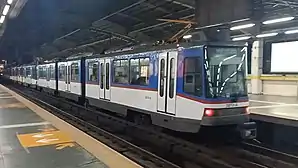 A 3000 class (RT8D5M) train at Araneta Center-Cubao station in December 2021, post-third refurbishment | |
 A scale model drawing of the MRTC 3000 class in a 3-car formation | |
| In service | 1999–present |
| Manufacturer | ČKD Tatra |
| Order no. | 1998: 180.261 180.263 - 180.272 180.292 - 180.315 180.321 - 180.334 1999: 180.335 - 180.346 180.262 180.147 - 180.157 |
| Built at | Prague, Czech Republic |
| Family name | Tatra KT8D5 |
| Constructed | 1997–1999 |
| Entered service | December 15, 1999 |
| Refurbished | 2008–2009 (Sumitomo-TESP, 73 LRVs) 2017 (BURI, 3 LRVs) 2019–present (Sumitomo-TESP, 35 out of 72 LRVs overhauled as of December 9, 2021)[1] |
| Number built | 73 vehicles[note 1] |
| Number in service | 63 vehicles (21 trainsets in 3-car configuration) |
| Formation | 3 cars per trainset |
| Design code | RT8D5M |
| Fleet numbers | 001–073 (34 LRVs renumbered to 3000 class)[note 2] |
| Capacity | Per car: 394 passengers Total maximum load: 1,182 |
| Operator(s) | Metro Rail Transit Corporation, DOTr |
| Depot(s) | North Avenue |
| Line(s) served | Line 3 |
| Specifications | |
| Car body construction | Body shell: Low alloy high tensile steel Ceiling material: Aluminum sheets |
| Train length | 3-car trainset: 99,000 mm (324 ft 10 in) |
| Car length | 33,000 mm (108 ft 3 in) |
| Width | 2,480 mm (8 ft 2 in) |
| Height | 3,550 mm (11 ft 8 in) |
| Floor height | 925 mm (3 ft 0.4 in) |
| Doors | 5 double leaf, plug-type doors per side |
| Articulated sections | 2 per car |
| Wheel diameter | 700 mm (27.56 in) (new) |
| Wheelbase | 1900 mm |
| Maximum speed | 65 km/h (40 mph)[4] |
| Weight | 46,800 kg (103,200 lb) |
| Axle load | 9.6 t |
| Traction system | ČKD IGBT Chopper TV14Z |
| Traction motors | ČKD Shunt-winding DC motor TE026A01-4 |
| Power output | 64.5kW |
| Transmission | Cardan drive (7.42 gear ratio) |
| Acceleration | 1.0 m/s² (3.28 ft/s²) |
| Deceleration | Service: 1.0 m/s2 (3.28 ft/s2) Emergency: 2.08 m/s2 (6.82 ft/s2) |
| Train ventilation | Air-conditioned; roof-mounted duct type (3 units per car) |
| Electric system(s) | 750 V DC overhead wire |
| Current collection method | Single-arm pantograph |
| UIC classification | Bo'+Bo'+Bo'+Bo' |
| AAR wheel arrangement | B+B+B+B |
| Bogies | Inside frame type |
| Minimum turning radius | 20 m (66 ft) |
| Braking system(s) | Dynamic brake w/ regeneration Mechanical friction brake Electromagnetic brake |
| Safety system(s) | ATP, ATS[5] |
| Coupling system | Scharfenberg-type |
| Track gauge | 1,435 mm (4 ft 8+1⁄2 in) |
| Seating | Longitudinal seating |
| Notes | |
| Key features are noted from these references.[6][7][8][9][10] | |
ČKD Tatra RT8D5M LRVs are owned by Metro Rail Transit Corporation (MRTC), and operated by the Department of Transportation (DOTr) thru DOTr MRT-3.
Purchase
In 1997, in line with the construction of the Manila MRT Line 3, the Metro Rail Transit Corporation, the consortium that constructed the line, signed a contract with ČKD Tatra to supply the trains for the line.[11]
Aside from a prototype, 73 light rail cars are produced by ČKD in two batches; 49 were produced in 1998 and the other 24 were completed the following year.[12] The first train was flown into Manila via plane while the remaining trains were transported by sea.[13] The fleet also happens to be the last produced by ČKD before it was taken over by Siemens.[14]
Design
Structure
The LRV design is a one-way eight-axle motorized car consisting of three articulated cars, which are connected to each other by the joint and the cover.[15] Each rail car is provided with five double leaf, electronically operated plug-sliding doors. The three center doors have an open width of 1,255 mm, while the two end doors measures at 861 mm.
Unlike the prototype 0029, these cars have rounded "foreheads" or beveled large windows at both ends.[2]
The trains wear a livery consisting of royal blue, red, and white. Under the "Metrostar Express" branding, the white portion contains the brand logo and lettering on the sides. However, since 2012, the branding has since been unused. The trains also usually wore wrap ads—unlike the LRTA 1200 class which wear ads as a whole trainset, the 3000 class are seen to wear wrap ads per car.
Each bi-articulated car has three roof-mounted air-conditioning units manufactured by Thermo King. In total, there are nine air-conditioning units in a three-car train set.
LRV 044 used to have experimental door lights above the doors in 2017. However, the lights were removed when Sumitomo refurbished and renumbered LRV 044 as 3044 in 2021.
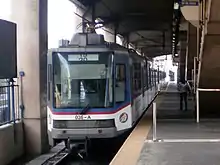 A 3000 class train bearing the "Metrostar Express" logo. (February 2011)
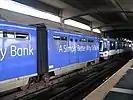 A 3000 class trainset with an LRV wearing wrap ads. (December 2006)
 A 3000 class trainset at North Avenue station. Notice the door lights above the doors in LRV 044. (July 2018)
Interior
Each train can seat 80 passengers and under crush loading conditions, each car can carry 394 commuters at any one time. Seats are longitudinal-type.
The Passenger Assist Railway Display System (PARDS), a passenger information system powered by LCD screens installed near the ceiling of the train that shows news, advertisements, current train location, arrivals and station layouts, are already installed inside the trains. PARDS is also installed on trains on LRT lines 1 and 2.[16]
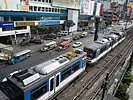 Roof-mounted trainsets' cooling systems and a single-arm pantograph of the 3000 class.
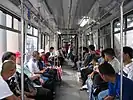 3000 class (RT8D5M) interior.
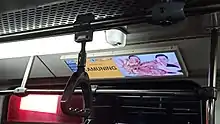 The Passenger Assist Railway Display System LCD monitor screen inside the 3000 class.
Prototype RT8D5 0029
In March 1995 the first three-car tram was tested in Prague under the number 0029 as a prototype.[7] It was a development of the Tatra KT8D5; 0029 retained its control, proportions, the front and rear sections, and unlike the later production vehicles, designed for bidirectional operation. Prototype 0029 remained in Prague and it was used in October to November 1998 together with the Tatra T5A5 prototype, tram no. 0013, and the T3 no. 6663 for various crash tests in the main workshop in Hostivař before being eventually scrapped.[2][17]
Operations
The trains run at a maximum speed of 65 kilometers per hour (40 mph), and run through standard rail tracks.[8] The RT8D5M operates as built on the high-speed city rail system with high platforms and in tropical conditions.[6][14] The vehicles are mainly operated in threes, and operations with four-car trainsets had been planned.[18] The trains have been in use since the opening of the line in 1999 and has undergone three refurbishments.
First refurbishment (2008–2009)
In 2008, during the line's first general overhaul, the trains were first refurbished by Sumitomo Corporation, Mitsubishi Heavy Industries and TES Philippines Inc. (TESP). The aging air-conditioning units of the trains since 1999 were replaced with new ones.[19] The interior and exterior of the trains were also refurbished. Sumitomo Corporation, along with MHI and TESP refurbished 73 light rail vehicles (LRVs) from 2008 to 2009.[20]
Second refurbishment (2017)
In January 2016, Busan Universal Rail, Inc., a Korean-Filipino consortium, was appointed as the maintenance provider of Line 3. Three LRVs underwent the second refurbishment in 2017. New air-conditioning units from Thermo King were installed in these three LRVs. BURI planned to overhaul 43 LRVs, but due to anomalies with the company and service interruptions at the time, BURI only refurbished three LRVs.[21]
Third refurbishment (2019–present)
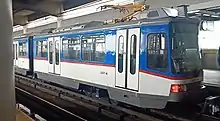
The trains are currently undergoing the third and current refurbishment that begun on May 1, 2019, with the overall rehabilitation of the entire MRTC 3000 class fleet of 72 cars being carried out by the Sumitomo Corporation, Mitsubishi Heavy Industries and TES Philippines Inc. (TESP). The rehabilitation project of the LRVs consists of the installation of new choppers, wheels, pantographs, air conditioning units from Thermo King; the repainting of the train's exteriors and interiors; and the fitting of new lighting installations throughout the trains, with the overall refurbishment program of the trains as part of the rehabilitation project are expected to be completed in December 2021.[22] SKD Trade, a. s., the company that produces spare parts for trains made by ČKD Tatra, is currently working with the Department of Transportation for the spare parts for the 3000 class trains as part of Line 3's rehabilitation project.[23]
The first light rail vehicle to be overhauled, LRV 070, had a test run in June 2019.[3] In October 2020, three more light rail vehicles, LRVs 3006, 3010, and 3026, were overhauled, and underwent a test run at a speed of 50 kilometers per hour (31 mph) on October 29, 2020.[24] Currently, 35 light rail vehicles (LRVs) are overhauled as of December 9, 2021, while 37 LRVs are yet to undergo general overhaul.[1]
Incidents
- On November 3, 2012, a train from the Araneta Center-Cubao Station caught fire as it approached GMA-Kamuning Station, causing passengers to scramble to the exits, and having two women injured. The train caught fire due to electrical short-circuit technical failure.[25]
- On March 26, 2014, at 10:50 am, a southbound train at Guadalupe Station suddenly stopped due to the train driver not observing the red light status at the Guadalupe Station and accelerated southbound without getting prior clearance from the Control Center, causing the automatic train stop system to trigger, resulting in 8 injuries.[5]
- On August 13, 2014, a southbound train heading to Taft Avenue station derailed and overshot to the streets. The train first stopped after leaving Magallanes station due to a technical problem. Later on, the train broke down altogether, another train was used to push the stalled train. During this process, however, the first train got detached from the rails and overshot towards Taft Avenue, breaking the concrete barriers and falling to the street below. At least 38 people were injured. The accident was blamed on 2 train drivers and 2 control personnel for failing to follow the proper coordination procedures and protocol.[26][27] The train car involved has not been seen since, and is either under restoration or already scrapped, but no confirmation for its ultimate fate has been given.
- On September 2, 2014, a train continued with one of its doors left open after a train door failed to close at the Guadalupe station. The passengers were then evacuated after the train arrived at Boni station.[28]
- On September 18, 2017, at 6:00 am, a seat inside 3000 class LRV no. 066 caught fire at the Santolan-Annapolis station with no injuries reported.[29]
- On November 16, 2017, at 11:30 am, at least 140 passengers were evacuated from a "detached train" coach between the railway lines of Buendia and Ayala Avenue Stations.[30]
- On August 7, 2018, an aircon leak caused "rain" inside a train and caused passengers inside to open their umbrellas. The train was removed from service to fix the air conditioning unit and the train involved in the incident returned to service the following day.[31]
- On May 7, 2021, 3000 class LRV 015 was vandalized by an unidentified culprit near Taft Avenue station. The authorities discovered the vandalized train on May 12, 2021. Investigations were conducted and initial reports state that the culprit had cut the perimeter fence near Taft Avenue station, which may have caused the vandalism.[32] The vandalized train was cleaned and returned to service on May 18, 2021.[33]
- On October 9, 2021, at 9:12 p.m., 3000 class LRV 032 caught fire near the Guadalupe station. A provisional service was implemented between North Avenue and Shaw Boulevard station, and the site of the incident was declared fire out at 9:51 p.m. As a result of the incident, 8 passengers sustained minor injuries.[34][35] Normal operations resumed the following day.[36]
- On November 21, 2021, at 6:51 a.m., a window in a 3000 class LRV was damaged due to a stoning incident, with one injury reported.[37] The suspect was later identified as a garbage collector and was subsequently arrested and charged.[38]
Notes
- Excluding 1 prototype vehicle produced in 1995.[2]
- 3 LRVs were renumbered by Busan Universal Rail, Inc. and 31 were renumbered by Sumitomo-TESP. LRV 3008, which was previously refurbished by BURI, was refurbished again by Sumitomo-TESP, retaining the LRV serial number. LRV 070 was also refurbished by Sumitomo-TESP in 2019 but retained its serial number.[3] Light rail vehicles refurbished by Sumitomo-TESP from October 2020 onwards were renumbered from 0XX to 30XX.
References
- Bilang ng newly-overhauled LRV ng MRT-3, nasa 34 na (16:9) (Facebook Watch). DOTr MRT-3. December 9, 2021. Retrieved December 9, 2021.
- Pražské tramvaje (2001). "RT8D5M". prazketramvaje.cz. ISSN 1801-9994. Archived from the original on January 19, 2019. Retrieved May 24, 2020.
- MRT-3 1st Generation Tatra RT8D5M rehabilitated by Sumitomo at Guadalupe Station. YouTube (video). June 25, 2019.
- "Tramcar RT8D5M Model Basic Features". skd.cz. Retrieved October 31, 2020.
- Fernandez, Amanda (March 26, 2014). "10 passengers hurt as MRT train makes sudden stop". GMA News Online. Retrieved November 21, 2021.
- SKD (2000). "Katalogový list tramvajového vozu RT8D5M" [Catalog sheet of tram car RT8D5M]. Archived from the original on December 12, 2009. Retrieved May 24, 2020.
- SKD (2000). "Celkové dodávky tramvají v letech 1952 až 2000" [Total deliveries of trams in the years 1952 to 2000]. SKD. Archived from the original on October 4, 2008. Retrieved May 24, 2020.
- DOTr-MRT Line 3. "About the MRT–3". dotcmrt3.gov.ph. GOV PH. Archived from the original on December 21, 2015. Retrieved May 24, 2020.
- R. Vodička 2008, p. 13.
- DOTC_Lot2 2010, p. 4.
- "About". dotrmrt3.gov.ph. Retrieved October 24, 2021.
- SKD (1999). "Dodávky tramvají v letech 1991-1999" [Tram deliveries in 1991–1999]. SKD. Archived from the original on May 24, 2020. Retrieved May 24, 2020.
- Railway Technology (2001). Manila Light Rail Extension operated by Metro Transit Corporation, Philippines (Report). Verdict Media Limited. Archived from the original on May 19, 2020. Retrieved May 24, 2020.
- "the most popular tram in the world – PCC, part 3: Czechoslovakia". Kraków public transport. Archived from the original on November 16, 2019. Retrieved February 25, 2018.
- "Tatra RT8D5 (In Czech)". Czech Trams. Archived from the original on February 26, 2018. Retrieved February 25, 2018.
- "Passenger information system to be installed in LRT, MRT". BusinessWorld. March 27, 2019. Retrieved December 12, 2020.
- SKD (1997). Crash testy vozu RT8D5M ev.č.0029 "Manila" [Crash test documentation of RT8D5M prototype car 0029 for Manila] (Video) (in Czech). Prague, Czech Republic: Prazketramvaje. Retrieved May 24, 2020.
- DOTC_Lot2 2010.
- Pateña, Aerol John (August 8, 2018). "DOTr apologizes over MRT aircon leak". Philippine News Agency. Retrieved August 7, 2021.
It said the ACUs were last replaced in 2008 as part of the system’s first general overhaul eight years after it started operating in 2000.
- Photo of MRT-3 ČKD Tatra RT8D5M light rail vehicle (LRV) being refurbished during the first round of general overhaul works under Sumitomo-TESP between years 2008 and 2009. July 22, 2021. Retrieved November 8, 2021.
- Orellana, Faye (January 25, 2018). "DOTr blames former maintenance provider BURI for MRT-3 woes". Philippine Daily Inquirer. Retrieved August 7, 2021.
- Mercurio, Richmond (May 2, 2019). "MRT-3 rehab underway with return of Sumitomo". The Philippine Star. Retrieved February 26, 2021.
- https://www.facebook.com/CzechEmbassyManila/posts/4473456612711014
- Dela Cruz, Raymond Carl (October 29, 2020). "MRT-3 conducts test runs on overhauled train at 50 kph". Philippine News Agency. Retrieved November 8, 2021.
- Geronimo, Gian (November 3, 2012). "MRT train coach catches fire near Kamuning Station". GMA News Online. Retrieved September 6, 2019.
- Pineda, Mj Lising (August 13, 2014). "MRT-3 Gets Derailed". Buhaykolehiyo. Archived from the original on October 25, 2014.
- Camus, Miguel R. (August 19, 2014). "DOTC: Human error blamed for MRT-3 train accident; 4 train workers face raps". Inquirer.net. Retrieved June 6, 2020.
- Hegina, Aries Joseph (September 3, 2014). "MRT train continues run with one of its doors open". Philippine Daily Inquirer. Retrieved November 30, 2021.
- "MRT operations temporarily stopped after seat catches fire". Rappler. September 18, 2017. Retrieved November 5, 2021.
- Lagrimas, Nicole-Anne (November 16, 2017). "Up to 140 riders evacuated from 'detached train'". GMA News Online. Retrieved November 16, 2017.
- Rey, Aika (August 8, 2018). "Aircon leak causes 'rain' inside MRT3". Rappler. Retrieved July 8, 2021.
- Manabat, Jacque (May 13, 2021). "MRT management looking for witnesses after train vandalism". ABS-CBN News. Retrieved May 13, 2021.
- "Malinis na at napapatakbo na sa mainline ang isang train car o bagon ng MRT-3 na matatandaang ginawan ng bandalismo noong ika-12 ng Mayo 2021". Facebook. Retrieved May 25, 2021.
- JUST IN: Bagon ng MRT-3 malapit sa Guadalupe station (NB), nagliyab (16:9) (Facebook Watch). GMA News. October 9, 2021. Retrieved October 9, 2021.
- Fernandez, Daniza (October 10, 2021). "MRT-3 fire injures 8 passengers". Philippine Daily Inquirer. Retrieved October 10, 2021.
- Montemayor, Ma. Teresa (October 10, 2021). "MRT-3 resumes full operation after fire". Philippine News Agency. Retrieved October 10, 2021.
- "One hurt after unidentified suspect hurls stone at MRT3 train coach". GMA News and Public Affairs. November 21, 2021. Retrieved November 21, 2021.
- "Suspek sa pambabato sa MRT3 na ikinasugat ng 1 pasahero, arestado". GMA News (in Filipino). November 21, 2021. Retrieved November 21, 2021.
Further reading
 |
Wikimedia Commons has media related to MRTC Class 3000. |
- Vodička, Radek (2008). Změna konstrukce stávající Kuželové převodovky tramvaje [The modification of the construction of the existing bevel gearbox of tram] (PDF) (Thesis). p. 13. Archived (PDF) from the original on May 24, 2020. Retrieved May 24, 2020.
- DOTC MRT3 (2010). MRT–3 CAPEX Lot 2: Upgrade of the Ancillary Systems (PDF) (Report). DOTr. Retrieved May 31, 2020.
- Official DOTC MRT3 Website
- Pražské tramvaje (2001). RT8D5M (Text and image gallery) (in Czech). Prague. ISSN 1801-9994. Archived from the original on January 19, 2019. Retrieved May 24, 2020.
- Website of the tram manufacturer, ČKD