Nanaya
Nanaya (Sumerian 𒀭𒈾𒈾𒀀, DNA.NA.A; also transcribed as "Nanāy", "Nanaja", "Nanāja", '"Nanāya", or "Nanai"; antiquated transcription: "Nanâ"; in Greek: Ναναια or Νανα; Aramaic: ננױננאױ; Syriac: ܢܢܝ)[4] was a Mesopotamian goddess of love, closely associated with Inanna.
| Nanaya | |
|---|---|
Goddess of love | |
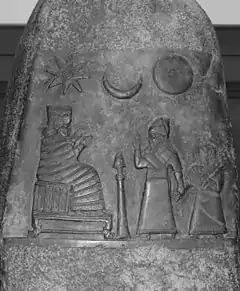 The Land grant to Ḫunnubat-Nanaya kudurru, a stele of King Meli-Shipak II (1186–1172 BCE). Nanaya, seated on a throne, is being presented the daughter of the king, Ḫunnubat-Nanaya. Kassite period limestone stele, Louvre. | |
| Major cult center | Uruk, Borsippa |
| Abode | Eanna |
| Personal information | |
| Parents | Urash (a male tutelary god from Dilbat, rather than Anu's earth goddess spouse)[1] |
| Consort | Nabu |
| Children | Kanisurra and Gazbaba |
| Equivalents | |
| Assyrian equivalent | Tashmetum(as Nabu's spouse)[2] |
| Elamite equivalent | Narundi[3] |
Origin
First texts mentioning Nanaya come from the period of Shulgi's reign.[5]
Frans Wiggermann proposes that Nanaya was originally an epithet of Inanna connected to her role as a goddess of love (he considers it possible that the original form of the name was an appelative with the meaning "My Inanna!") which eventually developed into a separate, though somewhat similar, deity.[6] Olga Drewnowska-Rymarz considers it a possibility that Nanaya was initially a hyposthasis of "Inanna as quintessence of womanhood," while Annunitum represented Ishtar/Inanna as a warrior.[7]
Functions
Nanaya's primary function was that of a goddess of love (bēlet ru'āmi, "lady of love"),[8] associated with eroticism but also with viewed as a guardian of lovers. In a text from Sippar (Si 57) titled "The Faithful Lover" by researchers and in some spells Nanaya is specifically presented as the deity of disillusioned or rejected lovers.[9]
She was also one of the deities believed to protect from the influence of the demon lamashtu, in this role often acting alongside Ishtar.[10]
Astral associations
One of the most recurring questions in scholarship about Nanaya through history was her potential association with Venus, or lack thereof.
Many early assyriologists assumed that Nanaya was fully interchangeable with Inanna and likewise a Venus goddess, but in the 1990s Joan Goodnick Westenholz challenged this view,[11][12] and her conclusions were accepted by most subsequent studies about Nanaya. Olga Drewnowska-Rymarz, following the research of Westenholz, concluded in her monograph Mesopotamian Goddess Nanajā that Nanaya wasn't herself a Venus goddess, and at most could acquire some such characteristics due to association or conflation with Inanna/Ishtar.[13] Michael P. Streck and Nathan Wassermann in a 2012 article discuss Nanaya as a heavenly deity, occasionally compared to the sun and moon,[14] but do not mention Venus. Piotr Steinkeller nonetheless asserted as recently as 2013 that Nanaya was simply a Venus goddess fully analogous to Inanna, and interchangeable both with her and with Ninsianna, without discussing the current state of research.[15] Ninsianna is well attested as a Venus deity and was associated with the Hurrian form of Pinikir who had similar character,[16] but no analogous evidence exists for Nanaya; Steinkeller doesn't discuss the evidence for Nanaya and Ninsianna as distinct figures from Inanna's circle in Larsa either.[17]
Corona Borealis was associated with Nanaya in astronomical texts.[18]
Nanaya Euršaba
Nanaya eventually developed a distinctly warlike aspect in addition to her primary function as a goddess of love, most evident in the case of Nanaya Euršaba, worshipped in Borsippa independently from Nabu; she was instead associated with the god Mār-bīti (who was however treated as Nabu's epithet rather than separate deity sometimes).[19]
Parentage
Nanaya's father was sometimes said to be the god Urash, the tutelary deity of Dilbat.[20][21] Urash was a farming god distinct from the more famous goddess Urash, and his wife was Ninegal.[22] In addition to references to Nanaya being his daughter in various documents, the underworld deity Lagamar was regarded as his son.[23]
Association with other deities
Inanna
God lists consistently associated Nanaya with Inanna and her circle, starting with the so-called Weidner list from the Ur III period.[25] In the standard arrangement she is placed third in her entourage, after Dumuzi, Inanna's husband, and Ninshubur, her sukkal.[26] Another text enumerates Ninshubur, Nanaya, Bizila and Kanisurra as Inanna's attendants, preserving Nanaya's place right after the sukkal.[27] In later times Ishtar and Nanaya were considered the main deities of Uruk, with the situation being comparable to Marduk's and Nabu's status in Babylon. While Ishtar was the "Lady of Uruk" (Bēltu-ša-Uruk), Nanaya was the "Queen of Uruk" (Šarrat Uruk).[28][29]
Some texts present Nanaya as a protégée of Inanna,[30] but only three known texts (a song, a votive formula and an oath) also present her as her daughter, and they might only be epithets implying a close connection between the functions of the two rather than account of a theological speculation[31]
Nabu
Next to Inanna/Ishtar, the deity most frequently associated with Nanaya was Nabu. They are attested alongside each other as early as in the Old Babylonian period.[32] In Borsippa, Nanaya and Nabu's spouse in other traditions, Tashmetu, shared some titles, but it's possible they were initially simply seen as goddesses of equal status.[33] Nanaya eventually overshadowed Tashmetum at Borsippa.[34]
Inanna's other attendants and own entourage
The minor goddess Kanisurra and Gazbaba were regarded as attendants and hairdressers of Nanaya,[35] and sometimes as her daughters with Nabu.[36] In a maqlu text, Ishtar, Dumuzi, Nanaya, identified as "lady of love" and Kanisurra, identified as "mistress of the witches" (bēlet kaššāpāti) were asked to counter the influence of a malevolent spell.[37]
Much like Ninshubur, Nanaya was frequently associated with the lamma goddesses, a class of minor deities believed to intercede between humans and major gods, and in some texts she is called the "lady of lamma."[38]
Bizila, either an alternate name of Nanaya or a goddess from her circle, was viewed as the sukkal (vizier) of Enlil's wife Ninlil in the Ḫursaĝkalama temple.[39] One text instead places Bizila in the circle of Nungal, the goddess of prisons.[40]
Worship

Uruk was the most important site associated with Nanaya's cult, as well as the oldest one; she was also prominent in Kish and Sippar.[41] In Larsa she was part of a trinity with Inanna and Ninsianna, in which Inanna's functions were seemingly split between three deities, with Nanaya as the love goddess.[42]
Records show that queen Shulgi-simti, one of the wives of Shulgi, made offerings to many foreign or minor deities, among them Nanaya, as well as "Allatum" (Allani), Ishara, Belet Nagar, Belet-shuhnir and Belet-terraban.[43]
In Borsippa a festival celebrating the marriage of Nanaya and Nabu was still celebrated in Seleucid times. Nanaya's name was written in a unique way in documents related to it (dNIN.KA.LI).[44] In the same period, Nanaya (as well as Ninsianna) had a prominent role in Uruk in ritual processions of deities accompanying Ishtar.[45]
The scale of her cult in Uruk grew considerably through Seleucid times.[46]
There is a lot of evidence for private worship of Nanaya, including seals with the phrase "servant of Nanaya" seemingly owned by many women.[47] In incantations related to love (ex. asking for feelings to be returned) she is attested as early as in the Neo-Sumerian and Old Babylonian periods.[48] In spells related to potency, Nanaya appears alongside Ishtar, Ishara, Kanisurra and Gazbaba.[49]
Numerous names with Nanaya as a theophoric elements are known[50] though only from after the Ur III period. Both men and women with such names are listed in records. Examples include: Qis-Nanaya ("Gift of Nanaya), Nanaja-šamhat ("Nanaya is the most beautiful"), Nanaya-ilu ("my deity Nanaya").[51] One prominent individual bearing such a name was Hunnubat-Nanaya, daughter of Babylonian king Melišipak (ca. 1186-1172 BCE), depicted alongside her father and the goddess on a famous kudurru.[52]
Outside Mesopotamia
In offering lists from Ur III period Mari, a goddess named dNin-Na-na-a, seemingly Nanaya with the determinative "lady" (nin) added to her name, appears in among gods introduced from Uruk. In the west she is also attested in Emar, though only in a god list.[53]
Nanaya was also worshiped in Susa in Elam, where her cult evidently lasted at least until Seleucid times, and is mentioned in Greek sources.[54]
She is attested in a small number of Hittite texts as well, which allude to her worship in Hittite towns.[55] Possible theophoric names are known from Hittite texts too.[56]
In the tale of Appu (CTH 360)6 gods are listed alongside their cult centers, among them Marduk, Shaushka and Nanaya; Nanaya's cult center in this text is Kiššina.[57]
In literature
The most notable text about Nanaya is a long hymn written in first person in which the goddess exalts herself and enumerates various deities she considers analogous to herself, including various hyposthases of Ishtar (from Uruk, Babylon, Daduni etc.), some similar goddesses like Ishara, spouses of prominent gods (ex. Shala, Sarpanit) and numerous city goddesses, for example Manzat from Der; the individual strophes end with the phrase "still I am Nanaya." The purpose of this composition was an exaltation of Nanaya and elevating her status to equal to that of the listed goddesses. She is referred to as the goddess of two cities herself in it, Borsippa and Sippar. The author notably omitted Tashmetum, a goddess also often regarded as Nabu's spouse.[58]
One litany assigned the epithets of Ninlil, Sarpanit and Tashmetum to her.[59]
Inanna and Nanaya were sometimes confused or conflated in poetry.[60] An example can be found in the text designated as A balbale to Inana as Nanaya in the Electronic Text Corpus of Sumerian Literature.
| Deities of the ancient Near East |
|---|
| Religions of the ancient Near East |
References
- O. Drewnowska-Rymarz, Mesopotamian Goddess Nanajā, 2008, p. 139
- R. Horry, Tašmetu (goddess), Ancient Mesopotamian Gods and Goddesses: "In first-millennium Assyria, Tašmetu was Nabu's consort but in Babylonia this role was taken by the goddess Nanaya"
- F. Wiggermann, Siebengötter A (Sebettu) [in:] Reallexikon der Assyriologie und vorderasiatischen Archäologie vol. 12, 2011, p. 462
- "The Comprehensive Aramaic Lexicon". cal.huc.edu. Retrieved 2021-11-18.
- O. Drewnowska-Rymarz, Mesopotamian Goddess Nanajā, 2008, p. 9
- F. A. M. Wiggermann, Sexualität A. In Mesopotamien · Sexuality A. In Mesopotamia [in] Reallexikon der Assyriologie und vorderasiatischen Archäologie vol. 12, 2010, p. 417
- O. Drewnowska-Rymarz, Mesopotamian Goddess Nanajā, 2008, p. 156
- O. Drewnowska-Rymarz, Mesopotamian Goddess Nanajā, 2008, p. 97
- O. Drewnowska-Rymarz, Mesopotamian Goddess Nanajā, 2008, p. 120; 125
- O. Drewnowska-Rymarz, Mesopotamian Goddess Nanajā, 2008, p. 12; 99-100
- O. Drewnowska-Rymarz, Mesopotamian Goddess Nanajā, 2008, p. 6-7
- A. Zgoll, FINKEL, I.L., M.J. GELLER (eds.) — Sumerian Gods and Their Representations (review), Bibliotheca Orientalis LVI N° 5/6, 1999, p. 664: "Der Artikel von J.G. Westenholz (»Nanaya: Lady of mystery«, S. 57-84) ist eine Monographie über die bislang noch wenig erforschte Göttin Nanaja, die klar chronologisch und geographisch gegliedert die textliche und bildliche Evidenz vorstellt und zu erklären versucht. Nanaja verkörpere die erotische Liebe, die Sinnlichkeit, sei aber keines falls eine Venusgottheit, sondern eher mit Sonne oder Mond zu verbinden."
- O. Drewnowska-Rymarz, Mesopotamian Goddess Nanajā, 2008, p. 154-155
- M. P. Streck, N. Wassermann, More Light on Nanāya, Zeitschrift für Assyriologie und Vorderasiatische Archäologie vol. 102, 2012, p. 184
- P. Steinkeller, More on the Nature and History of the Goddess Nanaya, NABU 4 (65), 2013, p. 107-110
- G. Beckman, The Goddess Pirinkir and Her Ritual from Hattusa (CTH 644), KTEMA 24, 1999, p. 27
- discussed in J. M. Asher-Greve, J. G. Westenholz, Goddesses in Context: On Divine Powers, Roles, Relationships and Gender in Mesopotamian Textual and Visual Sources, 2013, p. 92
- M. Stol, Nanaja [in:] Reallexikon der Assyriologie und vorderasiatischen Archäologie vol 9, 1998, p. 147
- J. M. Asher-Greve, J. G. Westenholz, Goddesses in Context: On Divine Powers, Roles, Relationships and Gender in Mesopotamian Textual and Visual Sources, 2013, p. 281-282
- O. Drewnowska-Rymarz, Mesopotamian Goddess Nanajā, 2008, p. 139
- M. Krebernik, Uraš A [in:] Reallexikon der Assyriologie und vorderasiatischen Archäologie vol. 14, 2014, p. 404; note that in the electronic edition authors of the entry on the two deities named Uraš and geographical location in Asia Minor are accidentally swapped
- G. De Clercq, Die Göttin Ninegal/Bēlet-ekallim nach den altorientalischen Quellen des 3. und 2. Jt. v. Chr. mit einer Zusammenfassung der hethitischen Belegstellen sowie der des 1.Jt. v. Chr. (dissertation), 2004, p. 17, footnote 80: "Ninegal und Uraš, der Stadtgott von Dilbat, formen hier ein Paar. Siehe Unger, RlA 2 ("Dilbat") 222 über den Tempel der Ninegal in Dilbat und ihre Verehrung als Gemahlin des Uraš. Über die doppelte Gestalt der Gottheit Uraš schreibt auch Kienast, in: Fs van Dijk (1985) 112f.: Er ist als männlicher Gott bekannt, als Stadtgott von Dilbat und allgemein in Nordbabylonien; andererseits kann die Gottheit weiblich sein ("die Erde") und mit An verbunden werden."
- K. van der Torn, Migration and the Spread of Local Cults [in:] A. Schoors, K. Van Lerberghe (eds.), Immigration and Emigration Within the Ancient Near East: Festschrift E. Lipinski, 1995, p. 368
- O. Drewnowska-Rymarz, Mesopotamian Goddess Nanajā, 2008, p. 32
- O. Drewnowska-Rymarz, Mesopotamian Goddess Nanajā, 2008, p. 9
- O. Drewnowska-Rymarz, Mesopotamian Goddess Nanajā, 2008, p. 23
- M. Stol, Nanaja [in:] Reallexikon der Assyriologie und vorderasiatischen Archäologie vol 9, 1998, p. 146
- O. Drewnowska-Rymarz, Mesopotamian Goddess Nanajā, 2008, p. 42
- J. M. Asher-Greve, J. G. Westenholz, Goddesses in Context: On Divine Powers, Roles, Relationships and Gender in Mesopotamian Textual and Visual Sources, 2013, p. 104
- A tigi to Nanaya for Ishbi-Erra in the ETCSL: "Nanaya, properly educated by holy Inana"
- O. Drewnowska-Rymarz, Mesopotamian Goddess Nanajā, 2008, p. 30
- M. Stol, Nanaja [in:] Reallexikon der Assyriologie und vorderasiatischen Archäologie vol 9, 1998, p. 148
- J. M. Asher-Greve, J. G. Westenholz, Goddesses in Context: On Divine Powers, Roles, Relationships and Gender in Mesopotamian Textual and Visual Sources, 2013, p. 105
- J. M. Asher-Greve, J. G. Westenholz, Goddesses in Context: On Divine Powers, Roles, Relationships and Gender in Mesopotamian Textual and Visual Sources, 2013, p. 105, 124, 133
- D. O. Edzard, Kanisurra [in] Reallexikon der Assyriologie und vorderasiatischen Archäologie vol 5, 1980, p. 389
- O. Drewnowska-Rymarz, Mesopotamian Goddess Nanajā, 2008, p. 31
- T. Abusch, The Witchcraft Series Maqlu, 2015, p. 105
- J. Peterson, UET 6/1, 74, the Hymnic Introduction of a Sumerian Letter-Prayer to Ninšubur, Zeitschrift für Assyriologie und vorderasiatische Archäologie vol. 106, 2016, p. 38
- J. M. Asher-Greve, J. G. Westenholz, Goddesses in Context: On Divine Powers, Roles, Relationships and Gender in Mesopotamian Textual and Visual Sources, 2013, p. 112
- A. Cavigneaux, M. Krebernik, Nungal [in:] Reallexikon der Assyriologie und vorderasiatischen Archäologie vol 9, 1998, p. 617
- M. Stol, Nanaja [in:] Reallexikon der Assyriologie und vorderasiatischen Archäologie vol 9, 1998, p. 147-148
- J. M. Asher-Greve, J. G. Westenholz, Goddesses in Context: On Divine Powers, Roles, Relationships and Gender in Mesopotamian Textual and Visual Sources, 2013, p. 92
- T. Sharlach, Shulgi-simti and the Representation of Women in Historical Sources [in:] M. Feldman, J. Cheng (eds.), Ancient Near Eastern Art in Context: Studies in Honor of Irene Winter, 2007, p. 365
- J. M. Asher-Greve, J. G. Westenholz, Goddesses in Context: On Divine Powers, Roles, Relationships and Gender in Mesopotamian Textual and Visual Sources, 2013, p. 124-125
- J. M. Asher-Greve, J. G. Westenholz, Goddesses in Context: On Divine Powers, Roles, Relationships and Gender in Mesopotamian Textual and Visual Sources, 2013, p. 126
- O. Drewnowska-Rymarz, Mesopotamian Goddess Nanajā, 2008, p. 83
- J. M. Asher-Greve, J. G. Westenholz, Goddesses in Context: On Divine Powers, Roles, Relationships and Gender in Mesopotamian Textual and Visual Sources, 2013, p. 273
- J. M. Asher-Greve, J. G. Westenholz, Goddesses in Context: On Divine Powers, Roles, Relationships and Gender in Mesopotamian Textual and Visual Sources, 2013, p. 242
- O. Drewnowska-Rymarz, Mesopotamian Goddess Nanajā, 2008, p. 97-98
- M. Stol, Nanaja [in:] Reallexikon der Assyriologie und vorderasiatischen Archäologie vol 9, 1998, p. 147
- O. Drewnowska-Rymarz, Mesopotamian Goddess Nanajā, 2008, p. 83-94
- J. M. Asher-Greve, J. G. Westenholz, Goddesses in Context: On Divine Powers, Roles, Relationships and Gender in Mesopotamian Textual and Visual Sources, 2013, p. 279-280
- O. Drewnowska-Rymarz, Mesopotamian Goddess Nanajā, 2008, p. 25-26
- O. Drewnowska-Rymarz, Mesopotamian Goddess Nanajā, 2008, p. 159-160
- O. Drewnowska-Rymarz, Mesopotamian Goddess Nanajā, 2008, p. 17
- O. Drewnowska-Rymarz, Mesopotamian Goddess Nanajā, 2008, p. 93
- G. Beckman, Ištar of Nineveh Reconsidered, Journal of Cuneiform Studies 1(50), 1998, p. 5
- J. M. Asher-Greve, J. G. Westenholz, Goddesses in Context: On Divine Powers, Roles, Relationships and Gender in Mesopotamian Textual and Visual Sources, 2013, p. 116-117
- J. M. Asher-Greve, J. G. Westenholz, Goddesses in Context: On Divine Powers, Roles, Relationships and Gender in Mesopotamian Textual and Visual Sources, 2013, p. 127
- J. M. Asher-Greve, J. G. Westenholz, Goddesses in Context: On Divine Powers, Roles, Relationships and Gender in Mesopotamian Textual and Visual Sources, 2013, p. 120
Further reading
- Drewnowska-Rymarz, Olga (2008). Mesopotamian Goddess Nanajā. Agade Publishing. ISBN 978-8387111410.
- Westenholz, Joan Goodnick (1997). "Nanaya: Lady of Mystery". In Finkel, Irving; Geller, Markham (eds.). Sumerian Gods and their Representations. Cuneiform Monographs. 7. Groningen: Styx Publications. pp. 57–84. ISBN 978-90-5693-005-9.
External links
 |
Wikiquote has quotations related to: Nanaya |
- A tigi to Nanaya for Išbi-Erra (Išbi-Erra C), translation at The Electronic Text Corpus of Sumerian Literature
- Nanaja > Antiquity volumes edited by: Hubert Cancik and Helmuth Schneider. Brill Online, 2015, Brill Online Reference Works