Pinikir
Pinikir, also known as Pinigir, Pirengir or Pininkir, was an Elamite goddess. She was called kikki gilira, "mistress of heaven."[2]
| Pinikir | |
|---|---|
Elamite goddess of love, sex and the sky | |
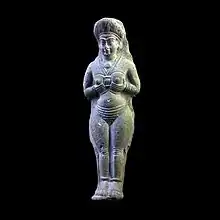 Figure of a woman from Susa, a city associated with Pinikir | |
| Personal information | |
| Parents | Nanna and Ningal (in only one text, due do syncretism with Ishtar)[1] |
| Siblings | Shamash (as above) |
| Consort | possibly Humban |
| Equivalents | |
| Mesopotamian equivalent | Ishtar, Ninsianna |
| Hurrian equivalent | Shaushka |
| Deities of the ancient Near East |
|---|
| Religions of the ancient Near East |
Character and cult
In Elamite religion Pinikir was a goddess of love and sex, though she also had an astral aspect and possibly was sometimes regarded as a warrior deity, similar to the Mesopotamian Ishtar.[3]
As the worship of Pinikir was concentrated in the north of Elam, especially in Susa, where Mesopotamian influence had a strong impact on culture and religion, Daniel T. Potts considers it possible that Ishtar was an influence on Pinikir's development, and that perhaps motifs from the myth of Ishtar and Tammuz were applied to her and Humban, a god sometimes assumed to be her consort.[4] Gary Beckman speculates that her name might have Sumerian origin.[5]
Disproven theories
Pinikir as a mother goddess and main deity of Elam
In older scholarly literature Pinikir was assumed to be a mother-goddess. Walther Hinz, who believed that Elamite society was originally matriarchal, assumed she was the head of the early Elamite pantheon.[6] However, Hinz's conclusions about the history and culture of Elam are regarded as controversial and biased by some other authors today, for example by Wouter Henkelman.[7] While she does appear in the first position in the list of Elamite gods in Naram-Sin's treaty, Kamyar Abdi notes in a recent article that there is no other evidence for her status being uniquely high.[8] Heidemarie Koch, who largely accepts Hinz's conclusions, likewise doesn't find the claim about Pinikir's central role in Elam plausible, assumes she could at most absorb maternal traits of other deities in later periods, and points out she was very rarely mentioned in texts and only a handful of theophoric names invoke her.[9]
Pinikir and Kiririsha as one deity
While some authors in the past considered Pinikir and the mother goddess Kiririsha to be interchangeable,[10][11] this theory, and the broader idea of some prominent Elamite deities being merely "taboo names" for others (for example Napirisha being a "taboo name" of Humban) is now considered disproven by experts in the field of Elamite studies.[12] Pinikir and Kiririsha were originally members of the pantheons of different parts of Elam, Pinikir didn't share Kiririsha's epithet ("Mother of the gods") and they had separate temples at Chogha Zanbil.[13][14] An inscription from a fragment of a bronze relief from the Inshushinak temple in Susa also mentions them separately, alongside Lagamar (an underworld deity associated with Inshushinak) and Nahhunte.[15] Additionally, while based on god lists and other sources Pinikir was analogous to Ishtar,[16] some modern researchers see similarities between Kiririsha and Ninhursag.[17]
Outside Elam
Pinikir is also attested to the west of Elam. She was mentioned in god lists and rituals from Ugarit and Emar, and Syrian Hurrians were likely responsible for introducing her to Hatti, where she was regarded as an astral deity (likely representing Venus) and associated with Ishtar, Shaushka and various hypostases of them.[18] The enigmatic figure DINGIR.GE6 - so-called "Goddess of the Night" - was particularly closely linked to her, and they formed a dyad together in cult.[19] The worship of duos of deities with similar domains as if they were one was a common feature of Hurrian cult.[20]
She played an important role in Carchemish, where oaths invoked the storm god of heaven (Tarhunt), Karhuha, Kubaba, the sun and moon gods and Pinikir.[21] Ritual formulas related to her Anatolian cult associate her with Susa,[22] despite the lack of direct contact between Elam and the local powers.[23] In Hittite religion she was also associated with horses and chariots, similar to Astarte in Egypt and Syria.[24]
Pinikir is depicted in the Yazikilaya sanctuary, like Shaushka among the male deities (figure number 31).[25] The occasional references to Pinikir as masculine in Hurro-Hittite sources might be related to her equation with Ninsianna, "Red Queen of Heaven".[26] Ninsianna was regarded as a personification of Venus and thus Inanna's astral aspect, and displayed both feminine and masculine attributes in various texts.[27]
In one document, Inanna's sukkal Ninshubur (or perhaps Ilabrat) was said to be Pinikir's vizier.[28][29]
References
- P. Taracha, Pirengir [in:] Reallexikon der Assyriologie und vorderasiatischen Archäologie vol. 10, 2005, p. 570
- W. M. F. Henkelman, The Other Gods who are: Studies in Elamite-Iranian Acculturation Based on the Persepolis Fortification Texts, 2008, p. 266
- K. Abdi, Elamo-Hittitica I: An Elamite Goddess in Hittite Court, The Digital Archive of Brief notes & Iran Review (DABIR) 3, 2017, p. 10
- D. T. Potts, Echoes of Mesopotamian divinity on a cylinder seal from south-eastern Iran, Revue d'Assyriologie 75, 1981, p. 141
- G. Beckman, The Goddess Pirinkir and Her Ritual from Hattusa (CTH 644), KTEMA 24, 1999, p. 28
- W. Hinz, The Lost World of Elam, London 1972, p. 42
- W. M. F. Henkelman, Humban and Auramazdā: royal gods in a Persian landscape [in:] W. M. F. Henkelman, C. Redard (eds.), Persian Religion in the Achaemenid Period - La religion perse à l’époque achéménide (Classica et Orientalia 16), 2017, p. 292-295
- K. Abdi, Elamo-Hittitica I: An Elamite Goddess in Hittite Court, The Digital Archive of Brief notes & Iran Review (DABIR) 3, 2017, p. 9
- H. Koch, Theology and Worship in Elam and Achaemenid Iran, Civilizations of the ancient Near East 3, 1995, p. 1960-1961
- Edwards, I.E.S.; Hammond, N. G. L. (31 October 1971). C. J. Gadd (ed.). The Cambridge Ancient History Volume 1, Part 2: Early History of the Middle East (3 ed.). Cambridge University Press. p. 665. ISBN 978-0-521-07791-0.
- Lurker, Manfred (27 May 2004). The Routledge dictionary of gods and goddesses, devils and demons (2nd ed.). p. 2. ISBN 978-0-415-34018-2.
- W. M. F. Henkelman, The Other Gods who are: Studies in Elamite-Iranian Acculturation Based on the Persepolis Fortification Texts, 2008, p. 354; see footnote 824 for details
- "Elamite religion" entry in Encyclopedia Iranica: "Several divinities from the plateau can be connected to the pantheons of the principal geopolitical entities that constituted Elam (...), for example, Pinikir, (...)in Awan; (...) Kiririša (...) in Anshan and its hinterland"; "Kiririša and Mašti were “mothers of the gods.”"; "In the north the wall was interrupted by the temples of Išnikarab and Kiririša, whereas that of Napiriša was connected to it. In the space between this wall and a second wall the temples of several gods were built. In order from the southeast to the northeast they were the temples of Pinikir, Adad and Šala, Šimut and Nin-ali, the Napratep gods, and after a wide interval that of Hišmitik and Ruhuratir"
- D. T. Potts, The Archaeology of Elam. Formation and Transformation of an Ancient Iranian State, 1999, p. 223
- D. T. Potts, The Archaeology of Elam. Formation and Transformation of an Ancient Iranian State, 1999, p. 217
- G. Beckman, Babyloniaca Hethitica: The "babilili-Ritual" from Bogazköy (CTH 718), [in:] K. A. Yener, H. A. Hoffner (eds.), Recent Developments in Hittite Archaeology and History: Papers in Memory of Hans G. Güterbock, 2002, p. 37
- M. A. Garrison, Ninkursaga [in:] Iconography of Deities and Demons: Electronic Pre-Publication
- G. Beckman, The Goddess Pirinkir and Her Ritual from Hattusa (CTH 644), KTEMA 24, 1999, p. 25-27
- J. L. Miller, Setting Up the Goddess of the Night Separately [in] M. R. Bachvarova, B. J. Collins, I. C. Rutherford (eds), Anatolian Interfaces: Hittites, Greeks and Their Neighbours, 2008, p. 68
- P. Taracha, Religions of Second Millennium Anatolia, 2009, p. 128
- P. Taracha, Pirengir [in:] Reallexikon der Assyriologie und vorderasiatischen Archäologie vol. 10, 2005, p. 571
- J. L. Miller, Studies in the Origins, Development and Interpretation of the Kizzuwatna Rituals, 2004, p. 368-369
- K. Abdi, Elamo-Hittitica I: An Elamite Goddess in Hittite Court, The Digital Archive of Brief notes & Iran Review (DABIR) 3, 2017, p. 8-9
- G. Beckman, The Goddess Pirinkir and Her Ritual from Hattusa (CTH 644), KTEMA 24, 1999, p. 39
- P. Taracha, Pirengir [in:] Reallexikon der Assyriologie und vorderasiatischen Archäologie vol 10, 2005, p. 571
- G. Beckman, The Goddess Pirinkir and Her Ritual from Hattusa (CTH 644), KTEMA 24, 1999, p. 27
- J. M. Asher-Greve, J. G. Westenholz, Goddesses in Context: On Divine Powers, Roles, Relationships and Gender in Mesopotamian Textual and Visual Sources, 2013, p. 86, 92
- P. Taracha, Pirengir [in:] Reallexikon der Assyriologie und vorderasiatischen Archäologie vol. 10, 2005, p. 571
- G. Beckman, Babyloniaca Hethitica: The "babilili-Ritual" from Bogazköy (CTH 718), [in:] K. A. Yener, H. A. Hoffner (eds.), Recent Developments in Hittite Archaeology and History: Papers in Memory of Hans G. Güterbock, 2002, p. 37