LRTA 2000 class
The LRTA 2000 class is a class of electric multiple units of the Light Rail Transit Authority (LRTA) in Metro Manila, Philippines, which began operation in 2003. It is used in Line 2.[4]
| LRTA 2000 class | |
|---|---|
(2017-09-22).jpg.webp) | |
| In service | 2003–present |
| Manufacturer | ROTEM (→Hyundai Rotem) |
| Built at | Uiwang, South Korea |
| Constructed | 2001–2003 |
| Entered service | April 5, 2003 |
| Refurbished | 2021–present (AMSCO JV and Woojin; 3 sets) |
| Number built | 72 vehicles (18 sets) |
| Number in service | 32 vehicles (8 sets) |
| Formation | 4 cars per trainset |
| Capacity | Head cars: 392 Intermediate cars: 422 Total crush load: 1,628 |
| Operator(s) | Light Rail Transit Authority |
| Depot(s) | Santolan |
| Line(s) served | Line 2 |
| Specifications | |
| Car body construction | Car body shell: Stainless steel Under frame: Stainless steel and LAHT steel Interior lining: Melamine and/or polyester faced ply metal |
| Train length | 92,600 mm (303 ft 10 in) (over anti-climber) |
| Car length | 23,800 mm (78 ft 1 in) (Head car) 22,500 mm (73 ft 10 in) (Intermediate car) |
| Width | 3,200 mm (10 ft 6 in) |
| Height | 4,100 mm (13 ft 5 in) |
| Floor height | 1,100 mm (3 ft 7 in) |
| Doors | 5 per side |
| Wheel diameter | 850mm (new) |
| Wheelbase | 2,300 mm (7 ft 7 in) |
| Maximum speed | 80 km/h (50 mph) |
| Weight | 295.92 t (295,920 kg) (4–car train set) 66.48 t (66,480 kg) (individual car) |
| Traction system | Original: Toshiba IGBT-VVVF Refurbished: Woojin IGBT-VVVF[lower-alpha 1] |
| Traction motors | Three-phase induction motor |
| Power output | 120 kW |
| Transmission | WN drive |
| Acceleration | 1.3 m/s² (4.26 ft/s²) |
| Deceleration | Service: 1.3 m/s² (4.26 ft/s²) Emergency: 1.5 m/s² (4.92 ft/s²) |
| Power supply | 34.5kV AC |
| Train ventilation | Air-conditioned; roof-mounted unitized type (2 units per car) |
| Electric system(s) | 1500V DC overhead wire |
| Current collection method | Single-arm pantograph |
| UIC classification | Bo'Bo'+Bo'Bo'+Bo'Bo'+Bo'Bo' |
| AAR wheel arrangement | B-B+B-B+B-B+B-B |
| Bogies | Bolsterless type |
| Braking system(s) | Dynamic (regenerative and rheostatic) Pneumatic disk |
| Safety system(s) | ATC, ATP, ATO, ATS |
| Coupling system | EMU cab ends: Mechanical, Shibata-type Between cars (non-cab ends): Semi-pernament couplers |
| Track gauge | 1,435 mm (4 ft 8+1⁄2 in) |
| Seating | Longitudinal seating |
| Notes | |
| Key features are taken from these sources.[1][2][3][4][5][6][7][8] | |
Purchase
In line with the construction of Line 2, 72 cars (18 sets) were produced by Hyundai Rotem between 2002 and 2003.[7] The trains were built in Uiwang, South Korea. The carbody was made by Hyundai Rotem, and the electric components were made by Toshiba. The trains were provided by the Asia-Europe MRT Consortium (AEMC), a consortium of Marubeni Corporation, Balfour Beatty, Toshiba, Daewoo Heavy Industries, and D.M. Consuji Incorporated (DMCI). The AEMC signed the Package 4 contract in 2000, in which includes the communications and fares systems, vehicles, and trackworks. The first batch of trains consisting of 4 sets (16 cars) arrived in November 2002, while the remaining 14 sets were delivered in the next months.[3]
Design
Exterior
The car body is made of stainless steel, and the under frame shares the similar material with LAHT steel.
The trains sport a livery of yellow and purple cheatlines. The upper yellow lines represent mango, the unofficial national fruit. The thicker purple lines are based from the ube, and it sports a geometric ethnic design.[3]
The trains have round front ends, which bears resemblance to the 2nd-generation trains of Seoul Metro Line 1, Line 4, and Bundang Line; these EMUs are also manufactured by Rotem (or then KOROS).[9]
Each car has two roof-mounted air-conditioning units manufactured by Carrier.[10] In total, there are eight air-conditioning units in a single train set.[11]
Trains prominently use wrap advertising.
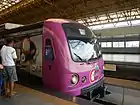 2000 class train with wrap advertising.
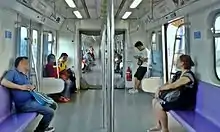 Interior of a 2000 class train.
Interior
The inner train space is lined with melamine and/or polyester faced ply metal. The windows are tinted safety glass, and the longitudinal seats are made of fiberglass reinforced plastics.[12] The flooring is of stainless steel keystone plate and a thick, nonslip covering. Open-type gangways are present in between cars. These are 1,500 millimetres (4 ft 11 in) wide. In 2017, some trains are retrofitted with the Passenger Assist Railway Display System (now known as TUBE), a passenger information system powered by LCD screens installed near the inner ceiling of the trains that shows news, advertisements, current train location, arrivals and station layouts.[13]
Traction equipment
The bogie is a bolsterless type, the axle length is 2,200 millimetres (7 ft 3 in), and the bogie center length is 1,580 millimetres (5 ft 2 in). The primary suspension consists of a conical rubber suspension and the secondary suspension is a diaphragm air spring.
Traction converter is IGBT-VVVF type, and one inverter is installed in each. The traction motor is a 120 kW three-phase AC induction motor.[14]
The original VVVF controller and propulsion system is supplied by Toshiba,[5] while the new VVVF controller and propulsion system done during the refurbishment period of three train sets is supplied by Woojin Industrial Systems.[1]
Formation
| Car No. | 1 | 2 | 3 | 4 |
|---|---|---|---|---|
| Designation[14] | Mc' | M | M | Mc' |
| Numbering | 2001 | 2002 | 2003 | 2004 |
Details of the car designations are listed below:
- Mc' - motor lead car
- M - motor car
Operations
The trains have been in use since the opening of the LRT Line 2 in 2003. However, by 2014, 12 out of the 18 sets remained in service.[15] By May 2019, the number of operational trains were reduced to 8 sets following a collision incident involving two train sets,[16] and by October 2019, the number of operational trains in the line were reduced to 5 due to power supply limitations following a power trip incident.[17] By July 2021, operational trains were increased to six after the Line 2 East Extension opened, with five trains used in the original line and one train as a shuttle train along the east extension stations as the signalling integration works of the east extension stations to the railway's existing systems were not completed at that time.[18] By September 3 of the same year, these have increased to 8 sets after the completion of signalling integration works of the east extension stations to the railway's existing systems.[2] Currently, eight trains are operational, while the other trains are being repaired/overhauled or awaiting spare parts.
Train upgrades and refurbishments
On April 16, 2018, the Light Rail Transit Authority signed a contract with Multi-Scan Corporation and MRail, Inc. for the replacement of 80 air-conditioning units in 10 train sets.[11] The replacement of air-conditioning units started on March 7, 2019[19] and was completed on May 24.[20]
Rehabilitation of three train sets started on March 3, 2021. The current maintenance provider of LRT Line 2, a joint venture of Autre Porte Technique Global Inc., Multi-Scan Corporation, and Opus Land Inc., started the installation of new train propulsion systems and train monitoring systems from manufacturer Woojin Industrial Systems in three 2000 class trains in order for those trains to return to service ahead of the original scheduled opening of the east extension in April 2021.[1]
Incidents
- On May 18, 2019, trainset no. 13 broke down between Anonas and Katipunan stations at 2:00 PM and was subsequently moved to the pocket track of Anonas waiting to be towed back to the depot. However at 9:15 PM, the train was reported to have moved on its own towards the eastbound track going towards Santolan station. At this time, trainset no. 18 was going towards Santolan station from Cubao station on the same track. The runaway train was reported via radio but eventually ran into train No. 13, injuring 34 passengers, with none in critical condition. The driver of one of the two trains was reported to have jumped out of his train before the collision, sustaining wounds and bruises.[21][22] Revenue operations were suspended to give way to maintenance checks, and normal operations resumed at 10:47 AM the next day.[23] Trainset no. 18 returned to service in June 2021,[24] while Trainset no. 13 returned to service in September 2021.
See also
 |
Wikimedia Commons has media related to LRTA Class 2000. |
Korail rolling stock manufactured by Hyundai Rotem
Philippine rolling stock manufactured by Hyundai Rotem
Notes
- Applies to only three train sets[1]
References
- Cordero, Ted (March 11, 2021). "LRT2 to add more running trains by April, says LRTA". GMA News. Retrieved December 13, 2021.
- Operations Update, retrieved September 3, 2021
- "Ultra modern Line 2 trains arrive at Manila" (Press release). Manila: Philstar. November 24, 2002. Retrieved May 23, 2020.
- "Railway Systems-Project Record View". Hyundai Rotem. Retrieved July 17, 2016.
- Toshiba.
- JICA 2011.
- DOTC & LRTA 2014.
- Light Rail Transit Authority 2017, p. 11, 15-17.
- "Hyundai Rotem Portfolio". Hyundai Rotem. 2009. Retrieved May 23, 2020.
- "철도차량용 냉방기 소개" [Air-conditioners for railway cars]. carrier.co.kr (in Korean). Retrieved November 9, 2021.
- "LRT-2 to start Systematic Replacement of Trains' Air-Conditioning System". PTV News. People's Television Network. April 21, 2018. Retrieved November 3, 2021.
- Light Rail Transit Authority 2017, p. 16.
- "Line 2 unveils PARDS for passengers". Metro Manila: ABS-CBN. ANC. May 6, 2017. Retrieved December 6, 2021.
- Light Rail Transit Authority 2017, p. 15.
- DOTC & LRTA 2014, p. 5.
- Cipres, Fred; Dava, Bianca (May 19, 2019). "34 hurt in LRT-2 collision; longer wait times seen". ABS-CBN News. Manila: ABS-CBN. Retrieved May 15, 2020.
- Popioco, Makoi (October 8, 2019). "Only 5 trains to run as LRT-2 resumes partial operations". CNN Philippines. Retrieved December 6, 2021.
- San Jose, Christian (July 5, 2021). "LRT-2 East extension now open and free for 2 weeks, but not all commuters are happy". NOLISOLI.PH. Retrieved December 6, 2021.
- Rita, Joviland (March 7, 2019). "Expect 'cooler' LRT2 trains as aircon units undergo temporary fix before being replaced". GMA News. Retrieved November 3, 2021.
- "LRTA refurbishes LRT-2 stations, completes train air-con replacement". Light Rail Transit Authority. June 24, 2019. Archived from the original on November 3, 2021. Retrieved November 3, 2021.
- Barcelon, Paolo (May 19, 2019). "Authorities to probe Line 2 collision that injured 34". CNN Philippines. Retrieved July 13, 2021.
- Rita, Joviland (May 19, 2019). "Probe underway into Line 2 trains collision; 34 hurt". GMA News Online. Retrieved May 19, 2019.
- Dava, Bianca (May 19, 2019). "LRT-2 resumes operations after train collision". ABS-CBN News. Retrieved July 13, 2021.
- "LRTA Line 2 TS #18 is back on track while TS #13 is 15% complete as of April 2021". Retrieved July 13, 2021.
Further reading
- Department of Transportation and Communications; Light Rail Transit Authority (September 2014). LRT LINE 2 OPERATIONS AND MAINTENANCE PROJECT (PDF) (Report). Public-Private Partnership Center, Philippines. Retrieved May 23, 2020.
- Light Rail Transit Authority (August 9, 2017). Maintenance of the Manila LRT Line 2 System, Terms of Reference (PDF) (Report). Light Rail Transit Philippines. Archived (PDF) from the original on June 12, 2020. Retrieved May 23, 2020.
- Hyundai Rotem. "Hyundai Rotem Project Record View". Hyundai Rotem. Retrieved May 15, 2020.
- "Dōnyū jisseki: Tetsudō shisutemu: Tōshiba (Ajia Oseania)" 導入実績:鉄道システム:東芝(アジア・オセアニア) [Toshiba installation record for railway systems (Asia/Oceania)]. Toshiba. Archived from the original on November 13, 2018. Retrieved June 12, 2020.
- JICA (2015). Firipin kuni Line 2-gōsen enshin keikaku junbi chōsa fainaru repōto フィリピン国Line 2号線延伸計画準備調査ファイナル・レポート [Preparatory study for Philippines Line 2 extension project, final report] (PDF) (Report). Japan International Cooperation Agency. Retrieved May 15, 2020.