LRTA 1000 class
The LRTA 1000 class is a class of high-floor light rail vehicles (LRV) currently operated by the Light Rail Manila Corporation. It first entered service under the Light Rail Transit Authority in 1984.
| LRTA 1000 class First-generation LRV | |
|---|---|
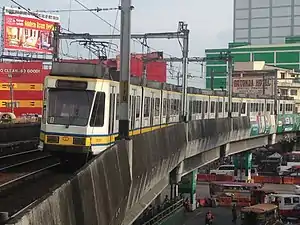 A 1000 class train at EDSA station | |
| In service | 1984–present |
| Manufacturer | BN Constructions Ferroviaires et Métalliques |
| Built at | Bruges, Belgium |
| Constructed | 1982–1983 |
| Entered service | December 1, 1984 |
| Refurbished | 1999–2001 (LRTA, BN, ACEC Transport S.A., Transurb Consult, Tractebel; 32 LRVs) 2003–2009 (LRTA; 63 LRVs) 2016–2017 (LRMC; 25 LRVs) |
| Scrapped | 2000– |
| Number built | 64 vehicles (32 sets, initially 2-car sets) |
| Number in service | 41 vehicles |
| Number scrapped | 8 vehicles (stored at Line 2 Santolan Depot) |
| Formation | 2–3 cars per trainset |
| Fleet numbers | 1001–1064 |
| Capacity | Per car: 374 2-car trainset: 748 3-car trainset: 1,122 |
| Operator(s) | Meralco Transport Organization (1984–1999) Light Rail Transit Authority (1984–2015) Light Rail Manila Corporation (2015–present) |
| Depot(s) | Baclaran |
| Line(s) served | LRT Line 1 |
| Specifications | |
| Car body construction | BI Sheet |
| Train length | 59,590 mm (195 ft 6+1⁄8 in) (2-car trainset) 89,370 mm (293 ft 2+1⁄2 in) (3-car trainset) |
| Car length | 29,280 mm (96 ft 3⁄4 in) |
| Width | 2,500 mm (8 ft 2+7⁄16 in) |
| Height | 3,272 mm (10 ft 8+7⁄8 in) (without added AC unit) 3,525 mm (11 ft 6+3⁄4 in) (with added AC units) |
| Floor height | 900 mm (2 ft 11+3⁄8 in) |
| Doors | 5 "BN" swing plug-type per side, opening space of 1,300 mm (4 ft 3 in) |
| Articulated sections | 2 per car |
| Wheel diameter | 660 mm (25.98 in) (new) |
| Maximum speed | 80 km/h (50 mph) |
| Weight | 41 t (41,000 kg) (2-car trainset) |
| Traction system | Thyristor Chopper (ACEC) |
| Traction motors | DC series-wound motor |
| Power output | 218 kW (292 hp) |
| Transmission | Right-angle link drive |
| Acceleration | 1.0 m/s2 (3.28 ft/s2) |
| Deceleration | 1.3 m/s2 (4.27 ft/s2) (service) 2.08 m/s2 (6.82 ft/s2) (emergency) |
| Train ventilation | Original: Forced ventilation; 12 units per car Refurbished: Air-conditioned; roof-mounted duct type; 5 units per car |
| Electric system(s) | 750 V DC overhead wire |
| Current collection method | Single-arm pantograph |
| UIC classification | Bo'+2'+2'+Bo' |
| AAR wheel arrangement | B+2+2+B |
| Bogies | Inside-frame type |
| Minimum turning radius | 25 m (82 ft 0 in) |
| Braking system(s) | Electro-dynamic (rheostatic) brakes |
| Safety system(s) | ATS, ATP |
| Coupling system | Towbar |
| Track gauge | 1,435 mm (4 ft 8+1⁄2 in) standard gauge |
| Notes | |
| Key features are noted from these references.[1][2][3] | |
Purchase
The Line 1 was constructed through a loan given by the Belgian Government. An additional loan package was given by ACEC (Ateliers de Constructions Electriques de Charleroi), BN (Constructions Ferroviaires et Metalliques, formerly Brugeoise et Nivelles), TEI (Tractionnel Engineering International), and TC (Transurb Consult) to the construction of the line. The trains were included in the second loan package.[4]
The trains were manufactured by BN (now Bombardier Transportation Belgium S.A.), while the electrical equipment supplied were from ACEC. A total of 64 trains were built between 1982 and 1983.
Design
Structure
The length of car is 29,280 mm (96 ft 3⁄4 in), 2,500 mm (8 ft 2+7⁄16 in) of width and 3,525 mm (11 ft 6+3⁄4 in) of height. The LRVs are double-articulated with 5 door swing plug-type doors per side, and is an 8-axle rigid body. The carbody is made of BI sheet.
The 1000 class currently sports a white body livery with blue and yellow cheatlines. Prior to the first refurbishment, the 1000 class wore an orange and cream-white livery under the "Metrorail" branding, and notably had "mushroom-cap" roof-mounted ventilation.
Prior to the 2003 refurbishment, each bi-articulated car had 12 roof-mounted forced ventilation units. A refurbished bi-articulated car has five roof-mounted air-conditioning units.
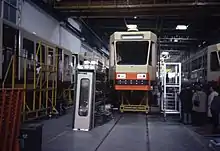 LRT 1000 class LRVs under construction in the BN plant in Bruges, Belgium
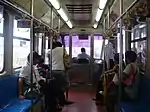 Interior of 1000 class LRV (first refurbishment).
 Interior of 1000 class LRV (second refurbishment).
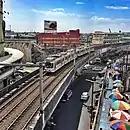 A two-car 1000 class LRV approaching EDSA station
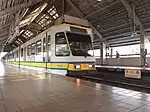 LRV 1016 1000 class LRV approaching United Nations station
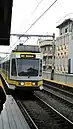 Newly refurbished 1st Generation LRT 1 trains with LED destination front display
Operations
The trains originally ran on a two-car configuration. In 1999, it was converted into a three-car configuration when LRTA refurbished the trains and purchased 7 four-car trains from Hyundai Precision.[2] However, not all of the train cars are capable to be coupled to form three-car sets.
First refurbishment (1999–2009)
In the early 1990s, the line faced problems due to poor maintenance and overcrowding. In addition, the forced ventilation units could no longer cool the trains properly.[6]
In 1999, thirty-two 1st generation LRVs underwent refurbishment, carried out by the consortium of BN (Bombardier Transportation Belgium S.A.), ACEC Transport SA, Transurb Consult, and Tractebel. Generally, this involved the repair of the carbody. The project included the introduction of the new livery, replacement of seats and other interior modifications, installation of new components, and modification of the roof for the installation of air conditioning units. Replacement and cleaning of electrical components were not included.[3]
The thirty-one remaining LRVs that were not modernized in Phase 1 underwent refurbishment in 2004, carried out by the Light Rail Transit Authority. The electrical components of the thirty-two LRVs refurbished in Phase 1 were cleaned and replaced. Refurbishment was completed on February 28, 2009.[7]
Second refurbishment (2016–2017)
The Light Rail Manila Corporation (LRMC) took over the operations and maintenance of Line 1 on September 12, 2015.[8] At that time, there were only 77 running LRVs.[9] To increase the running trains and reduce the headway, the company initiated the second refurbishment of the 1000 class LRVs in 2016 worth ₱1 billion.[10]
Twenty-five LRVs underwent the second refurbishment. The refurbishment includes the removal of rust from the carbody, repainting, replacement of flooring, and installation of new LED lightings and signaling systems.[11] Out of service LRVs were also repaired and reentered revenue service.[12] Refurbishment was completed in May 2017.[12]
Themed trains
When the Light Rail Manila Corporation took over the operations and maintenance of Line 1 in 2015, the railway operator began placing special themed decorations in the 1000 class LRVs since 2016. These include the yearly Christmas-themed[13] and Valentine's-themed trains,[14] special COVID-19 pandemic and vaccination-themed decorations,[15] and a special "Gabay Guro"-themed train for teachers.[16]
Gradual retirement and decommisioning
With the testing and commisioning of the 13000 class LRVs, the 1000 class LRVs will be gradually decommisioned.[17] As of 2021, there are eight decommisioned 1000 class LRVs. These were previously stored at the LRT Line 1 Baclaran Depot until these were transfered to the LRT Line 2 Santolan Depot due to the expansion of the former.
Incidents and accidents
- On Rizal Day in the year 2000, a train (car number 1037) exploded at Blumentritt station as part of a series of explosions in a terrorist attack known as the Rizal Day bombings. The attack on Line 1 killed some 22 people and injured hundreds. The damaged train was decommissioned immediately after the incident. No confirmed plans were announced on its ultimate fate, whether it would be restored or scrapped.[18] The train, together with other trainsets involved in accidents, were stored at the Line 2 Santolan Depot in Pasig and were ultimately sold for scrap.
- On February 18, 2011, two trains (3G and 1G trains) collided near Roosevelt Station in Quezon City on Friday at the reversing tracks, around a kilometer away to the east. No passengers were injured. The cause of the collision is yet to be determined, whether due to driver error or technical malfunction.[19]
- On May 23, 2015, thousands of passengers were stranded after a train of Line 1 slammed into another train near the Monumento station. A train driver was hurt after the impact caused his head to slam into the dashboard of the train.[20] The accident, later revealed to be caused by power fluctuation that affected the signalling system, forced passengers to alight from the station until services was restored around 1 pm at the same day.[21]
- On March 10, 2016, a door in a 1G train car was left open while running between Central Terminal and Pedro Gil stations. The problem was fixed at the Pedro Gil station.[22]
- On March 22, 2016, the doors of a 1G train car at the Central Terminal station failed to open, leaving passengers trapped inside the train.[23][24]
- On September 26, 2016, a faulty door in a 1G train car suddenly slammed shut in less than a second. No one was injured.[25]
- On September 26, 2018, a faulty 1G train door was unable to open at the Balintawak station. A passenger pushed the door open and was able to disembark. The next passenger pushed the door but it abruptly closed on him but managed to get through.[26]
- On November 6, 2020, a 1G train car emitted smoke at Gil Puyat station at 2:00 PM due to a catenary fault. Passengers were evacuated, and the line implemented a provisional service from Balintawak to Central Terminal and vice versa.[27] The situation normalized at 8:00 PM.[28]
References
 |
Wikimedia Commons has media related to LRTA Class 1000. |
- "BN Light Rail". 2020. Archived from the original on December 2, 2021. Retrieved December 2, 2021.
- "MANILA LRT1 EXTENSION, OPERATIONS AND MAINTENANCE PROJECT" (PDF). The Official Site Public-Private Partnership center of the Philippines. Retrieved April 9, 2018.
- Light Rail Transit Authority. "The LRT Line 1 Rehabilitation I Project Phase 3 – Rolling Stock Rehabilitation". Archived from the original on November 17, 2010. Retrieved February 13, 2020.
- "LRTA History". lrta.gov.ph. Archived from the original on May 24, 2018. Retrieved May 23, 2018.
- "マニラLRT1号線車両紹介1st Generation Train" (in Japanese). Retrieved December 12, 2021.
- Satre, Gary (June 1998). "The Metro Manila LRT—A Historical Perspective" (PDF). Japan Railway & Transport Review. 16: 33–37.
- Light Rail Transit Authority. "The LRT Line 1 Modernization Phase II-Project: Modernization and Upgrading of Existing BN ACEC LRVs". Archived from the original on March 21, 2009. Retrieved February 13, 2020.
- Cabacungan, Gil; Camus, Miguel (September 15, 2015). "LRT1 now under Ayala, Metro Pacific management". Philippine Daily Inquirer. Retrieved March 30, 2019.
- officialLRT1 (December 15, 2016). "LRT-1 now operates with 96 light rail vehicles". Light Rail Manila Corporation. Retrieved December 3, 2021.
- "LRMC spending P1B to rehabilitate old trains of LRT-1". Interaksyon. June 8, 2017. Retrieved February 13, 2020.
- Marasigan, Lorenz (June 7, 2017). "25 LRT 1 trains complete P1-billion rehabilitation, LRMC head says". BusinessMirror. Retrieved February 13, 2020.
- Dela Paz, Chrisee (June 7, 2017). "LRT1 operator completes restoration, vows more daily rides soon". Rappler. Retrieved February 13, 2020.
- "LOOK: LRT-1 launches Christmas-themed train". ABS-CBN News. November 29, 2016. Retrieved September 5, 2021.
- Esguerra, Darryl John (February 12, 2020). "'Love is in the Train': LRT-1 commuters off to a Valentine's treat". Philippine Daily Inquirer. Retrieved September 5, 2021.
- "LRMC launches LRT-1 Ingat Angat Bakuna Lahat themed train". Manila, Philippines: Light Rail Manila Corporation. August 5, 2021. Retrieved September 5, 2021.
- Arcilla, Jan (September 19, 2019). "LRT 1 mounts 'Gabay Guro Train' to promote Baybayin". The Manila Times. Retrieved September 5, 2021.
- "New '4th gen' trains for LRT-1 arrive in PH". NationBuilder. October 26, 2021. Retrieved December 8, 2021.
- Tubeza. Philip (July 8, 2003). "Terrorist raps filed vs Asia's most wanted man". Inquirer. Archived from the original on December 6, 2003.
- Castro, Doland (February 18, 2011). "2 LRT trains collide". Quezon City, Metro Manila. Archived from the original on May 26, 2020. Retrieved May 26, 2020.
- Gonzales, Yuji Vincent (May 23, 2015). "2 LRT trains collide due to technical glitch; at least 1 hurt". South Caloocan, Metro Manila. Archived from the original on February 4, 2016. Retrieved May 26, 2020.
- Palma, Paola (May 23, 2015). "Minor collision disrupts LRT operation Saturday". Metro Manila. Retrieved May 26, 2020.
- "LRT-1 train travels two stations with door open". CNN Philippines. March 11, 2016. Archived from the original on March 18, 2016. Retrieved October 30, 2021.
- Bajo, Ramil; Galupo, Rey (March 23, 2016). "LRT passengers trapped as LRT doors fail to open". The Philippine Star. Retrieved October 30, 2021.
- People Trapped inside LRT and One Passed Out Because the Door Won't Open!. YouTube (video).
- Yee, Jovic (September 28, 2016). "LRT-1 door slams shut on passengers; no one hurt". Philippine Daily Inquirer. Retrieved October 30, 2021.
- "YOU SHALL NOT PASS: Malfunctioning train door closes by itself, makes disembarking a challenge for commuters". Coconuts Manila. September 28, 2018. Retrieved October 30, 2021.
- Marquez, Consuelo (November 6, 2020). "LRT-1 train catches fire in Pasay; management limits train ops". INQUIRER.net. Retrieved April 25, 2021.
- Marquez, Consuelo (November 6, 2020). "LRT-1 resumes regular operations after technical woes at Gil Puyat Station". INQUIRER.net. Retrieved April 25, 2021.

