LRTA 1100 class
The LRTA 1100 class is a high-floor LRV of the Light Rail Transit Authority (LRTA) in Manila, Philippines, which began operation in 1999.[5][8]
| LRTA 1100 class Second-generation LRV | |
|---|---|
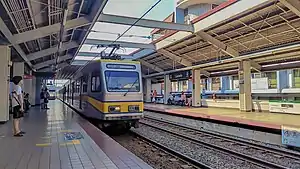 A 1100 class train approaching Carriedo station in June 2020 | |
| In service | 1999–present |
| Manufacturer | Carbody: Hyundai Precision Electrical components: ADtranz |
| Built at | Changwon, South Korea |
| Constructed | 1997–1998 |
| Entered service | 1999 |
| Refurbished | 2019–2020 (LRMC and Voith; 6 sets) |
| Number built | 28 vehicles (7 sets) |
| Number in service | 24 vehicles (6 sets) |
| Formation | 4 cars per trainset |
| Fleet numbers | 1101–1128 |
| Capacity | Per car: 347 passengers Total maximum load: 1,358 |
| Operator(s) | Light Rail Transit Authority (1999–2015) Light Rail Manila Corporation (2015–present) |
| Depot(s) | Baclaran |
| Line(s) served | Line 1 |
| Specifications | |
| Car body construction | Stainless steel |
| Train length | 3–car trainset: 79,350 mm (260 ft 4 in) 4–car trainset: 105,700 mm (346 ft 9 in) |
| Car length | Motor head cars with driving cab 26,500 mm (86 ft 11 in) Motor intermediate cars 26,350 mm (86 ft 5 in) |
| Width | 2,590 mm (8 ft 6 in) |
| Height | From top of rail: 3,525 mm (11 ft 6.8 in) Pantograph locked down: 3,950 mm (13 ft 0 in) |
| Floor height | 920 mm (3 ft 0 in) |
| Doors | 4 per side, sliding pocket-type |
| Articulated sections | 1 per car |
| Wheel diameter | 660 mm (25.98 in) (new) |
| Maximum speed | 60 km/h (37 mph) |
| Weight | Head car: 37.4 t (37,400 kg) Intermediate car: 36.5 t (36,500 kg) |
| Traction system | Original: Adtranz IGBT-VVVF Refurbished: Voith IGBT-VVVF |
| Traction motors | Three-phase, AC induction motor |
| Power output | Original: 125kW Refurbished: 170kW |
| Acceleration | 1.0 m/s2 |
| Deceleration | Service: 1.3 m/s2 Emergency: 2.08 m/s2 |
| Train ventilation | Air-conditioned; roof-mounted duct type (2 units per car) |
| Electric system(s) | 750 V DC overhead wire |
| Current collection method | Single-arm pantograph |
| UIC classification | Bo'+2'+Bo' |
| AAR wheel arrangement | B+2+B |
| Bogies | Outside-frame type |
| Safety system(s) | ATS, ATP |
| Track gauge | 1,435 mm (4 ft 8+1⁄2 in) |
| Seating | Longitudinal seating |
| Notes | |
| Key features are based from these references.[1][2][3][4][5][6][7] | |
Purchase
The LRT Line 1 in Metro Manila reached its capacity in the 1990s. As such, expanding the capacity of Line 1 was needed. Initially, 32 cars with identical specifications to the 1000 class trains were planned to be ordered for the 32 two-car trains operating at the time so that each train would consist of three cars. However, with the increasing transport demand, four-car trains were instead ordered.[9]
On October 18, 1996, Hyundai Precision signed a contract with the Light Rail Transit Authority to produce 28 cars (7 sets) for the LRT Line 1. These cars were produced between 1997 and 1998 as its first manufactured light rail vehicle.[5] The capacity extension project was due to traffic congestion and air pollution, which in turn led to an increased demand for public transport in Metro Manila by the LRT Line 1.[10][11][12][13][14]
The handover ceremony and test-run of the 1100 series LRV was done with former President Joseph Estrada and former Vice-President Gloria Macapagal Arroyo in 1999.
Design
Structure
The train car body is made of stainless steel, and the LRV design is a 6-axle rigid body consisting of one articulated section. Each LRV has four sliding pocket-type doors per side.[1]
Similar to the 1000 class, the 1100 class have cheatlines of blue and yellow that run through its sides. The trains also served as a prototype for future LRVs made by Hyundai Precision, which bears resemblance to the trains used in the Adana Metro and the Istanbul T4 Line.
Each mono-articulated car has two roof-mounted air-conditioning units. In total, there are eight air-conditioning units in a four-car train set.[1]
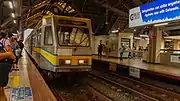 1100 class train at train platform.
.jpg.webp) Image shows stanchions, ACU vents, and briefly, the builders' plate.
Image shows stanchions, ACU vents, and briefly, the builders' plate._Balintawak_station_2021-06-05.jpg.webp) A refurbished 1100 class train in June 2021. Note the new controller box under the door that has been supplied by Voith.
A refurbished 1100 class train in June 2021. Note the new controller box under the door that has been supplied by Voith.
Interior
The trains have longitudinal seating. A wheelchair provision is present near the articulated portion of the intermediate cars.
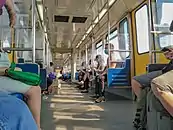 1100 class interior.
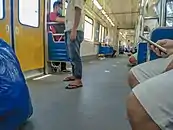 1100 class train with seats removed, showing wheelchair space.
Bogie layout and traction unit
The bogies are of outside-frame type. Each LRV has three bogies consisting of two motorized bogies at the ends of the LRV and one trailer bogie under the articulation.[2]
Traction control system is IGBT-VVVF type. The traction motor is a three-phase induction motor (enclosed type). The original traction motors produces 120 kW (160 hp), while the new traction motors installed during the refurbishment period produces 170 kW (230 hp). The trainset produces a distinct high-pitched acceleration sound that is unique to the Adtranz VVVF controller used, a trait present in the train's derivative models.
The original VVVF controller is supplied by ADtranz, while the new VVVF controller installed during the refurbishment period is supplied by Voith.[2] The change of VVVF controller is due to Adtranz no longer able to supply spare parts as it changed management and ownership, as well as general modernization of the fleets.
Operations
The 1100 class entered service in 1999, which raised the line's capacity by half.[16] After 2001, many vehicles left the service owing to problems in operations and maintenance.[17] Although spare parts had been substantially given in 2004, 14 cars remained out-of-service due to the lack thereof as of 2013, with two cars inoperable after a collision.[18][19][20][21]
In addition, these trainsets are commonly used as "skip trains" or trains meant to target a particular station due to extremely high volume of passengers, especially during rush hours. However, these trainsets now stop at all stations when Metro Manila was placed under General Community Quarantine in June 2020 (and eventually, the alert level system in September 2021) as a response to the COVID-19 pandemic.
The 1100 class trains operate in a 4-car configuration. However, there are rare occurrences of 1100 class trains operating in a 3-car formation, this happened in March 2021.[22]
Refurbishments
Before the rehabilitation of the 1100 class trains, 2 out of the 7 sets remained in service. One of the train units was also involved in a collision as well, causing it to be put out of service due to damaged train body. Rehabilitation was initiated by the Light Rail Manila Corporation in 2018, which aimed to restore the inactive fleet into serviceable conditions and increase the capacity of Line 1. In February 2018, LRMC and Voith signed an agreement to refurbish the said fleet which includes the control devices, traction systems, and automatic diagnostic displays of main circuits.[23][3] The refurbishment was carried out between 2019 and 2020 and 6 out of 7 sets returned to operation with an extended vehicle life.[2]
Incidents
- On November 27, 2017, a 1100 class train door malfunctioned after a passenger forcibly opened it at Vito Cruz station, causing the sensor to malfunction. The train continued its journey with the door left open, and a passenger recorded this incident on camera.[24]
See also
 |
Wikimedia Commons has media related to LRTA Class 1100. |
Philippine rolling stock manufactured by Hyundai Rotem
References
- DOTC & LRTA 2012, p. 10.
- "Electric traction system Modernization of light rail trains Light Rail Manila Corporation". Voith. Archived from the original on November 3, 2021. Retrieved November 3, 2021.
- Louella Desiderio (February 23, 2018). "LRT-1 operator taps Austrian engineering experts". Philstar Global. Retrieved May 27, 2020.
- JICA 2013a, p. 5-2.
- Roteco 1999, p. 1217.
- JICA 2013b, p. A-26.
- "Manila shutoken no kōkyō kōtsū seibi ni kansuru kenshū-yō sofuto seisaku jigyō riyō tebiki-sho" マニラ首都圏の公共交通整備に関する研修用ソフト制作事業 利用手引書 [User guidebook for the production of training software for public transport maintenance in Metro Manila]. Nippon Foundation. 2011. Retrieved May 27, 2020.
- "Managing Safety in LRT-1" (PDF). LRTA. May 27, 2020. Retrieved December 2, 2019.
- JICA 2004, p. 3-4.
- "ODA 見える化サイト LRT1号線増強事業". Japan International Cooperation Agency. Retrieved May 27, 2020.
- DOTC & LRTA 2012, p. 30.
- DOTC & LRTA 2012, p. 9.
- JICA 2004, p. 1-2.
- JICA 2013b, p. A-25.
- "マニラLRT1号線車両紹介2nd Generation Train" (in Japanese). Retrieved December 12, 2021.
- DOTC & LRTA 2012, p. 15.
- DOTC & LRTA 2012, p. 14.
- JICA 2013a, p. 3-14.
- JICA 2004, p. 9.
- JICA 2013a, p. 5-3.
- Light Rail Manila Corporation (March 17, 2017). "Trains of the LRT Line 1 in history". Facebook. Retrieved May 25, 2021.
- Ang Litratista ng Daang-Bakal. LRT1 Rare 3-car Generation 2 LRV Spotted (16:9). YouTube (video). Retrieved June 6, 2021.
- Pelea, Jet (February 21, 2018). "LRMC, Voith sign agreement for P450M repair of more trains for LRT–1". Retrieved May 27, 2020.
- Bacungan, VJ (November 28, 2017). "WATCH: LRT-1 train runs with open door". CNN Philippines. Retrieved July 11, 2021.
Further reading
- Department of Transportation and Communications; Light Rail Transit Authority (June 4, 2012). MANILA LRT1 EXTENSION, OPERATIONS AND MAINTENANCE PROJECT (PDF) (Report). Retrieved May 27, 2020.
- Japan International Cooperation Agency; Oriental Consultants Co., Ltd.; ALMEC Corporation; Katahira & Engineers International; Tonichi Engineering Consultants, Inc. (2013). Study on railway strategy for enhancement of railway network system in Metro Manila of the Republic of the Philippines: Final report, Vol.1-LRT Line 1: Cavite extension project (2013) (PDF) (Report). Retrieved May 27, 2020.
- Japan International Cooperation Agency; Oriental Consultants Co., Ltd.; ALMEC Corporation; Katahira & Engineers International; Tonichi Engineering Consultants, Inc. (2013b). Study on railway strategy for enhancement of railway network system in Metro Manila of the Republic of the Philippines: Final report, Vol.1 LRT Line 1: Cavite extension project (2013) (PDF) (Report). Retrieved May 27, 2020.
- Japan International Cooperation Agency (2004). Metro Manila LRT Line 1 Capacity Expansion Project (PDF) (Report). Retrieved November 27, 2021.
- Korea Railroad 100 Years Compilation Committee (1999). 1.11.2 경전철 차량 (LeRV : LIGHT ELECTRIC RAIL VEHICLE). hangug cheoldochalyang 100nyeonsa 한국철도차량100년사 [Korea Railroad 100–Year History] (PDF) (in Korean). Railway Vehicle Technology Review Team, Korea. pp. 1209–1218. Archived (PDF) from the original on December 5, 2021. Retrieved May 27, 2020.