Mawtini (Ibrahim Tuqan song)
"Mawṭinī" (Arabic: موطني, lit. 'My Homeland') is the national anthem of Iraq, being adopted as such in 2004.
| English: My Homeland | |
|---|---|
| موطني | |
National anthem of 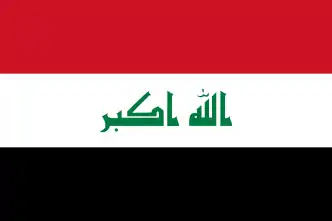 Iraq Iraq | |
| Lyrics | ʾIbrāhīm Ṭūqān, 1934 |
| Music | Muḥammid Flayfil, 1934 |
| Adopted | 1936 (by Palestine) 2004 (by Iraq) |
| Preceded by | "Mawtini" (Iraq) |
| Audio sample | |
"Mawṭinī" (instrumental)
| |
The song formerly served as an unofficial anthem of Palestine from the late 1930s Palestinian Arab revolt to 1996, when the country formally adopted an official national anthem.[1][2] Though it has since been superseded by an official national anthem there, many Palestinians still identify strongly with it and consider it a sort of unofficial second national anthem of their country.
History
| National anthems of Iraq | ||||||||||||
|---|---|---|---|---|---|---|---|---|---|---|---|---|
|
||||||||||||
.svg.png.webp)
.svg.png.webp)
.svg.png.webp)
.svg.png.webp)
.svg.png.webp)
It is a popular poem written by the Palestinian poet ʾIbrāhīm Ṭūqān c. 1934 and composed by the Lebanese composer Muḥammid Flayfil. It served as Palestine's de facto national anthem from its inception to 1996 when it was officially replaced by "Fidā'ī". However, many Palestinians still identify with it along with "Fida'i" and consider the former a sort of unofficial second national anthem of their country.[3]
In 2004, it was re-adopted as a national anthem, this time by Iraq, on the order of Coalition Provisional Authority chief Paul Bremer[4] as the national anthem of Iraq. It replaced "Mawṭinī" (of no relation to the current national anthem), which in turn replaced the old national anthem "Arḍulfurātayni", which had been in use since 1981 and was thus associated with Saddam Hussein's Ba'athist regime.[5]
Background
During the late 1950s and early 1960s, after it became a republic, Iraq used a national anthem also called "Mawṭinī", composed by Lewis Zanbaka.[6] Though it shares the same name as the current Iraqi national anthem, it is a different song altogether.[6] Unlike the current Iraqi national anthem, this version is instrumental and has no lyrics.[7][6]
After Iraq's Ba'athist regime was deposed in 2003, the old "Mawṭinī" formerly used as the Iraqi national anthem during the late 1950s and early 1960s was brought back and used temporarily as an interim national anthem[6] until it was replaced by the current "Mawṭinī" in 2004.
Lyrics
| Arabic[8][9] | Transliteration | IPA transcription | English translation[10][11] |
|---|---|---|---|
كورال: |
Kūrāl: |
[kuː.rɑːl] |
Chorus: |
See also
- "as-Salām al-Malakī", the former Iraqi national anthem, used from 1932 to 1958.
- "ʾArḍ ul-Furātayn", the former Iraqi national anthem, used from 1981 to 2003.
- "Humat ad-Diyar", anthem of Syria, also composed by Mohammed Flayfel.
References
- "National Anthems".
- "The song that inspired the Arab world: Ibrahim Tuqan and the making of "Mawtini"". Palestinian Journeys. Archived from the original on 2019-08-29. Retrieved 2019-02-15.
- Wills, Emily Regan (July 2016). "Discourses and Differences: Situating Pro-Palestine Activism in Discursive Context". Theory in Action. 9 (3): 48–71. doi:10.3798/tia.1937-0237.16018.
- "Iraq aims to unite with new national anthem, flag". The Daily Star. September 24, 2012. Retrieved 1 October 2012.
- "Iraq - Mawtini". NationalAnthems.me. Retrieved 2011-11-05.
- Schaffer, Edward; Scotland, Jan; Popp, Reinhard (2017). "Iraq (1958-1965, 2003-2004)". National Anthems. Archived from the original on December 1, 2017. Retrieved November 30, 2017.
Immediately after the fall of the Sadam Hussein government in 2003, 'Mawtini' was used again for a brief time as an interim anthem until a new one was adopted. (The title of this anthem is identical to the title of the anthem that replaced it in 2004).
CS1 maint: bot: original URL status unknown (link) - Wetzel, Dan (August 24, 2004). "One last chance". Yahoo! Sports. Yahoo!. Retrieved December 4, 2017.
The song is 'My Country.' It is relatively short, contains no words and was composed by a man named Lewis Zanbaka...
- نشيد مَوطِني. المدرسة العربية الالكترونية. April 2003.
- سمير الرسام - النشيد الوطني العراقي - موطني بحلته الجديدة - الحوار المتمدن. Ahewar. December 18, 2016.
- "Maw6ini" (PDF). Xpace Cultural Centre. June 29, 2018.
- "My Homeland: "The Youth will not tire, 'till your independence!"". Bethlehem Bible College. November 28, 2015.
External links
 |
Wikisource has original text related to this article: |
 |
Wikimedia Commons has media related to Mawtini. |
- Information on Mawtini at NationalAnthems.me
- Ilham al Madfai – A free download of Iraqi singer Ilham al Madfai's version of "Mawtini" is available at his official website, from the CD "The Voice of Iraq"
- Anthem Original Performance
- Watch Mawtini sung by Algerian youth
- Free download of Mawtini performed by Sgt. Brenda Bushera, a member of the 34th Red Bull Infantry Band
- Listen to a Syrian version
- Watch the People's National Army (Algeria) singing Mawtini
| |||||||||||||||||||
Authority control  |
|---|