Hymn to Liberty
The "Hymn to Liberty" or "Hymn to Freedom" (Greek: Ὕμνος εἰς τὴν Ἐλευθερίαν,[lower-alpha 1] also Ὕμνος πρὸς τὴν Ἐλευθερίαν),[lower-alpha 2] is a poem written by Dionysios Solomos in 1823 that consists of 158 stanzas, which is used as the national anthem of Greece and Cyprus. It was set to music by Nikolaos Mantzaros, and is the longest national anthem in the world by length of text.[1][3] It officially became the national anthem of Greece in 1865, and Cyprus in 1966.[4][5][6]
| English: Hymn to Liberty | |
|---|---|
| Ὕμνος εἰς τὴν Ἐλευθερίαν Ὕμνος πρὸς τὴν Ἐλευθερίαν | |
 | |
National anthem of Greece and Cyprus | |
| Lyrics | Dionysios Solomos, 1823 |
| Music | Nikolaos Mantzaros, 1865 |
| Adopted | 1865 (by Greece)[1] 1966 (by Cyprus)[2] |
| Audio sample | |
"Hýmnos is tin Eleftherían" (instrumental)
| |
History
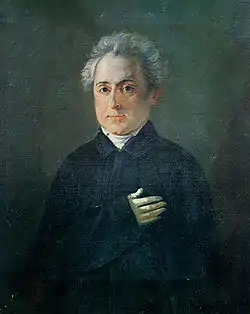
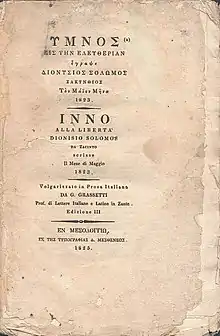
Dionysios Solomos wrote "Hymn to Liberty" in 1823 in Zakynthos and one year later was printed in Messolonghi. It was set to music in 1865 by the Corfiot operatic composer Nikolaos Mantzaros, who composed two choral versions, a long one for the whole poem and a short one for the first two stanzas; the latter is the one adopted as the national anthem of Greece. "Hymn to Liberty" was adopted as the national anthem of Cyprus by order of the Council of Ministers in 1966.[7]
Lyrics
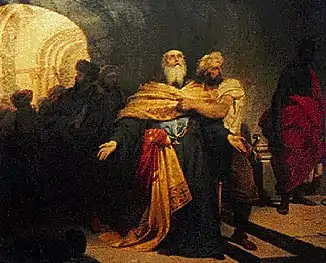
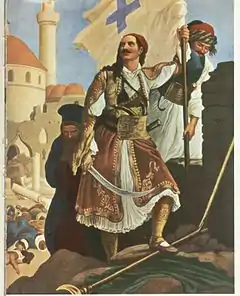
Inspired by the Greek War of Independence, Solomos wrote the hymn to honor the struggle of Greeks for independence after centuries of Ottoman rule.[8][9][10]
"Hymn to Liberty" recounts the misery of the Greeks under the Ottomans and their hope for freedom. He describes different events of the War, such as the execution of Patriarch Gregory V of Constantinople, the reaction of the Great Powers, extensively the Siege of Tripolitsa and the Christian character of the struggle.[lower-alpha 3]
Greek original
| Greek original[11][12][13] | Transliteration | IPA transcription | Common Turkish translation[14][15][16][17] (co-official language of Cyprus) |
English translation[18] (Rudyard Kipling, 1918) |
|---|---|---|---|---|
Σε γνωρίζω από την κόψη |
Se ghnorízo apó tin kópsi |
[se ɣnoˈrizo‿aˈpo tiŋ ˈgopsi] |
Tanırım seni, kılıcının |
We knew thee of old, |
Uses
An adapted version was used during the short-lived Cretan State as the Cretan Anthem. The "Hymn to Liberty" had been the Greek royal anthem after 1864.
"Hymn to Liberty" has been the national anthem of Cyprus since 1966.[2]
"Hymn to Liberty" has been performed at every closing ceremony of the Olympic Games, to pay tribute to Greece as the birthplace of the Olympic Games. The version commonly played by military bands is an arrangement composed by Lieutenant Colonel Margaritis Kastellis (1907–79), former director of the Greek Music Corps.[19]
Notes
- Hýmnos is tin Eleftherían, pronounced [ˈimnos is tin elefθeˈri.an].
- Hýmnos pros tin Eleftherían, pronounced [ˈimnos pros tin elefθeˈri.an].
- Transcriptions are a coordiation of sources from Greek language, Modern Greek phonology and Help:IPA/Greek.
References
- Εθνικός Ύμνος [National Anthem] (in Greek). www.presidency.gr. Archived from the original on 3 May 2011. Retrieved 30 May 2011.
- "Presidency of the Republic of Cyprus - The National Anthem". Archived from the original on 3 May 2011. Retrieved 14 February 2011.
- "Greece: Hymn to Liberty". NationalAnthems.me. Retrieved 7 April 2017.
- Ηλίας Κανέλλης (25 September 2010). "Το μνημείο διατίθεται για διαδηλώσεις Η "χρήση" του Άγνωστου Στρατιώτη και... άλλες βέβηλες ιστορίες". Ta Nea.
Ο «Ύμνος προς την Ελευθερίαν» του Διονυσίου Σολωμού είναι, πρωτίστως, ένα ποίημα μέσω του οποίου υμνήθηκε το έθνος-κράτος, σε περίοδο που οι εθνικές οντότητες ήταν ταυτόσημες της νεωτερικότητας.
- Κωστούλα Τομαδάκη (22 November 2010). "Ο εθνικός ύμνος "ελεύθερος" στο Διαδίκτυο". To Pontiki.
Το 1865, μετά την ένωση της Επτανήσου με την Ελλάδα, ο «Ύμνος προς την Ελευθερίαν» καθιερώθηκε ως εθνικός ύμνος της Ελλάδας.
- Argolikos Archival Library of History and Culture (14 September 2012). "Εφημερίδα της Κυβερνήσεως – Το Ναύπλιον γενέθλιος πόλις της εφημερίδος της Κυβερνήσεως". Αργολική Αρχειακή Βιβλιοθήκη Ιστορίας & Πολιτισμού (Argolikos Archival Library of History and Culture.
Ας σημειωθή χαρακτηριστικώς, ότι η περί ης ο λόγος εφημερίς προέτεινεν εις το φύλλον της 21ης Οκτωβρίου 1825 την καθιέρωσιν ως εθνικού ύμνου του ποιήματος του Δ. Σολωμού «Ύμνος προς την Ελευθερίαν», του οποίου εδημοσίευσεν ανάλυσιν υπό του Σπ. Τρικούπη.
- "National Anthem". Archived from the original on 13 August 2011. Retrieved 3 June 2015.
- "Ύμνος εις την Ελευθερίαν". stixoi. Retrieved 8 August 2019.
- "Ύμνος εις την Ελευθερίαν". sansimera. Retrieved 8 August 2019.
- Papaloizos, Theodore (2009). Greek language, Modern. ISBN 9780932416025. Retrieved 8 August 2019.
- "Ύμνος εις την Ελευθερίαν". Stixoi.
- "Ύμνος εις την Ελευθερίαν". Sansimera.
- Papaloizos, Theodore (2009). Greek language, Modern. ISBN 9780932416025.
- "Yunan milli marşının anlamını biliyor musunuz?". TimeTurk. Retrieved 11 October 2021.
- "EGE ADALARIMIZ YUNAN İŞGALİ ALTINDA * Andımız yasak, Yunan marşı serbest!". Nacikaptan. 14 November 2018. Retrieved 11 October 2021.
- "Andımız Yasak, Yunan Milli Marşı Serbest!". 17 November 2018.
- Türk adalarında Yunan Milli Marşı okunuyor. Sonsöz.
- "The National Anthem". Presidency.gr.
- "National Anthem". Hellenic Army Academy. Archived from the original on 9 February 2015. Retrieved 30 January 2015.
External links
 |
Wikisource has original text related to this article: |
|
Greek Wikisource has original text related to this article: |
- Short 30 min Version Full version Versions of the Hymn at YouTube
- The Greek Presidency – The website for the Presidency of the Hellenic Republic has a page about the National Anthem, including an instrumental file.
- Michał Bzinkowski, Eleuthería ē Thánatos!: The idea of freedom in modern Greek poetry during the war of independence in 19th century. Dionysios Solomos’ “Hymn to Liberty”
- Neugriechische Volksgesänge, Johann Matthias Firmenich
- The Hymn with all 158 stanzas (in Greek & English)
- From the Official Website of the Greek Presidential Guard
- The Greek national Anthem (in mp3)
Symbols of Greece | |||||
|---|---|---|---|---|---|
| National symbols |
|  | |||
| Other symbols |
| ||||
| Natural | |||||
| Monuments | |||||
| Music | |||||
| National poets |
| ||||
| National epics |
| ||||
| Cuisine | |||||
| Patron Saints/Religion | |||||
| Former national symbols | |||||
| |||||


| History |
|  | ||||||||
|---|---|---|---|---|---|---|---|---|---|---|
| Geography |
| |||||||||
| Politics | ||||||||||
| Economy | ||||||||||
| Society |
| |||||||||
Authority control  |
|---|