Bílá Voda
Bílá Voda (German: Weißwasser/Märkirsch Weißwasser, Polish: Biała Woda, all meaning "white water") is a village and municipality (obec) in Jeseník District in the Olomouc Region of the Czech Republic. The municipality covers an area of 14.98 square kilometres (5.78 sq mi), and has a population of 282 (as at 2 October 2006).
Bílá Voda | |
|---|---|
Municipality | |
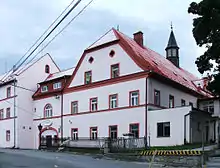
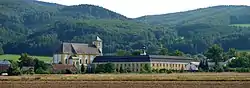 Former Piarist college and Visitation Church | |
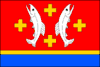 Flag 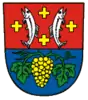 Coat of arms | |
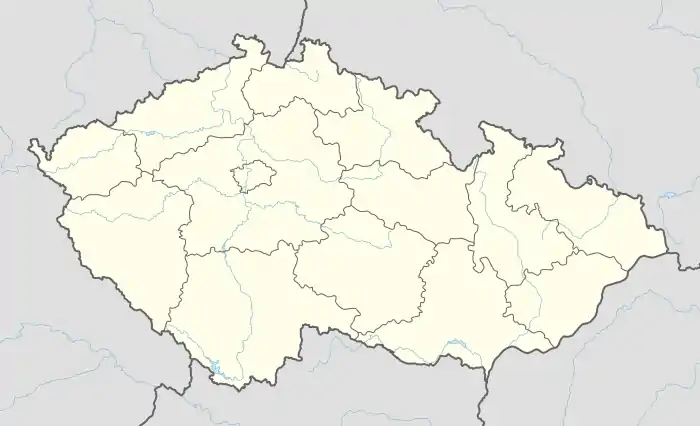  Bílá Voda | |
| Coordinates: 50°26′31″N 16°54′56″E | |
| Country |  Czech Republic Czech Republic |
| Region | Olomouc |
| District | Jeseník |
| Area | |
| • Total | 14.98 km2 (5.78 sq mi) |
| Elevation | 305 m (1,001 ft) |
| Population (2006) | |
| • Total | 282 |
| • Density | 19/km2 (49/sq mi) |
| Postal code | 790 69 |
| Website | http://www.bilavoda.cz |
Bílá Voda lies on the northern slope of the Golden Mountains range of the Eastern Sudetes, at the westernmost point of the Czech Silesia region, close to the Polish border at Złoty Stok. It is located approximately 31 kilometres (19 mi) north-west of Jeseník, 98 km (61 mi) north of Olomouc, and 182 km (113 mi) east of Prague. In the east it borders the municipal area of Javorník. The village is named after the Bílá Voda mountain stream, a tributary of the Nysa Kłodzka river and part of the Oder basin. About two thirds of the municipal area are covered with forests.
History
The settlement in the Silesian Duchy of Nysa within fragmented Piast-ruled Poland was probably founded with the castle in the 13th century. Later on, along with the duchy it fell under Bohemian (Czech) suzerainty. From 1507 onwards the Prince-Bishops of Wrocław had the castle rebuilt as a summer palace. Weißwasser was first mentioned in a 1532 deed. Jakob Ernst von Liechtenstein-Kastelkorn, the later Bishop of Olomouc, established a Piarist college on his inherited Bílá Voda estates in 1723, a response to the 1707 Convention of Altranstädt granting religious freedom to the Silesian Protestants. When the Prussian king Frederick the Great conquered most of Silesia in 1742, the Duchy of Nysa was divided and Bílá Voda became a border town of the Austrian-ruled Bohemian Kingdom, administratively located in Austrian Silesia. After the dissolution of the duchy in 1850, it was incorporated directly into the Bohemian Kingdom, and after World War I it became part of the newly established state of Czechoslovakia. In 1930, Bílá Voda had a population of 1104, of which 941 were German-speaking.
Upon the 1938 Munich Agreement the area was annexed by Nazi Germany and incorporated into the Reichsgau Sudetenland. During World War II, the Germans operated the E200 forced labour subcamp of the Stalag VIII-B/344 prisoner-of-war camp for Allied POWs,[1] and a subcamp of the Gross-Rosen concentration camp for Jewish women in the village.[2] In 1945, following Germany's defeat in the war, the village was restored to Czechoslovakia. After 1945 the German population was expelled according to the Beneš decrees and Potsdam Agreement.
References
- "Working Parties". Lamsdorf.com. Archived from the original on 29 October 2020. Retrieved 12 November 2021.
- "Subcamps of KL Gross- Rosen". Gross-Rosen Museum in Rogoźnica. Retrieved 13 November 2021.
External links
 |
Wikimedia Commons has media related to Bílá Voda. |
Authority control  | |
|---|---|
| General | |
| National libraries | |