Vidnava
Vidnava (German: Weidenau, Polish: Widnawa) is a town in Jeseník District in the Olomouc Region of the Czech Republic. It has about 1,300 inhabitants.
Vidnava | |
|---|---|
Town | |
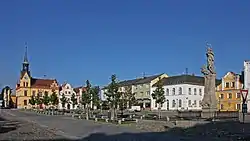 Town square | |
 Flag 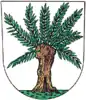 Coat of arms | |
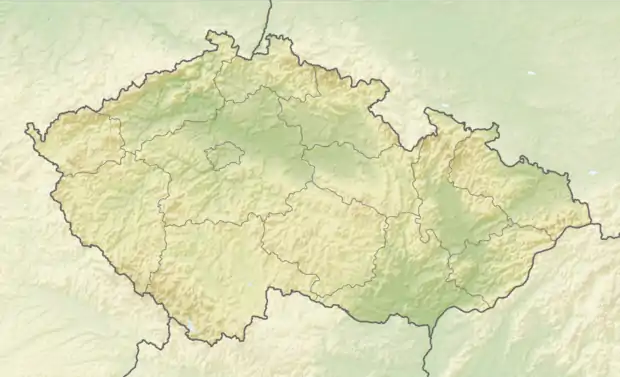  Vidnava Location in the Czech Republic | |
| Coordinates: 50°22′20″N 17°11′11″E | |
| Country |  Czech Republic Czech Republic |
| Region | Olomouc |
| District | Jeseník |
| First mentioned | 1291 |
| Area | |
| • Total | 4.25 km2 (1.64 sq mi) |
| Elevation | 239 m (784 ft) |
| Population (2020-01-01[1]) | |
| • Total | 1,266 |
| • Density | 300/km2 (770/sq mi) |
| Time zone | UTC+1 (CET) |
| • Summer (DST) | UTC+2 (CEST) |
| Postal code | 790 55 |
| Website | www |
Vidnava lies approximately 16 kilometres (10 mi) north of Jeseník, 87 km (54 mi) north of Olomouc, and 200 km (124 mi) east of Prague.
History
During the German occupation (World War II), the occupiers operated the E780 forced labour subcamp of the Stalag VIII-B/344 prisoner-of-war camp in Vidnava, and the E214 subcamp of Stalag VIII-B/344 in Krasov (present-day settlement in the Vidnava municipality).[2] Four PoWs who were killed by the Germans during escape attempts were buried at the Catholic cemetery in Vidnava.[2] Vidnava was, for many prisoners of war, a stopping place on "The Long March" during the final months of the World War II in Europe. About 30,000 Allied PoWs were force-marched westward across German-occupied Poland, Czechoslovakia and Germany in appalling winter conditions, lasting about four months from January to April 1945.[3]
References
- "Population of Municipalities – 1 January 2020". Czech Statistical Office. 2020-04-30.
- "Working Parties". Lamsdorf.com. Archived from the original on 29 October 2020. Retrieved 12 November 2021.
- http://www.lamsdorf.com/the-long-march.html
- "Partner und Freunde". neuburg-donau.de (in German). Neuburg an der Donau. Retrieved 2020-09-18.
 |
Wikimedia Commons has media related to Vidnava. |
Authority control  | |
|---|---|
| General | |
| National libraries | |