LRTA 1200 class
The LRTA 1200 class is a class of high-floor LRV of the Light Rail Transit Authority (LRTA) in Manila, Philippines, which began operation in March 2007.[5]
| LRTA 1200 class Third-generation LRV | |
|---|---|
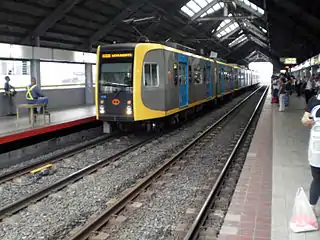 A 1200 class (3rd generation LRV) train in 2011 | |
| In service | 2007–present |
| Manufacturer | Kinki Sharyo Nippon Sharyo |
| Built at | Osaka, Kansai, Honshū, Japan Aichi, Chūbu, Honshū, Japan |
| Constructed | 2005–2006 |
| Entered service | March 2007 |
| Number built | 48 vehicles (12 sets) |
| Number in service | 44 vehicles (11 sets) |
| Formation | 3 or 4 cars per trainset |
| Fleet numbers | 1201–1248 |
| Capacity | Per car: 347 passengers Total maximum load: 1,388 |
| Operator(s) | Light Rail Transit Authority (2007–2015) Light Rail Manila Corporation (2015–present) |
| Depot(s) | Baclaran |
| Line(s) served | LRT Line 1 |
| Specifications | |
| Car body construction | Stainless steel |
| Train length | 3-car trainset: 79,350 mm (260 ft 4 in) 4-car trainset: 105,750 mm (346 ft 11 in) |
| Car length | Motor end cars with driving cab: 26,500 mm (86 ft 11 in) Motor intermediate cars: 26,350 mm (86 ft 5 in) |
| Width | 2,590 mm (8 ft 6 in) |
| Height | 3,430 mm (11 ft 3 in) |
| Floor height | 920 mm (3 ft 0 in) |
| Doors | 4 per side, sliding pocket-type |
| Articulated sections | 1 per car |
| Wheel diameter | 660 mm (25.98 in) |
| Maximum speed | 60 km/h (37 mph) |
| Weight | Head cars: 37.4 t (37,400 kg) Intermediate car: 36.5 t (36,500 kg) |
| Traction system | Mitsubishi Electric IGBT–VVVF |
| Traction motors | Three-phase induction motor |
| Power output | 105 kW (141 hp) |
| Transmission | Two-stage reduction drive |
| Train ventilation | Air-conditioned; roof-mounted duct type (2 units per car) |
| Electric system(s) | 750 V DC overhead wire |
| Current collection method | Single-arm pantograph |
| UIC classification | Bo'+2'+Bo' |
| AAR wheel arrangement | B+2+B |
| Bogies | Inside-frame type |
| Braking system(s) | Air and regenerative brakes (Knorr-Bremse) |
| Safety system(s) | ATS, ATP |
| Coupling system | Towbar |
| Track gauge | 1,435 mm (4 ft 8+1⁄2 in) |
| Seating | Longitudinal seating |
| Notes | |
| Key features are based from these references.[1][2][3][4] | |
Purchase
In 2005, Sumitomo Corporation and Itochu Joint Venture Company Limited received an order of 48 Light Rail Vehicles (LRV) and signed a construction contract between Kinki Sharyo and Nippon Sharyo to supply 48 vehicles, the first train completed in December 2005.[4] The trains were provided by the Manila Tren Consortium and were ordered to as part of the LRT Line 1 Capacity Expansion Project Phase 2.[6][7] The capacity expansion project was funded by Japan's official development assistance.[8]
Design
Structure
The 1200 class' carbody is made of beadless lightweight stainless steel, with composite materials on the indoor panels and aluminum on the inner bone to reduce weight.[4]
Each LRV is bi-articulated with inside-frame bogies which are 26 mm (1.0 in) in length. The carbody measures 26,000 mm (85 ft 4 in) in length, 2,590 mm (8 ft 6 in) in width, and 3,430 mm (11 ft 3 in) in height.[5]
1200 class LRVs have 4 electronic sliding doors on both sides.
Each mono-articulated car has two roof-mounted air-conditioning units that can generate 41,000 kcal (170,000 kJ). In total, there are eight air-conditioning units in a four-car train set.[5]
Interior
The interior is color-toned based on light and dark two-color green in the seats to complement the landscape of Manila. Seats are made of fiber reinforced plastic and has an aluminum bracket type cantilever longitudinal seat for reducing weight. Seating and grip sticks are designed to have ergonomic dimensions, aside from equipment arrangement inside the cab.[5] A wheelchair-compatible space is provided beside the gangway of the intermediate car, alongside an equipped fire extinguisher.
_(Caloocan)(2017-07-08).jpg.webp) Interior of the 1200 class
Interior of the 1200 class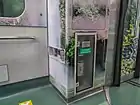 Wheelchair strap and space, and fire extinguisher
Drive unit
The bogie is inside frame type with 660 mm diameter, the wheels are the same as the 1100 series, and the traction motors are Three-phase AC Induction motor producing 105 kW (141 hp).
The traction control system is IGBT–VVVF that drives the four main motors of the two carriages. The resistors are mounted on the roof for backup regenerative brakes. The VVVF controller is manufactured by Mitsubishi Electric, and it has Electronic Command braking device supplied by Knorr-Bremse that uses air and regenerative brakes.[9]
Safety Systems
The 1200 class are operated with Automatic Train Protection and Automatic Train Stop and has disc brakes on the bogies.
Operations
The 3rd-generation trains were handed over to the Philippine government on December 9, 2006, with Japanese Prime Minister Shinzō Abe and former President Gloria Macapagal Arroyo attended the handover ceremony of 1200 series as part of the transportation capacity enhancement of the Manila LRT Line 1.[4] The trains subsequently entered service in March 2007.[5]
On February 25, 2010, a 1200 class train was used in a test run of the LRT Line 1 North Extension and the MRT Line 3 as part of the MRT-LRT Closing the Loop project that intends to integrate the LRT Line 1 and MRT Line 3 operations, but the integration of operations has not been pursued.[11]
The 1200 class trains operate in a 4-car configuration. However, there are some occurrences of 1200 class trains operating in a 3-car formation.
Special themed trains
In September 2018, a 3G trainset was decorated with a special "Gabay Guro" decoration to celebrate the National Teachers' Month in the Philippines. The decoration has a library-themed look with images of books. The special themed train was launched on September 6, 2018 and ended a year later.[12]
Incidents
- On February 18, 2011, two trains (1G and 3G) collided near Roosevelt Station in Quezon City at the reversing tracks, around a kilometer away to the east. There were no passengers on board when the incident happened.[13] This however caused one of the 3G units to be in idle state and has not yet been restored for service.
- On May 23, 2015, thousands of passengers were stranded after two trains (1G and 3G) collided near the Monumento station. A train driver was hurt after the impact caused his head to slam into the dashboard of the train.[14] The accident, later revealed to be caused by power fluctuation that affected the signalling system, forced passengers to alight from the station until services was restored around 1 pm at the same day.[15]
References
 |
Wikimedia Commons has media related to LRTA Class 1200. |
- "MANILA LRT1 EXTENSION, OPERATIONS AND MAINTENANCE PROJECT" (PDF). The Official Site Public-Private Partnership center of the Philippines. Retrieved April 9, 2018.
- "LRTA LRV". KINKISHARYO. Archived from the original on July 17, 2011. Retrieved April 9, 2018.
- Kinki Sharyo 2006.
- Nippon Sharyo 2007.
- Kinki Sharyo 2006, p. 2.
- "3rd Generation LRV Mock Up on Display". Light Rail Transit Authority. March 9, 2006. Archived from the original on April 24, 2006. Retrieved November 27, 2021.
- "ITOCHU Corporation". Japan Overseas Railway System Association. Archived from the original on August 7, 2020. Retrieved November 27, 2021.
In the Philippines, we undertook the Manila LRT Line 1 Capacity Expansion 2 as a JV contractor and we supplied rolling stock and railway systems.
- Japan International Cooperation Agency (2012). Ex-Post Evaluation of Japanese ODA Loan Project - LRT Line 1 Capacity Expansion Project (II) (PDF) (Report). Retrieved December 11, 2021.
- Knorr-Bremse 2011, p. 11.
- "マニラLRT1号線車両紹介3rd Generation Train" (in Japanese). Retrieved December 12, 2021.
- RTVMalacanang (February 25, 2010). MRT-LRT Closing the Loop Ride. YouTube. Event occurs at 1:37. Retrieved June 8, 2021.
- "LOOK: 'Gabay Guro' train offers chance to rediscover joys of reading, learning". ABS-CBN News. September 6, 2018. Retrieved September 5, 2021.
- Castro, Doland (February 18, 2011). "2 LRT trains collide". ABS-CBN News. Quezon City, Metro Manila: ABS-CBN News and Current Affairs. Archived from the original on May 26, 2020. Retrieved May 26, 2021.
- Gonzales, Yuji Vincent (May 23, 2015). "2 LRT trains collide due to technical glitch; at least 1 hurt". South Caloocan, Metro Manila. Archived from the original on February 4, 2016. Retrieved May 26, 2021.
- Palma, Paola (May 23, 2015). "Minor collision disrupts LRT operation Saturday". CNN Philippines. Metro Manila. Retrieved May 26, 2021.
Further reading
- Kinki Sharyo (October 2006). New product マニラ1号線向け連接電車 (PDF) (Report) (in Japanese). Archived from the original (PDF) on April 9, 2018.
- Nippon Sharyo. フィリピン・マニラ都市圏軽軌道公社殿向けLRT1号線用車両完成 (Report). Archived from the original on November 16, 2015.
- Knorr-Bremse Group (PDF) (Report). September 22, 2011.